




GM Envisions Driverless Cars on Horizon
DETROIT - Cars that drive themselves — even parking at their destination — could be ready for sale within a decade.
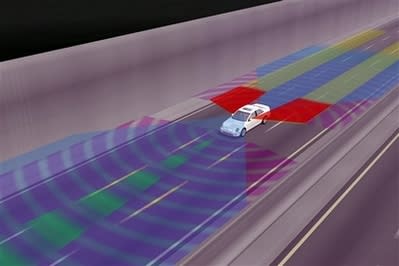
DETROIT - Cars that drive themselves — even parking at their destination — could be ready for sale within a decade, General Motors Corp. executives say.
GM, parts suppliers, university engineers and other automakers all are working on vehicles that could revolutionize short- and long-distance travel. At the Consumer Electronics Show in Las Vegas GM Chief Executive Rick Wagoner will devote part of his speech to the driverless vehicles.
"This is not science fiction," Larry Burns, GM's vice president for research and development, said in a recent interview.
The most significant obstacles facing the vehicles could be human rather than technical: government regulation, liability laws, privacy concerns and people's passion for the automobile and the control it gives them.
Much of the technology already exists for vehicles to take the wheel: radar-based cruise control, motion sensors, lane-change warning devices, electronic stability control and satellite-based digital mapping. And automated vehicles could dramatically improve life on the road, reducing crashes and congestion. If people are interested.
"Now the question is what does society want to do with it?" Burns said. "You're looking at these issues of congestion, safety, energy and emissions. Technically there should be no reason why we can't transfer to a totally different world."
GM plans to use an inexpensive computer chip and an antenna to link vehicles equipped with driverless technologies. The first use likely would be on highways; people would have the option to choose a driverless mode while they still would control the vehicle on local streets, Burns said.
He said the company plans to test driverless car technology by 2015 and have cars on the road around 2018.
Sebastian Thrun, co-leader of the Stanford University team that finished second among six teams completing a 60-mile Pentagon-sponsored race of driverless cars in November, said GM's goal is technically attainable. But he said he wasn't confident cars would appear in showrooms within a decade.
"There's some very fundamental, basic regulations in the way of that vision in many countries," said Thrun, a professor of computer science and electrical engineering.
The Defense Department contest, which initially involved 35 teams, showed the technology isn't ready for prime time. One team was eliminated after its vehicle nearly charged into a building, while another vehicle mysteriously pulled into a house's carport and parked itself.
Thrun said a key benefit of the technology eventually will be safer roads and reducing the roughly 42,000 U.S. traffic deaths that occur annually — 95 percent of which he said are caused by human mistakes.
"We might be able to cut those numbers down by a factor of 50 percent," Thrun said. "Just imagine all the funerals that won't take place."
Other challenges include updating vehicle codes and figuring out who would be liable in a crash and how to cope with blown tires or obstacles in the road. But the systems could be developed to tell motorists about road conditions warn of crashes or stopped vehicles ahead and prevent collisions in intersections.
Later versions of driverless technology could reduce jams by directing vehicles to space themselves close together, almost as if they were cars in a train, and maximize the use of space on a freeway, he said.
"It will really change society, very much like the transition from a horse to a car," Thrun said.
The U.S. government has pushed technology to help drivers avoid crashes, most notably electronic stability controls that help prevent rollovers. The systems are required on new passenger vehicles starting with the 2012 model year.
Vehicle-to-vehicle communication and technology allowing cars to talk with highway systems could come next.
Still in debate are how to address drivers' privacy, whether current vehicles can be retrofitted and how many vehicles would be need the systems to develop an effective network.
"Where it shakes out remains to be seen but there is no question we see a lot of potential there," said Rae Tyson, a spokesman for the National Highway Traffic Safety Administration.
More Operations

Company Vehicle or Reimbursement? How Fleets Are Rethinking Assignments
As fleet costs and insurance pressures rise, fleet managers are taking a closer look at which employees need company-provided vehicles and when a reimbursement program may make more sense.

Fleetio, ASE Launch Scholarship Program for Automotive Technicians
The second annual program will award 15 scholarships totaling $35,000 to support ASE certification, testing fees, and equipment costs.

Reading the Global Signals: What AI and the Energy Transition Mean for Fleets Now
In this opening keynote of the 2026 Fleet Forward Conference, John Rossant, founder of CoMotion, How can fleet managers navigate a never-ending, changing industry landscape?

90% Use Telematics. Are Fleets Getting Safer? | AF News Recap
This week, we're breaking down which industries have the highest rates, how Jamie McKay manages 2,400 vehicles, what's happening with the 2027 fleet awards, and why software-defined vehicles could introduce new costs.

What's Best Handled by an FMC, and What's Better Done Directly?
Fleet managers continue to rely on FMCs for essential services but are taking a closer look at where working directly with suppliers can improve efficiency and responsiveness.

Fleet Meets: Erin Gilchrist
Meet Erin Gilchrist, the inaugural Mike Antich Spirit of Fleet Award winner, as she shares insights on leadership, mentorship, the power of industry connections, and why people remain at the heart of fleet's future.

How 2026 Fleet Visionary Jamie McKay Manages 2,400 Vehicles Across 37 States
How do you keep 2,400 vehicles running across 37 states? Fleet Visionary Award winner Jamie McKay shares how collaboration, flexibility, and a few simple strategies help her tackle fleet management challenges at Aptive Pest Control.

Managing Fleet Costs in an Era of Permanent Volatility
Fleet operating costs have risen more than 20% since 2020, raising a key question: When does extending a vehicle's service life stop making financial sense?

The Next Evolution of Fleet Management: Autonomous Operations
This opening keynote session at the Fleet Forward Conference highlights the future of autonomous driving for fleets.

How to Reduce the Total Cost of Risk From Catalytic Converter Theft
A stolen catalytic converter can cost fleets far more in downtime and lost productivity than in repairs. A total-cost-of-risk approach can help fleet managers quantify their exposure and prioritize theft prevention.