




GM Crash Test Dummy Donated to Smithsonian
WASHINGTON - A General Motors crash test dummy, whose 15 years of service included scores of full-vehicle crash tests and a host of special assignments, will spend a peaceful retirement in the Smithsonian's National Museum of American History.
WASHINGTON - A General Motors crash test dummy, whose 15 years of service included scores of full-vehicle crash tests and a host of special assignments, will spend a peaceful retirement in the Smithsonian's National Museum of American History.
The donation of 50H-1, an anthropomorphic test device (ATD), is part of a museum project to collect materials related to technological advancements in the auto industry to improve safety features. The ATD will be part of a collection that also includes costumes and props from the Vince and Larry safety belt PSA campaign by the National Highway Traffic Safety Administration and the Ad Council.
"GM's leading role in the development of crash test devices over the decades makes it fitting that one of our crash veterans become part of the Smithsonian's collections," said Mike Robinson, GM vice president of safety policy. "With all that we have learned from him over the years, it almost seems unfair to call 50H-1 a dummy."
Though not as talkative as Vince and Larry, 50H-1 is significant because he represents the dummy most used in U.S. automotive crash testing. His title refers to the Hybrid III ATD representing a typical male adult in the 50th percentile for height and weight.
"GM developed the Hybrid III dummy design in the 1980s and shared the patents with government and industry," said Jack Jensen, a GM Technical Fellow and engineering group manager who supervises GM's ATD lab at the Milford Proving Ground. "This is the dummy most widely used in crash testing across the U.S."
Just since 2007, 50H-1 has been used in more than 50 tests designed to improve the safety of Chevrolet, Buick, GMC and Cadillac cars, trucks and crossovers. 50H-1 is intimately familiar with the Barrier Crash Facility, known as Building 61, at Milford. It was among the first dummies used in rollover crash testing when the $10 million addition opened in late 2006.
Like his 200 brothers and sisters in Milford, 50H-1 spent plenty of time in the ATD lab repair shop for new sensors, knees, feet and other body parts that took the brunt of crash impacts.
In calmer times, 50H-1 was the subject of static testing for vehicle seat positioning and seat belt routing studies. 50H-1 traveled throughout the United States for everything from highway guard rail testing in Nebraska to a robotics display in Atlanta.
In addition to 50H-1, GM's donation includes an ATD leg and instruments used for measuring crash forces, and an energy-absorbing steering column from a 1967 Chevrolet.
More Safety

Tips for Driving Safely on Halloween Night
This video features a reminder from the Connecticut Department of Transportation (DOT) and the Connecticut Police Chiefs Association, urging drivers to prioritize safety this Halloween.
Read More →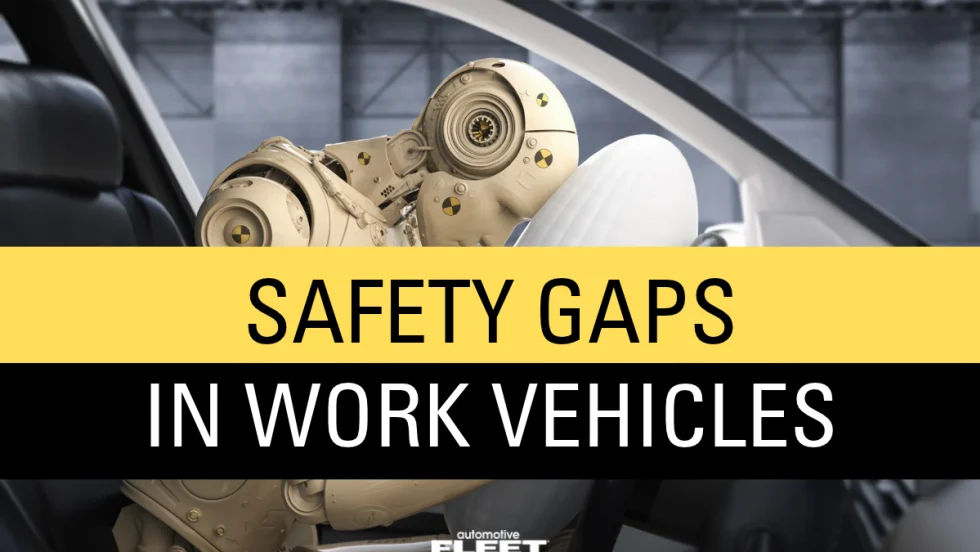
IIHS Crash Avoidance Tests Reveal Safety Gaps in Cargo Vans and Work Trucks
New crash-avoidance ratings from the Insurance Institute for Highway Safety reveal inconsistent performance among commercial vehicles, with several popular cargo vans and heavy-duty pickups struggling to avoid collisions with other vehicles and pedestrians.
Read More →
What’s Next for Fleet? Safety, AI & Industry Recognition | AF News Recap
Could your company's culture be encouraging distracted driving? This week, we're exploring how workplace expectations affect driver safety, what AI, EVs, and autonomous vehicles could mean for the future of fleet management, and how fleet professionals can strengthen their award nominations.
Read More →
Does Your Fleet's Culture Encourage Distracted Driving?
What happens when the people responsible for enforcing safety rules are the ones setting the wrong example? The answer may reveal why some of the biggest risks to fleet drivers have little to do with what's written in the employee handbook.
Read More →
Fleet Manager’s Ultimate Playbook: Navigating the New Standard in OEM Connectivity
Rising operating costs, driver safety concerns, and unplanned downtime are putting unprecedented pressure on modern fleets. Discover how fleet managers use embedded OEM connectivity and real-time vehicle data to cut TCO, prevent downtime, and protect drivers without aftermarket telematics hardware.
Read More →
From Driver Well-Being to EV Charging | AF News Recap
Mental health belongs in the fleet safety conversation. This week, we’re looking at five ways fleets can support employee well-being before a crisis, plus Holman’s expansion in Mexico, new one-day Fleet Forward passes, and why EV charging demand is outpacing infrastructure growth.
Read More →
Nexar-Nauto Merger Aims to Give Fleets Better Safety Intelligence Through Larger Driving Dataset
Stefan Heck tells Automotive Fleet that combining more than 10 billion miles of driving history with Nexar's AI models will give fleets deeper insights into driver risk and roadway conditions than either company could provide independently.
Read More →
Don't Wait for a Crisis: 5 Ways to Build Mental Health Into Your Fleet Safety Program
For Suicide Prevention Month, fleet and safety leaders have an opportunity to put mental health where it belongs: at the center of workplace safety.
Read More →
How Camera Data Can Strengthen a Fleet’s Insurance Renewal
Insights from a commercial insurance carrier and a broker show how fleets can turn video telematic data, driver coaching, and improved claims results into a stronger case at insurance renewal.
Read More →
The Safest Fleets Aren’t the Ones with the Most Technology
You’ve made the telematics investment. Here’s how to capture the other half of its value and build the safest fleet on the road.
Read More →