




GM Claims Highest Power Ratings for Colorado/Canyon
Horsepower and torque ratings announced this morning by General Motors will make its 2015 Chevrolet Colorado and GMC Canyon pickups the most powerful in the midsized truck segment, the company claims.

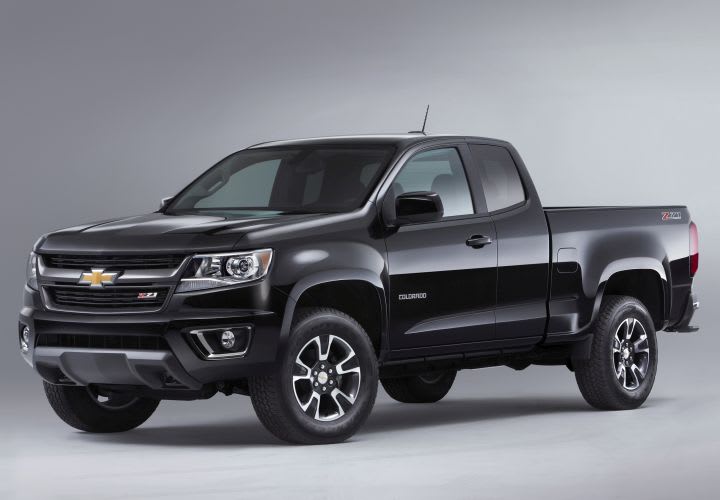
Photo of Chevrolet Colorado courtesy of GM.
Photo of Chevrolet Colorado courtesy of GM.
Horsepower and torque ratings announced this morning by General Motors will make its 2015 Chevrolet Colorado and GMC Canyon pickups the most powerful in the midsized truck segment, the company claims.
The trucks are larger and roomier than current models, and product planners included commercial uses during the design process.
The Colorado and Canyon's gasoline engines will include the standard 2.5-liter inline-4, rated at 200 horsepower and 191 pound-feet, and the optional 3.6-liter V-6, with 305 horsepower and 269 pound-feet. The announcement did not mention a diesel that will be available later.
With trailering packages and the V-6, the Colorado and Canyon will have towing capacities of up to 7,000 pounds, also the most in the midsize segment, GM's announcement said. Main competitors are the Nissan Frontier and Toyota Tacoma, which also use I-4 and V-6 engines.
The GM engines feature direct fuel injection, dual-overhead camshafts with variable valve timing, and jet-spray piston cooling. They have lightweight aluminum blocks and strong forged-steel crankshafts, said Anita Burke, vehicle chief engineer for midsize trucks.
Both are based on engines used throughout the General Motors car family, but are optimized for the demands of truck use, she said. This includes torque at lower RPMs for better towing power and a more confident feeling while pulling a trailer.
Both engines are matched to a six-speed automatic transmission; a six-speed manual is available on certain extended-cab 2WD models. The six-speed automatic is tuned specifically for the truck engines, offering features like auto grade braking and tow/haul mode.
"Not everyone needs the size or the capability of a full-sized pickup," Burke said in explaining why GM chose to stay in the segment while Ford dropped its Ranger pickup. "Now customers have a viable option in a smaller package."
"We had a real pull from the market," Mike Jones, GM's truck product manager, said earlier this year. "They (customers) really liked it. If you don't need towing but still need the versatility of a pickup, and want maneuverability and fuel economy, why not?"
Jones thinks the new Colorado/Canyon should do well as a commercial truck, including for foremen and supervisors who haul themselves more than boards, bags and boxes of supplies and tools, and services like pest control, where companies are already using current compact and midsize trucks.
Quiet cabs and a big, roomy console can make the Colorado/Canyon into a rolling office. A bed-delete option will be available so specialized bodies can be mounted without having to pay for and discard the pickup bed.
The Colorado and Canyon will be assembled at GM's Wentzville, Mo., plant, with production beginning this fall.
By Tom Berg
More Operations

Avis Budget Group Deploys Neology Toll Management Technology Across Major Brands
Neology’s neoFleet platform will manage toll transactions and toll-authority operations for vehicles across Avis, Budget, Payless, Budget Truck and Zipcar.
Read More →
Fleet Personal-Use Charges Edge Higher in 2026
Nearly eight in 10 surveyed fleets allow personal use of company vehicles, while just over half of respondents report charging employees for the privilege.
Read More →
The Future of Fleet + What’s Changing Right Now | AF News Recap
Could developments overseas offer a preview of what’s coming for U.S. fleets? This week, we’re looking at the future of AI, autonomy, and electrification, plus Ford Pro’s new certified pre-owned program, smarter vehicle offboarding, and a new way for fleets to manage toll expenses.
Read More →
How to Handle Vehicle Offboarding
What do fleet managers need to do when a driver leaves?
Read More →
Fleet Manager’s Ultimate Playbook: Navigating the New Standard in OEM Connectivity
Rising operating costs, driver safety concerns, and unplanned downtime are putting unprecedented pressure on modern fleets. Discover how fleet managers use embedded OEM connectivity and real-time vehicle data to cut TCO, prevent downtime, and protect drivers without aftermarket telematics hardware.
Read More →
U.S. Bank Adds Verra Mobility Toll Management to Voyager Fleet Platform
The integration allows U.S. Bank Voyager fleet customers to manage toll payments and violations alongside fuel, EV charging and maintenance expenses.
Read More →
ADAS Prevents Crashes. But Repairs Cost More | AF News Recap
ADAS-equipped vehicles may crash less often, but they can cost more when they do. This week, we’re breaking down what that tradeoff means for fleets, plus Subaru’s first Forester Wilderness Hybrid, Nissan’s new e-POWER Rogue, and why Calstart has become Catalyst Mobility.
Read More →
Moventum Fleet Management Names Mark Iorillo Head of Sales
Iorillo brings nearly 20 years of fleet management and sales experience to the role, including previous positions at Element Fleet Management, CEI, Donlen and Ryder.
Read More →
Fleet Has a Talent Pipeline Problem. What Comes Next? | AF News Recap
Where will fleet’s next generation of leaders come from? This week, we’re looking at the industry’s talent pipeline, what certification can add to a fleet career, how to build an award-worthy track record, and the return of Automotive Fleet’s Personal Use Survey.
Read More →
Smith System Launches Driver Risk Management Program
Fleets have more driver data than ever, but identifying risky behavior doesn't necessarily correct it. Smith System's new Driver Risk Management program combines monitoring, training, and follow-up coaching to help fleets connect risk signals with driver intervention.
Read More →