




Georgia DOT Plans to Reopen I-85 by June 15
Georgia’s Department of Transportation is aiming to complete rebuilding of the stretch of I-85 that collapsed last week — slicing one of the main arteries through metropolitan Atlanta — by June 15, which would be roughly 10 weeks since the collapse.

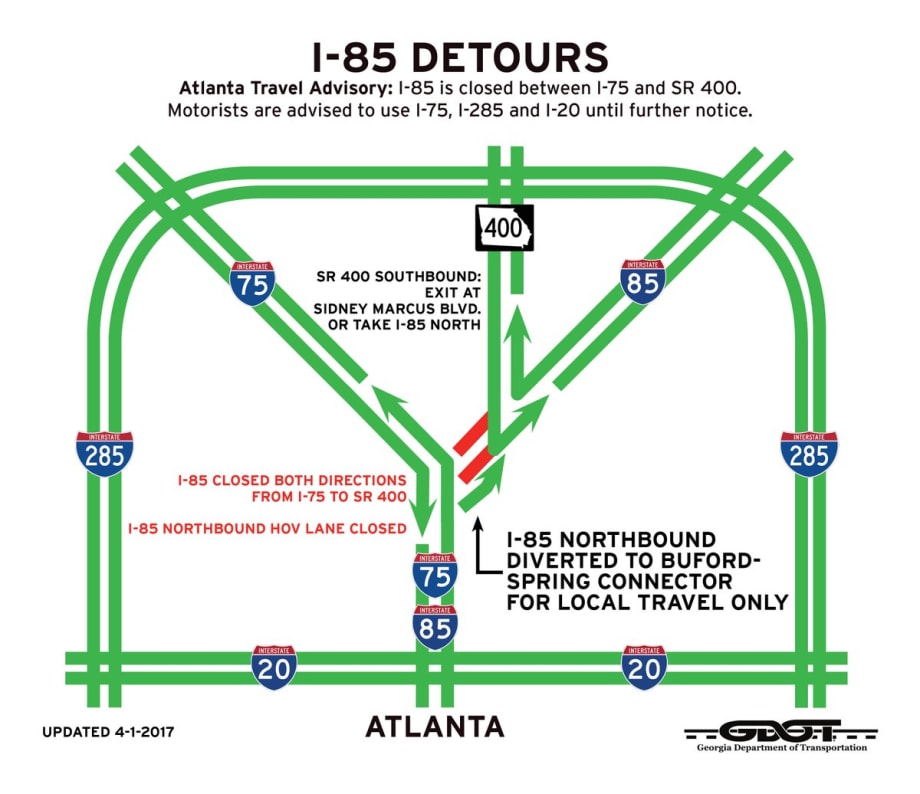
Image: Georgia Dept. of Transportation

Image: Georgia Dept. of Transportation
Georgia’s Department of Transportation is aiming to complete rebuilding of the stretch of I-85 that collapsed last week — slicing one of the main arteries through metropolitan Atlanta— by June 15, which would be roughly 10 weeks since the collapse.
A fire that erupted under the elevated roadway during the evening rush on March 30 consumed GDOT construction materials stored there. The highway, shrouded in flames and thick black smoke visible for miles, was shut down shortly before the fire burned so hot that it collapsed the bridge supports at about 7 p.m.
“At the governor’s urging, we are going to incentivize the completion of this work,” GDOT Director of Construction Marc Mastronardi said at an April 4 media briefing. “We have selected a date that we believe is aggressive but attainable and will offer a bonus for early completion.”
GDOT has chosen Marietta-based C.W. Mathews Contracting Company to lead the rebuilding effort. The agency said the firm was selected based on its availability, resources and experience providing a similar response to a tanker fire that damaged I-285 over SR 400 in 2001.
To expedite rebuilding, the contractor will be retrofitting the bridge columns, using concrete that will cure in 24 hours, and pre-fabricating some elements of the bridge, the agency said.
GDOT Commissioner Russell R. McMurry commented on the ongoing investigation of the cause of the collapse. “We have and continue to fully cooperate with the fire investigation by local officials,” he said. “We are not in a position to comment on certain aspects, but we can reiterate what we have already said. In an effort to save taxpayer dollars, GDOT chose to store the material [HDPE (high-density polyethylene) conduit] in hopes it could be used on another job. The material was stored on state property in a secured area with a locked gate. The area was breached by an individual or individuals who illegally trespassed on private, state-owned property, with devastating outcome. We are told by fire officials and media reports that the blaze was deliberately set and it subsequently spread to the HDPE."
McMurry also said he has requested the assistance of Georgia’s Office of Insurance and Safety Fire Commissioner and State Fire Marshal to conduct a joint review of GDOT’s storage procedures, practices and policies, "especially in proximity to bridges or other transportation infrastructure."
He also noted that GDOT will be joining with the National Transportation Safety Board as a party to the investigation of the fire and subsequent roadway collapse.
In addition, State Traffic Operations Engineer Andrew Heath said GDOT is “continuously improving” signal timing on the surface streets impacted by the closing of I-85 to help motorists deal with the new traffic patterns.
Here is the current status of the I-85 closure, as posted on April 5 by GDOT:
A major fire on Thursday March 30 caused a section of I-85 to collapse. Both the northbound and southbound lanes are closed indefinitely between GA 400 and I-75. Traffic passing through the Atlanta area should use I-285 to bypass the closure
Local traffic may continue to use I-85 to the points of closure. For southbound, this is up to the exit to GA 400 N. At that point, all traffic must exit I-85. In the northbound direction, drivers can get to Exit 86 (Buford Hwy / SR 13), and then must exit I-85
GA 400 southbound is also affected by this incident. Southbound traffic must exit at either Sidney Marcus Blvd or take the flyover ramp to I-85 Northbound. Traffic cannot continue on GA 400 South onto I-85 South
Go to www.511ga.org or call 511 locally for official up-to-date information about Georgia roadway conditions.
More Operations

How Fleets Can Recruit and Train Veterans for Technician Roles
Here's how the technician shortage has affected uptime for fleets, and what to do about it.
Read More →
Avis Budget Group Deploys Neology Toll Management Technology Across Major Brands
Neology’s neoFleet platform will manage toll transactions and toll-authority operations for vehicles across Avis, Budget, Payless, Budget Truck and Zipcar.
Read More →
Fleet Personal-Use Charges Edge Higher in 2026
Nearly eight in 10 surveyed fleets allow personal use of company vehicles, while just over half of respondents report charging employees for the privilege.
Read More →
The Future of Fleet + What’s Changing Right Now | AF News Recap
Could developments overseas offer a preview of what’s coming for U.S. fleets? This week, we’re looking at the future of AI, autonomy, and electrification, plus Ford Pro’s new certified pre-owned program, smarter vehicle offboarding, and a new way for fleets to manage toll expenses.
Read More →
How to Handle Vehicle Offboarding
What do fleet managers need to do when a driver leaves?
Read More →
Fleet Manager’s Ultimate Playbook: Navigating the New Standard in OEM Connectivity
Rising operating costs, driver safety concerns, and unplanned downtime are putting unprecedented pressure on modern fleets. Discover how fleet managers use embedded OEM connectivity and real-time vehicle data to cut TCO, prevent downtime, and protect drivers without aftermarket telematics hardware.
Read More →
U.S. Bank Adds Verra Mobility Toll Management to Voyager Fleet Platform
The integration allows U.S. Bank Voyager fleet customers to manage toll payments and violations alongside fuel, EV charging and maintenance expenses.
Read More →
ADAS Prevents Crashes. But Repairs Cost More | AF News Recap
ADAS-equipped vehicles may crash less often, but they can cost more when they do. This week, we’re breaking down what that tradeoff means for fleets, plus Subaru’s first Forester Wilderness Hybrid, Nissan’s new e-POWER Rogue, and why Calstart has become Catalyst Mobility.
Read More →
Moventum Fleet Management Names Mark Iorillo Head of Sales
Iorillo brings nearly 20 years of fleet management and sales experience to the role, including previous positions at Element Fleet Management, CEI, Donlen and Ryder.
Read More →
Fleet Has a Talent Pipeline Problem. What Comes Next? | AF News Recap
Where will fleet’s next generation of leaders come from? This week, we’re looking at the industry’s talent pipeline, what certification can add to a fleet career, how to build an award-worthy track record, and the return of Automotive Fleet’s Personal Use Survey.
Read More →