




GE Capital and Clean Energy Expand Natural Gas Availability
GE Capital’s Transportation Finance business and Clean Energy Fuels Corp. have entered into an alliance to accelerate the conversion of heavy-duty trucking fleets from diesel to cleaner-burning, less-expensive natural gas.
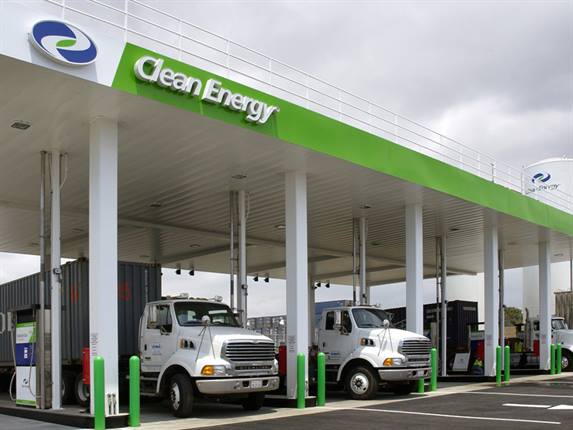
Truck fleet operators can work with Clean Energy to develop natural gas fueling contracts. Photo courtesy Clean Energy Fuels.
GE Capital’s Transportation Finance business and Clean Energy Fuels Corp. have entered into an alliance to accelerate the conversion of heavy-duty trucking fleets from diesel to cleaner-burning, less-expensive natural gas.
To take advantage of this opportunity, truck fleet operators will first work with Clean Energy to develop natural gas fueling contracts and will then apply for loans and leases — including fair market value leases — from GE Capital to acquire trucks from manufacturers that produce commercial natural gas vehicles (NGVs).
Then Clean Energy will help offset the monthly cost of newly-acquired NGVs to make it consistent with the cost of a diesel truck, if the customer makes a fuel commitment, says the company.
“We think this alliance will help to open up the natural gas market for long-haul operators,” said Dan Clark, president and general manager of GE Capital Transportation Finance. “The alliance will support the parties’ mutual goal of reducing the financial impact of transitioning to natural gas and lowering the industry’s environmental footprint.”
Class 8, or heavy-duty, trucks can use both compressed natural gas (CNG) and liquefied natural gas (LNG). Both CNG and LNG cost less than diesel — a key factor considering that fuel comprises nearly 40% of a typical over-the-road carrier’s operational costs.
Two of the factors that had delayed the transition to natural gas in the over-the-road trucking industry were related to technology and infrastructure. With the ongoing refinement and expanded availability of natural gas engines by commercial vehicle manufacturers and the 400-plus natural gas fueling stations owned, operated, maintained and/or supplied by Clean Energy throughout the U.S. and Canada, those issues are being addressed.
“Together with GE Capital, we’re breaking down the barriers to entry that may have prevented some fleet owners from making the transition to natural gas,” said Andrew J. Littlefair, president and CEO of Clean Energy. “Our goal is to work with fleet operators to achieve a one-year payback on the incremental cost of natural gas heavy-duty trucks — and our alliance with GE Capital is another tool in achieving this important goal.”
More Green Fleet

Merchants Fleet Reports 290M EV Miles as Fleets Navigate Changing Electrification Market
From millions in operating savings to hundreds of millions of EV miles, Merchants Fleet’s latest report reveals what’s working and what’s changing in fleet electrification.
Read More →
The EV Breakdown Nobody's Talking About: Why Most Electric Vehicle Roadside Calls Aren't Mechanical Failures
Here's why EV breakdowns are widely misunderstood.
Read More →
ChargePoint Now Available in Energy Pass
ChargePoint and additional planned charging network integrations were added to GM's Energy Pass.
Read More →

First Look: Slate Auto's Electric Fleet Pickup
Could an affordable, modular EV pickup make electrification more practical for fleets?
Read More →
Slate Debuts Colorful, Unique EV Models
A recent media and client event, studded with electric vehicles dressed up on platforms, planted a new position for the manufacturer in the wider EV market. Fleets will find cost-saving advantages.
Read More →
Slate Electric SUV, Pickup Switchable Model Aims For Light-Duty Fleets
Everything about this EV is counterintuitive and understated, making it stand out from the crowd.
Read More →
Inspiration Mobility Acquires Key Electrada Assets
Inspiration Mobility Group has acquired select assets of Electrada, adding the fleet electrification provider's team, technology, and charging infrastructure development capabilities to its energy management business.
Read More →
Turning Connected Vehicle Data Into Decisions That Matter
Fleet leaders have more data than ever, but turning that data into clear, actionable decisions remains a challenge. This white paper shows how leading organizations are using connected vehicle data to improve safety, reduce costs, and optimize fleet performance. Learn how to turn insight into action across your fleet.
Read More →
Are You Tracking Your Fleet's True Total Cost of Ownership?
Bobit Business Media surveyed 190 fleet professionals and found that while most fleets are tracking costs, fragmented systems and data gaps are keeping true TCO visibility out of reach. With rising pressure to control spend in an increasingly volatile environment, the gap between what fleets think they know and what the data actually shows is wider than you might expect. See how your peers are managing costs today and where the industry still has room to improve.
Read More →