





Related: Ford Upgrading 2017 Super Duty's Brakes, Suspension
Ford Super Duty to Offer Driver-Assist Technologies
Ford has announced 17 new driver-assist features for its 2017 F-Series Super Duty pickup.
July 7, 2016

Photo courtesy of Ford.
2 min to read
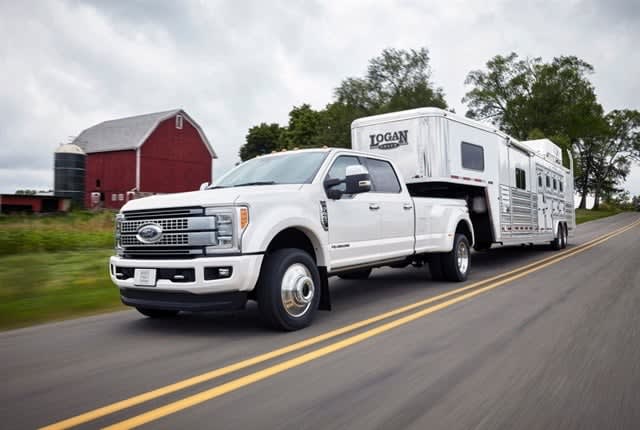
Photo courtesy of Ford.
Ford has announced 17 new driver-assist features for its 2017 F-Series Super Duty pickup.
Adaptive cruise control, adaptive steering, and Blind Spot Information System (BLIS) with trailer coverage are among the new features available on the Super Duty, according to the automaker.
The adaptive cruise control uses radar to measure the distance and speed of vehicles ahead, then automatically slows the truck and trailer to maintain that preset distance at speeds above 20 mph, using the engine brake to assist drivers towing heavy trailers.
Speed is controlled on descents using the adaptive cruise control with the integrated engine brake, which is enabled at a push of a button. Extra engine braking power helps reduce wear-and-tear on wheel brakes – especially on downhill grades.
Adaptive cruise control is optional on Lariat, King Ranch, and Platinum Super Duty pickups, including the F-450 Super Duty.
The adaptive steering technology changes the ratio between the driver’s actions at the steering wheel and how much the front wheels turn. With adaptive steering, the ratio continually changes with vehicle speed, optimizing steering response in all conditions. Housed entirely within the steering wheel, the precision-controlled actuator - an electric motor and gearing system - can add to or subtract from a driver's inputs.
BLIS with trailer cover uses radar hidden in the taillights to detect a vehicle entering a driver’s blind spot while driving or backing up, and alerts the driver with a yellow light in the sideview mirror. BLIS can extend to the back of the trailer, helping to make the driver aware of vehicles entering the trailer’s blind spot.
Also available is lane-departure warning, which vibrates the steering wheel to mimic rumble strips when the driver begins to drift over a lane marker.
The complete list of driver-assist technologies includes:
Adaptive cruise control and collision warning with brake support.
Adaptive steering.
BLIS with trailer coverage.
BoxLink with premium locking cleats.
Factory-installed customer-placed trailer camera.
Inflatable rear outboard safety belts.
Multicontour front seats with Active Motion.
Power-deployable running boards.
PowerScope power-telescoping and power-folding trailer tow mirrors.
Remote tailgate release with power lock.
Standard flat load floor on SuperCab and Crew Cab.
Stowable loading ramps.
SYNC3.
Tailgate step.
Trailer Reverse Guidance.
Trailer tire pressure monitoring system.
Utility lighting system (LED side-mirror spotlights).
The Super Duty will go on sale in late 2016.
More Operations

How Fleets Can Recruit and Train Veterans for Technician Roles
Here's how the technician shortage has affected uptime for fleets, and what to do about it.
Read More →
Avis Budget Group Deploys Neology Toll Management Technology Across Major Brands
Neology’s neoFleet platform will manage toll transactions and toll-authority operations for vehicles across Avis, Budget, Payless, Budget Truck and Zipcar.
Read More →
Fleet Personal-Use Charges Edge Higher in 2026
Nearly eight in 10 surveyed fleets allow personal use of company vehicles, while just over half of respondents report charging employees for the privilege.
Read More →
The Future of Fleet + What’s Changing Right Now | AF News Recap
Could developments overseas offer a preview of what’s coming for U.S. fleets? This week, we’re looking at the future of AI, autonomy, and electrification, plus Ford Pro’s new certified pre-owned program, smarter vehicle offboarding, and a new way for fleets to manage toll expenses.
Read More →
How to Handle Vehicle Offboarding
What do fleet managers need to do when a driver leaves?
Read More →
Sponsored•October 1, 2026
Fleet Manager’s Ultimate Playbook: Navigating the New Standard in OEM Connectivity
Rising operating costs, driver safety concerns, and unplanned downtime are putting unprecedented pressure on modern fleets. Discover how fleet managers use embedded OEM connectivity and real-time vehicle data to cut TCO, prevent downtime, and protect drivers without aftermarket telematics hardware.
Read More →
U.S. Bank Adds Verra Mobility Toll Management to Voyager Fleet Platform
The integration allows U.S. Bank Voyager fleet customers to manage toll payments and violations alongside fuel, EV charging and maintenance expenses.
Read More →
ADAS Prevents Crashes. But Repairs Cost More | AF News Recap
ADAS-equipped vehicles may crash less often, but they can cost more when they do. This week, we’re breaking down what that tradeoff means for fleets, plus Subaru’s first Forester Wilderness Hybrid, Nissan’s new e-POWER Rogue, and why Calstart has become Catalyst Mobility.
Read More →
Moventum Fleet Management Names Mark Iorillo Head of Sales
Iorillo brings nearly 20 years of fleet management and sales experience to the role, including previous positions at Element Fleet Management, CEI, Donlen and Ryder.
Read More →
Fleet Has a Talent Pipeline Problem. What Comes Next? | AF News Recap
Where will fleet’s next generation of leaders come from? This week, we’re looking at the industry’s talent pipeline, what certification can add to a fleet career, how to build an award-worthy track record, and the return of Automotive Fleet’s Personal Use Survey.
Read More →