




Ford Showcases Current and Future Commercial Truck Lineup
DEARBORN, MI – Ford Motor Company showcased its newest truck offerings during a two-day Commercial Truck Showcase Dec. 6 and 7 at its Dearborn Rouge River Center and testing facility.
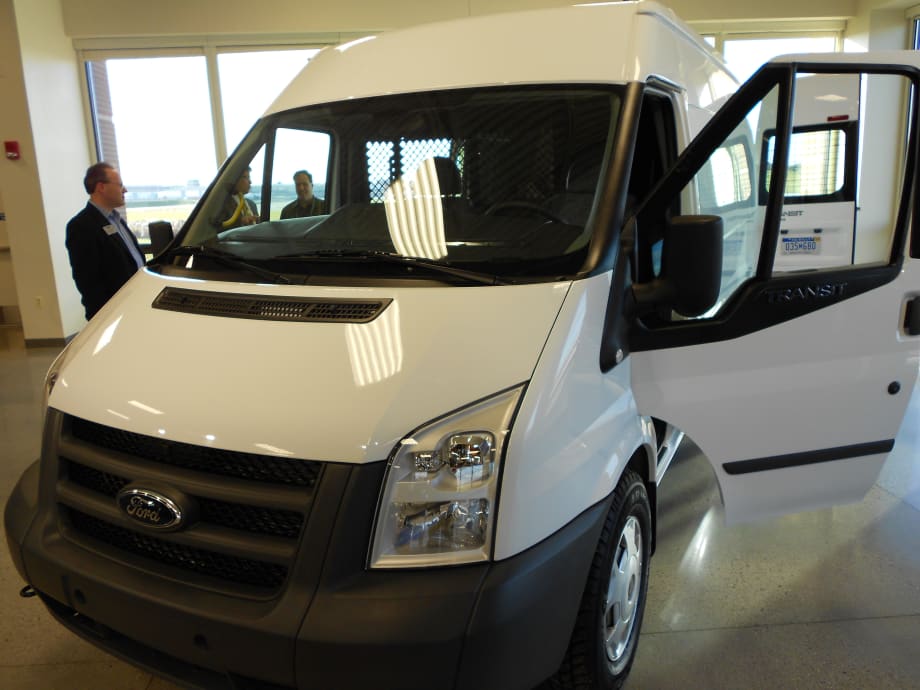
The Transit commercial van. Photo by Chris Wolski.
The Transit commercial van. Photo by Chris Wolski.
DEARBORN, MI – Ford Motor Company showcased its newest truck offerings to media during a two-day Commercial Truck Showcase Dec. 6 and 7 at its Dearborn Rouge River Center and testing facility.
You can view a photo gallery from the event here.
Members of Ford’s executive team for commercial vehicles, including Derrick Kuzak, group vice president global product development; Len Deluca, director commercial truck; Gerry Koss, fleet marketing manager; and Rob Stevens, chief engineer commercial vehicles, briefed the attendees about the company’s new offerings, which are underpinned by the automaker’s One Ford strategy. The company expects to reduce its vehicle platforms to 12 by 2014 and eventually down to 10, using a so-called “top-hat strategy,” which has been initiated already with the Fiesta and Focus models. Kuzak told the attendees that Ford’s commercial truck line up has a “breadth that can fit any fleet needs” ranging from Class 1-7 vehicles, heavy-duty trucks, and stripped chassis.
Altogether the new commercial truck lineup fits into the company’s sustainability strategy. Ford has now entered the mid-term phase of the strategy, which includes equipping most of the vehicles with the EcoBoost engine, electric power steering, six-speed transmissions, and focusing on lightweighting vehicles from 250 to 750 lbs. across the company’s platforms. Hybrid technology, diesel, and renewable fuels will also be used more fully. Each of the vehicles spotlighted during the showcase clearly fit into this strategy in one or more ways.
Highlighting the One Ford, global strategy was the announced 2013 launch of the Ford Transit for the U.S. market. The vehicle, which has been a fleet mainstay since the mid-1960s in the UK and Europe, will replace the venerable E-Series. The U.S. version of the Transit promises a 25-percent improvement in mpg due, in part to its 300-lb weight reduction. The U.S. Transit will be manufactured at Ford’s Kansas City Assembly Plant, which will get a $1.1 billion upgrade in preparation for the new model. The Transit will be available in numerous variations of chassis, engines, lengths, and heights.
Other vehicles highlighted during the briefing, included the F-650 and F-150 with EcoBoost. The 2012 Ford F-650 with new 6.8L V-10 gas engine option and fuel-efficient six-speed transmission promises to save municipal customers with tight budgets an average of $8,300 per vehicle compared to the F-650 diesel model. More important the cost of ownership will go down said Kuzak, and that will “mean a savings of thousands of dollars in our commercial owners’ pockets.”
Reflecting its commitment to sustainability, the automaker is targeting a 30 percent reduction in CO2 emissions from its vehicles in the U.S. and Europe. Certified clean-burning CNG/LPG alternative-fuel gaseous engine prep packages are available across Ford’s truck lineup, helping lower commercial customer operating costs along with emissions.
The Ford F-150, which can be equipped with a traditional 6.2L V-8 or 3.5L EcoBoost V-6, is rated up to 22 mpg/highway. Additionally, the 3.7L V-6 and 5.0L V-8 engines are flex-fuel capable.
In his presentation, Koss noted that “the internal combustion engine will continue to predominate the market, and we have to find ways to make it more efficient, particularly since more fleets have fuel efficiency as a goal.” According to Koss, by 2013, the EcoBoost will be available in 90 percent of Ford’s vehicles.
The entire Ford F-Series Super Duty pickup truck and cassis cab lineup is available with conventional, diesel, biodiesel B-20 and CNG/LPG-dedicated or bi-fuel capability, while the F-650 and F-750 medium-duty trucks can be optioned for biodiesel or CNG/LPG operation. In addition to biodiesel and CNG/LPG offerings, the 6.2L V-8 can also be operated on E-85.
The Transit Connect small van is available with either conventional, CNG or a battery electric drive system that is capable of up to 80 miles of range with zero emissions. During the event ride-and-drive, attendees had the opportunity experience every fuel-iteration of the Transit Connect.
During his presentation, Deluca was bullish on the automobile market and the economy in general, noting that unemployment claims, housing starts, and building permits are all up — good news for the commercial truck fleets. He added that the automotive industry is recovering, with it on track to sell 13 million vehicles overall, and is predicted to grow to 16-million units by 2015. According to Deluca, Ford’s commercial truck platforms have seen double-digit growth over the last year. “The market has grown and Ford has grown with it,” he said.
After an extensive tour of its Rouge River facility where the Ford F-150 is produced, the attendees had an opportunity to put the pedal to the metal and try out, firsthand, the company’s new commercial truck lineup, including the F-150 and F-250 Super Duty, the Ford Transit Connect, the F-650, F-550 Spartan Motors Fire Truck, F-59 Walk-in Van, and an E-450 shuttle and school bus.
By Chris Wolski
More Operations

Fleet Has a Talent Pipeline Problem. What Comes Next? | AF News Recap
Where will fleet’s next generation of leaders come from? This week, we’re looking at the industry’s talent pipeline, what certification can add to a fleet career, how to build an award-worthy track record, and the return of Automotive Fleet’s Personal Use Survey.
Read More →
Smith System Launches Driver Risk Management Program
Fleets have more driver data than ever, but identifying risky behavior doesn't necessarily correct it. Smith System's new Driver Risk Management program combines monitoring, training, and follow-up coaching to help fleets connect risk signals with driver intervention.
Read More →
Automotive Fleet Opens 2026 Personal Use Survey for Commercial Fleet Managers
Less than two weeks left! Commercial and corporate fleet managers are invited to share how their organizations handle company vehicle personal-use policies, charges, and driver eligibility.
Read More →
From AI Prompts to AI-Generated Safety Songs | AF News Recap
Can better prompts make AI more useful for fleet managers? This week, we’re breaking down smarter fleet analysis, an AI-assisted experiment that turned safety training into music, and what happened to fuel prices in August.
Read More →
How to Write Better AI Prompts for Fleet Analysis
Include these six elements in your fleet prompts to generate more relevant analysis and accurate answers.
Read More →
Fleet Meets: Eric Kilgore
This edition of the Fleet Meets series features one of the industry's best leaders driving multi-market and national operations.
Read More →
Why Reactive Fleet Management Is Becoming Too Expensive to Sustain
Research highlights a growing need for proactive management strategies to address rising costs in fleet operations effectively.
Read More →
What Your Fleet KPIs Aren’t Telling You
Tracking fleet metrics is only useful when the data leads to better decisions. This guide helps fleet leaders assess cost, utilization, and downtime more accurately, identify performance gaps, and prioritize the actions that can improve operational results.
Read More →
Hidden in Plain Sight: Fleet Compliance Risks
Fleet compliance isn't just about having policies — it's about consistently enforcing them. This practical guide reveals six hidden compliance risks common in public sector and shared fleet operations and outlines proven strategies to improve visibility, accountability, and audit readiness
Read More →
Turning Fleet Payment Data into Executive Insights
Does data alone drive results in operations?
Read More →