




Ford Sells More than 26M F-Series Trucks
Ford is celebrating a major milestone as F-Series now reigns as the top-selling truck in the country for 40 consecutive years and best-selling vehicle for 35 years, selling more than 26 million F-Series trucks since January 1977.
Image courtesy of Ford Motor Co.
Ford is celebrating a major milestone as F-Series now reigns as the top-selling truck in the country for 40 consecutive years and best-selling vehicle for 35 years, selling more than 26 million F-Series trucks since January 1977. Think of it like this: That many trucks could circle the globe more than three times, or, lined up bumper-to-bumper, would span 90,000-plus miles, according to the manufacturer.
Ford truck leadership was established with the sixth-generation of F-Series for the 1977 model year, a time when 8-track tapes, disco, and bell bottoms were the rage. The company was riding a sales wave – based on an all-new F-150 light-duty pickup featuring an improved 351-series V-8 engine, standard front disc brakes, and an extended SuperCab offering.
Even with the momentum in 1977, Ford engineers were already at work on a clean-sheet design for an all-new lineup. That seventh-generation F-Series not only set sales records for trucks, but also by 1982 it had become the overall best-selling vehicle in America, according to Ford.
“The 1980 model was a breakthrough generation for Ford,” said historian and author James Wagner. “It was all new – probably the greatest change in 40 years. It was fresh and had a strong emotional appeal with the twin I-beam front suspension. It seems from that point on, things really went Ford’s way as far as trucks were concerned.”
1997 marked the beginning of a split for F-Series into two distinct platforms – the 10th-generation F-150 was geared toward light-duty truck customers, while new F-250 and F-350 Super Duty brand trucks debuted in 1999 targeting heavy-duty commercial vehicle buyers.
Image courtesy of Ford Motor Co.
Beginning with the King Ranch in 2001, Ford began offering luxury edition pickups that provided a combination of capability, style, and comfort. Furthermore, models like the Platinum and Limited series went further, featuring leather seating, rich wood trim, full power accessories and premium sound systems.
Ford also pioneered performance and specialty truck segments with the special-edition Harley-Davidson F-150 and SVT F-150 Lightning in 1993. By 2002, Ford was marking 25 years as best-selling truck in America and 20 years as best-selling vehicle overall.
For the 2004 model-year, the 11th-generation F-150 received a top-down redesign. 2009 saw Ford charging ahead with some of the strongest visual cues ever for the 12th-generation F-Series. For the 2011 model-year, the company was poised to combat skyrocketing energy costs with introduction of the all-new fuel-efficient 3.5L EcoBoost V-6 engine for F-150.
Ford’s all-new high-strength, military-grade aluminum-alloy body for the light-duty F-150 in 2015 was a breakthrough product, according to the automaker. Then Ford applied the same lightweight material to make the all-new 2017 F-Series Super Duty even more capable than ever. When paired with advanced powertrains, like Ford EcoBoost V-6 engines, the F-150 lineup offers the most hauling capability* and best-in-class gas mileage**.
F-Series innovations and milestones, 1977 to present include:
1977: Ford begins F-Series truck leadership, selling 818,580 trucks for the model-year
1979: Ford introduces the Built Ford Tough brand promise
1980: All-new seventh-generation F-Series features efficient gasoline and diesel V-8 engines, new angular design, improved interior features; twin-traction-beam four-wheel-drive front suspension introduced
1984: F-150 replaces F-100 as base F-Series truck, adding improved safety features and new center console; optional CD player comes a year later
1987: Eighth-generation F-Series features a more aerodynamic design, available electronic fuel injection, redesigned interior including instrument panel, and rear antilock brakes
1998: Super Duty brand of medium-duty trucks debuts for commercial customers and aligns the popular F-150 line for light-duty customers
2001: Luxury King Ranch is an unprecedented success
2002: Ford, celebrating 25 years as best-selling truck in America and 20 years as best-selling vehicle overall, introduces Ford-engineered, Ford-built 6.7L Power Stroke turbo diesel engine
2008: Ford introduces all-new Class 3 F-450 pickup, raising the bar for maximum towing capacity
2011: EcoBoost engine technology introduced for F-150
2015: Ford shifts production away from steel to high-strength, military-grade, aluminum-alloy body for F-150; introduces all-new technology, including 360-degree camera
2016: New Pro Trailer Backup Assist helps make backing up a trailer as easy as turning a knob; plus F-150 is only full-size pickup to earn a five-star rating from National Highway Traffic Safety Administration and a Top Safety Pick from Insurance Institute for Highway Safety
2017: Ford celebrates F-Series leadership, marking 40 years with the best-selling truck in America and the best-selling vehicle overall for 35 years
(*) When properly configured. Class is Full-Size Pickups under 8,500 lbs. GVWR based on Ford segmentation.
(**) EPA-estimated rating of 19 city/26 hwy/22 combined mpg. 2.7L EcoBoost, 4x2. Actual mileage will vary. Class is Full-Size Pickups under 8,500 lbs. GVWR based on Ford segmentation.
More Operations
Managing Fleet Costs in an Era of Permanent Volatility
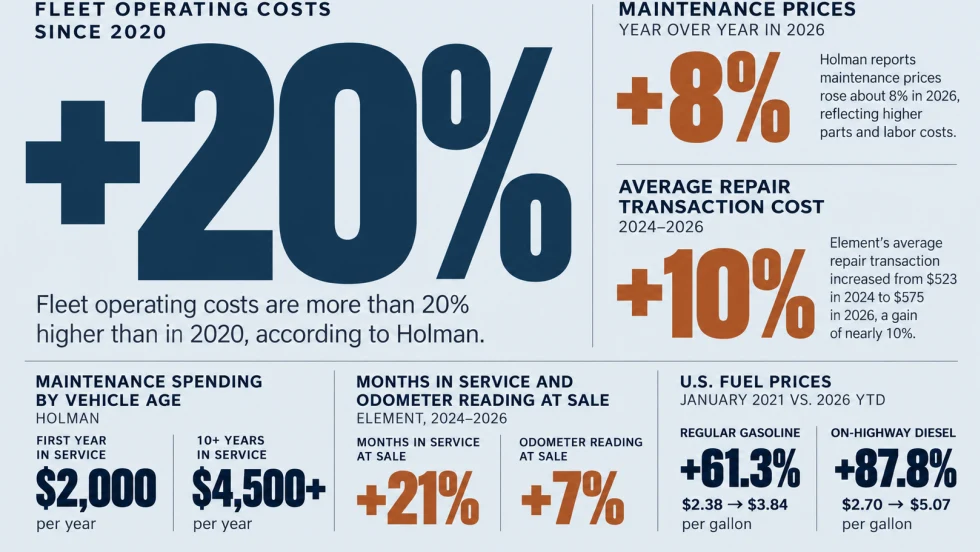
Fleet operating costs have risen more than 20% since 2020, raising a key question: When does extending a vehicle's service life stop making financial sense?
Read More →
The Next Evolution of Fleet Management: Autonomous Operations
This opening keynote session at the Fleet Forward Conference highlights the future of autonomous driving for fleets.
Read More →
How to Reduce the Total Cost of Risk From Catalytic Converter Theft
A stolen catalytic converter can cost fleets far more in downtime and lost productivity than in repairs. A total-cost-of-risk approach can help fleet managers quantify their exposure and prioritize theft prevention.
Read More →

Personal-Use Charges Rise as Vehicle Values Fall | AF News Recap
Personal-use charges are climbing, wholesale used-vehicle values are declining, and commercial fleet sales growth is slowing. This week, we're breaking down the latest fleet data, plus how Element Fleet Management is helping Waymo prepare for its first Canadian robotaxi market.
Read More →
Here's When You Should Make an Exception to Fleet Policy
Fleet policies are designed to create consistency, but not every driver or situation fits neatly within standard rules.
Read More →
AI-Native or AI-Acquired: What Should Fleet Managers Look for in an AI Platform?
Six questions can help fleet managers look beyond AI marketing claims to evaluate integration, data access, and real-world operational performance.
Read More →
A buyer's guide to fleet management software in 2027
Buying fleet management software in 2027 means looking beyond features and price. As fleet operations, technology and expectations evolve, this guide explores what today’s fleet professionals should consider when choosing a system that can deliver value now and adapt to what comes next.
Read More →
What Will Shape the Next Era of Fleet Management?
EVs, AI, and autonomous vehicles are reshaping fleet management. Discover what’s ahead—and how fleet leaders can prepare for the next era.
Read More →
How Fleets Can Recruit and Train Veterans for Technician Roles
Here's how the technician shortage has affected uptime for fleets, and what to do about it.
Read More →
Avis Budget Group Deploys Neology Toll Management Technology Across Major Brands
Neology’s neoFleet platform will manage toll transactions and toll-authority operations for vehicles across Avis, Budget, Payless, Budget Truck and Zipcar.
Read More →