




Ford Ranger Earns 5-Star EuroNCAP Crash Rating
BRENTWOOD, UK -- The all-new Ford Ranger has become the first pickup to draw a maximum five-star rating under the European New Car Assessment Program (EuroNCAP) crash test protocol.
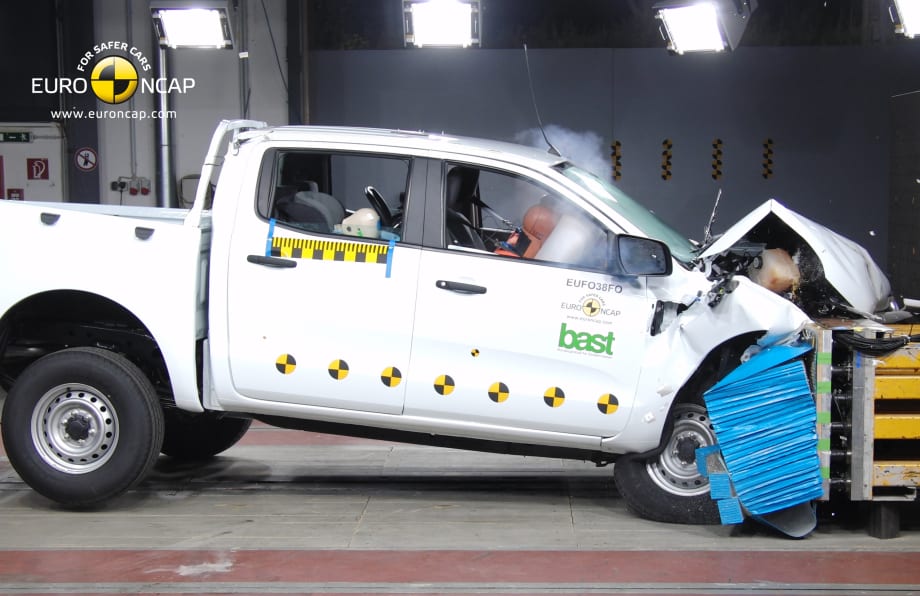
The Ford Ranger undergoes crash tests
BRENTWOOD, UK -- The all-new Ford Ranger has become the first pickup to draw a maximum five-star rating under the European New Car Assessment Program (EuroNCAP) crash test protocol.
The Ranger scored 89 percent for overall safety – the best score ever earned by a pickup and one of the highest scores recorded by Euro NCAP for any type of vehicle. Moreover, the new Ranger achieved the highest rating of any vehicle ever tested by Euro NCAP for pedestrian protection (81 percent).
"No one wants to be involved in an accident but if the worst were to happen, the new Ranger is proven to provide outstanding protection to occupants of all ages as well as pedestrians," said Stephen Odell, chairman and CEO of Ford of Europe.
Euro NCAP was established in 1997 and backed by several governments, along with motoring, consumer and insurance organizations. It is the largest and most respected independent authority on crash testing in Europe.
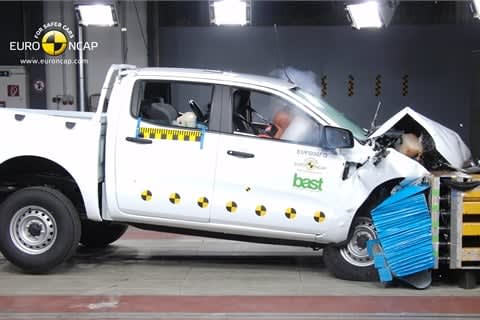
The Ford Ranger undergoes crash tests
Michiel van Ratingen, Euro NCAP secretary general, said: "With such good pedestrian protection, the Ford Ranger is undoubtedly raising the bar of safety in the category of pickup trucks, which had until now not proven to be the safest."
The Ranger's advanced safety protection begins with a reinforced passenger cell that uses high-strength steel throughout. Employing multiple load paths in the front, side and rear of the vehicle, crash forces are directed away from occupants. This structure, along with the all-new ladder frame, was optimized to manage the crash energy in a variety of impacts and provide protection for all passengers, Ford said.
Using computer modeling, engineers assessed more than 9,000 virtual crash tests before any of the 110 actual vehicle crash tests or 410 system sled tests were undertaken. These virtual simulations allowed the engineers to optimize the vehicle structure and safety systems, Ford said. All this was achieved before any real prototype vehicle was built and subjected to crash testing.
Side curtain airbags, standard on all Ranger cab styles in Europe for the first time, deploy from the headliner to provide a protective cushion for the head of occupants in case of a side impact. The curtain is designed to protect both rows of occupants in Double Cab and Super Cab models by covering the upper side structure and glass from the A-pillar to the rear of the passenger compartment.
New side airbags also deploy from the side bolster of the front seats to protect the thorax from side-impact forces, working in tandem with the front airbags for the driver and front passenger. A driver’s knee airbag is also standard across all models.
Other safety technologies include three-point safety belts for all seating positions, with pre-tensioners and load limiter for the front seats, as well as Ford BeltMinder technology, which helps remind front-seat occupants to wear their belts.
The Ranger has been engineered with the latest pedestrian protection features. Technologies that emerged from a global Ford research project on pedestrian-friendly vehicle designs have now been applied to a pickup for the first time. This includes a "hexageneous" under-bonnet structure to reduce the potential for pedestrian head injuries, and a pedestrian-friendly front bumper design incorporating energy-absorbing materials.
The Ranger also uses active safety and driver assistance technologies to help drivers avoid accidents. A key standard feature is the Electronic Stability Program (ESP) that uses advanced sensors to constantly monitor the vehicle's behavior and assist stability and control.
The Trailer Sway Control system monitors the behavior of the tow vehicle and trailer array to sense the advent of trailer sway and apply braking countermeasures to reduce its effects. Adaptive Load Control provides additional stability assurance for drivers dealing with heavy payloads.
When driving downhill, Hill Descent Control ensures that the brakes will be applied to control the vehicle at a set speed. Or when stopping on a steep grade, Hill Launch Assist helps the driver to pull away confidently without creeping backwards, even when fully laden.
More Safety
NAFA Fleet Safety Symposium to Collocate With 2026 Fleet Forward Conference
The daylong certificate program will precede the Fleet Forward Conference at the Gaylord National Harbor in Maryland.
Read More →
The Distractions You Can’t Turn Off: What Drivers Face Outside the Vehicle
Fleet drivers face constant visual, cognitive, and environmental interruptions the moment they hit the road. From roadside chaos to mental fatigue and digital overload, today’s biggest driving risks often come from outside the vehicle itself.
Read More →
FLASH Weather AI Launches First Deep-Learning Hail Prediction Model With High-Resolution Forecasting
FLASH Weather AI has launched a first-of-its-kind hail prediction model capable of forecasting hail size and arrival time at 1-kilometer resolution up to 55 minutes ahead, giving fleets and insurers critical time to prepare for severe storms.
Read More →
How Coca-Cola United Protects Its Fleet from Growing Legal Risk
As litigation risk rises, vehicles are increasingly targeted. This Coca-Cola bottler shares how it’s reducing exposure through driver training, technology, and a proactive risk management approach.
Read More →
How to Speak the Same Language on Fleet Safety
Drivers, supervisors, and data often speak different safety “languages.” Getting on the same page will drive better results.
Read More →
Fleet Cybersecurity 101: What You Need from Your Technology Vendors
From identity management to third-party certifications, the right technology partner should make security easier to manage. Here are the three building blocks that fleet managers need to stay in control as connected systems scale.
Read More →
Reducing Risk by Eliminating Phone Use Behind the Wheel
Distracted driving remains one of the most persistent risks in fleet operations. New approaches focus on removing mobile device use entirely while adding real-time safety support.
Read More →
Distracted Driving in the Age of Smart Tech – Part 2
As distraction risks evolve, fleets are turning to smarter, more connected technologies to better understand what’s happening behind the wheel. Part 2 explores how these tools are helping identify risky behaviors and improve visibility across operations.
Read More →
Data Rights, Risks, and Responsibilities After a Crash
What fleets capture to improve safety can also expose them in litigation, forcing leaders to rethink how data is managed, stored, and shared.
Read More →
From Distraction to Detection: Strengthening Awareness in Fleet Drivers
Distracted driving is often measured by what we can see—phones in hand, eyes off the road. But what about the distractions we can’t? A recent incident raises a bigger question about awareness, attention, and why subtle risks so often go unnoticed.
Read More →