




Ford Offers Shuttle Service for Employees
Ford is piloting an on-demand Dynamic Shuttle service for its Dearborn, Mich., employees this month, providing a new mobility solution featuring smart ride-hailing technology with premium customized shuttles, applying insights from earlier experiments and research with global urban commuters.
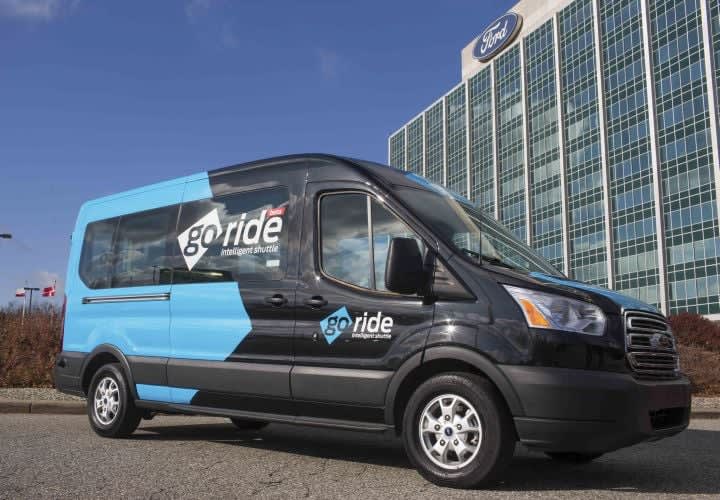
Photo courtesy of Ford.
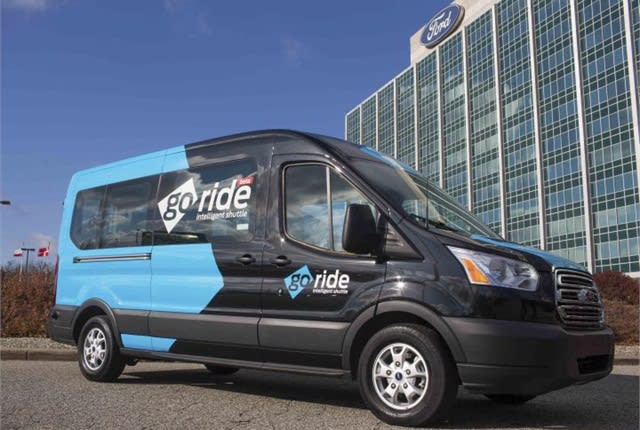
Photo courtesy of Ford.
Ford is piloting an on-demand Dynamic Shuttle service for its Dearborn, Mich., employees this month, providing a new mobility solution featuring smart ride-hailing technology with premium customized shuttles, applying insights from earlier experiments and research with global urban commuters.
Dynamic Shuttle — a Ford Smart Mobility experiment announced in January — supports the company's broader effort to change the way the world moves. Ford Smart Mobility is the company’s plan to take connectivity, mobility, autonomous vehicles, the customer experience, and data and analytics to the next level.
Providing a platform to test new ideas, the pilot ultimately could help Ford develop mobility solutions to improve the lives of people in cities struggling with traffic gridlock and few public transit options.
The company is piloting Dynamic Shuttle with four Ford Transit vehicles. The program is expected to expand to more shuttle vehicles in Dearborn to potentially increasing ridership as Ford tests the performance of the software and gathers fleet data.
The Ford shuttle service will begin processing customer ride requests on the new platform as it gradually migrates from its dispatch-based platform. A mobile-friendly Web portal and smartphone application will be available to riders next quarter.
The convenience of Ford’s Dynamic Shuttle will allow people to summon point-to-point rides on-demand.
Once a mobile-based ride request is made, the Ford-developed software immediately determines the shuttle best suited to address the request without extending the travel time of riders already aboard.
It then sends the rider an offer detailing proposed pick-up time and maximum duration of the trip, which the requester can accept or decline. If accepted, the request is dispatched to the shuttle driver’s navigation interface, along with the most efficient route to complete the requests of all riders in the timeliest manner.
In developing the software, Ford’s technology team also crafted the ideal shuttle vehicle.
Each Ford Transit shuttle has been adapted to carry six to eight passengers. Customer findings shaped the best vehicle height for easy on-boarding and off-boarding, as well as rider-requested amenities including complimentary Wi-Fi, USB charging ports for each seat and personal storage space.
Research teams surveyed people in various cities around the world to understand how consumer attitudes and needs vary from region to region. In the United States and United Kingdom, this included conducting research in different-sized cities – Atlanta, New York, Edinburgh and London. They also took into account growing national economies, studying Rio de Janeiro and São Paulo in Brazil, along with Chennai and Mumbai in India.
Researchers found that many people requesting pick-up at their residence were willing to walk a short distance to a neutral location – both to make the service more efficient for others and to afford greater privacy for themselves.
The concept sounds simple enough. But to operate seamlessly, Dynamic Shuttle requires global collaboration among Ford teams – groups studying people’s commuting behaviors, developing software and designing vehicles to craft the ultimate ride-sharing experience.
Initially available exclusively for Ford’s Dearborn campus, Dynamic Shuttle benefits could one day extend to other locations and to more applications, including delivery services, emergency medical transportation and beyond.
More Operations

Fleet Has a Talent Pipeline Problem. What Comes Next? | AF News Recap
Where will fleet’s next generation of leaders come from? This week, we’re looking at the industry’s talent pipeline, what certification can add to a fleet career, how to build an award-worthy track record, and the return of Automotive Fleet’s Personal Use Survey.
Read More →
Smith System Launches Driver Risk Management Program
Fleets have more driver data than ever, but identifying risky behavior doesn't necessarily correct it. Smith System's new Driver Risk Management program combines monitoring, training, and follow-up coaching to help fleets connect risk signals with driver intervention.
Read More →
Automotive Fleet Opens 2026 Personal Use Survey for Commercial Fleet Managers
Less than two weeks left! Commercial and corporate fleet managers are invited to share how their organizations handle company vehicle personal-use policies, charges, and driver eligibility.
Read More →
From AI Prompts to AI-Generated Safety Songs | AF News Recap
Can better prompts make AI more useful for fleet managers? This week, we’re breaking down smarter fleet analysis, an AI-assisted experiment that turned safety training into music, and what happened to fuel prices in August.
Read More →
How to Write Better AI Prompts for Fleet Analysis
Include these six elements in your fleet prompts to generate more relevant analysis and accurate answers.
Read More →
Fleet Meets: Eric Kilgore
This edition of the Fleet Meets series features one of the industry's best leaders driving multi-market and national operations.
Read More →
Why Reactive Fleet Management Is Becoming Too Expensive to Sustain
Research highlights a growing need for proactive management strategies to address rising costs in fleet operations effectively.
Read More →
What Your Fleet KPIs Aren’t Telling You
Tracking fleet metrics is only useful when the data leads to better decisions. This guide helps fleet leaders assess cost, utilization, and downtime more accurately, identify performance gaps, and prioritize the actions that can improve operational results.
Read More →
Hidden in Plain Sight: Fleet Compliance Risks
Fleet compliance isn't just about having policies — it's about consistently enforcing them. This practical guide reveals six hidden compliance risks common in public sector and shared fleet operations and outlines proven strategies to improve visibility, accountability, and audit readiness
Read More →
Turning Fleet Payment Data into Executive Insights
Does data alone drive results in operations?
Read More →