




Ford Offers All-New F-150 Powertrain Lineup
DETROIT - Ford Motor Company is offering four new truck engines with six-speed automatic transmission as standard in the 2011 Ford F-150.
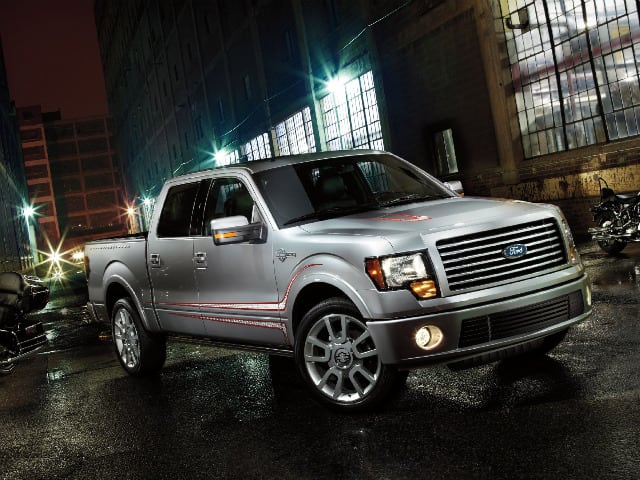
2011 Ford Harley-Davidson F-150
DETROIT- Ford Motor Company is offering four new truck engines with six-speed automatic transmission as standard in the 2011 Ford F-150.
Each engine delivers improved fuel economy, outstanding performance and class-leading capability, according to the automaker. This versatile new powertrain lineup enables F-150 customers to choose the engine that best suits their needs.
Available at launch are a 3.7L V-6 and a 5.0L V-8, each with fuel-saving and performance-enhancing twin independent variable camshaft timing (Ti-VCT) technology, and a version of the 6.2L V8 that is the base engine in the 2011 Ford F-Series Super Duty.
A 3.5L EcoBoost engine, specially tuned and calibrated for the F-150, will be available in early 2011. With this engine, the F-150 will have up to 20 percent better fuel economy compared with the outgoing 2010 F-150.
2011 Ford F-150 3.5L EcoBoost Engine
"Our new engine lineup allows greater flexibility for customers to select the powertrain choice that best suits their needs," said Barb Samardzich, vice president of powertrain engineering. "We are in the midst of a powertrain revolution, with 30 new powertrains over the next two years."
Highlights of each new engine include:
3.7L four-valve Ti-VCT V6
Best-in-class 300 horsepower (estimated) at 6,500 rpm.
275 lb.-ft. of torque at 4,500 rpm.
Class-leading fuel economy.
Best-in-class 6,100 lbs. maximum trailer tow.
Ti-VCT creates precise, variable timing control of both the intake and exhaust camshafts to optimize power, performance and fuel economy.
E-85 flex-fuel capability.
Piston-cooling jets, which squirt oil on the underside of the pistons to keep the piston crowns cool under extreme operating conditions.
Forged-steel crankshaft for improved durability.
5.0L four-valve dual-overhead-camshaft Ti-VCT V8
Best-in-class 360 horsepower at 5,500 rpm and 380 lb.-ft. of torque at 4,250 rpm.
Class-leading fuel economy.
Best-in-class 9,800 lbs. maximum trailer tow.
New strengthened block and new cylinder head optimized for performance and enhanced cooling.
Unique intake camshafts, combined with Ti-VCT, composite intake manifold and optimized compression ratio for improved low-speed torque and towing capability.
Forged-steel crank and all-new oil cooler enhance durability.
Piston-cooling jets, which squirt oil on the underside of the pistons to keep the piston crowns cool under extreme operating conditions.
E-85 flex-fuel capability.
6.2L two-valve single-overhead-camshaftV8
Best-in-class 411 horsepower at 5,500 rpm and 434 lb.-ft. of torque at 4,500 rpm.
Best-in-class 11,300 lbs. maximum trailer tow.
Competitive fuel economy.
Utilizes a large bore and shorter stroke. The large bore allows for larger intake and exhaust valves for improved engine airflow, and the short stroke allows higher engine speed for increased horsepower.
Because of the large bore size, two spark plugs per cylinder are used to more efficiently burn the fuel-air mixture in the combustion chamber, enabling better fuel economy and increased engine torque. The twin plugs also help the engine maintain a smooth, stable idle, according to Ford.
Used as the standard engine on the 2011 F-Series Super Duty, but tuned for the F-150 with a special cam profile. The engine will be standard on the 2011 F-150 SVT Raptor and other specialty applications, and pumps out up to 411 horsepower and 434 lb.-ft. of torque.
3.5L Ti-VCT EcoBoost
Ti-VCT creates precise, variable timing control of both the intake and exhaust camshafts to optimize power, performance, and fuel economy.
Fuel economy improves up to 20 percent versus 2010 model year F-150 5.4L V-8.
Improved intake and exhaust camshafts optimized for improved fuel economy and performance.
Cast exhaust manifolds for heavy-duty operation and durability.
Improved manifold and cylinder heads for improved performance.
Direct-acting mechanical bucket valvetrain with polished buckets to reduce friction and improve fuel economy.
The new engines for the Ford F-150 follow the all-new engine lineup for the 2011 Ford F-Series Super Duty introduced earlier this year and highlighted by the 6.7L Power Stroke V-8 turbocharged diesel, which delivers best-in-class torque, horsepower, and fuel economy, according to the automaker.
More Operations

Hidden in Plain Sight: Fleet Compliance Risks
Fleet compliance isn't just about having policies — it's about consistently enforcing them. This practical guide reveals six hidden compliance risks common in public sector and shared fleet operations and outlines proven strategies to improve visibility, accountability, and audit readiness
Read More →
Turning Fleet Payment Data into Executive Insights
Does data alone drive results in operations?
Read More →
Automotive Fleet Opens 2026 Personal Use Survey for Commercial Fleet Managers
Commercial and corporate fleet managers are invited to share how their organizations handle company vehicle personal-use policies, charges, and driver eligibility.
Read More →
Gary Van Orden Retires After Nearly Four Decades in Commercial Fleet
From answering customer calls at Ford Motor Company to leading fleet sales across multiple OEMs and a fleet management company, Gary Van Orden's career reflects nearly four decades of leadership in commercial fleet.
Read More →
How Stellantis Plans to Get Ahead of Fleet Downtime
Vehicle acquisition may grab the headlines, but fleet uptime increasingly determines operating success. Darren Bradshaw of Mopar North America gives the details.
Read More →
Hyundai Releases 2027 Commercial Program Incentives
The 2027 Model Year "Fleet Street Incentives" are available to commercial and government fleets.
Read More →
It's All Downhill from Here! Fleet Industry Raises $22,000 for Skilled Trades Scholarships
Work Truck’s Lauren Fletcher and Automotive Fleet’s Chris Brown turned a friendly racing rivalry into $22,000 for automotive technology and skilled trades scholarships.
Read More →
The Top 300 Commercial Fleets
The Top 300 Commercial Fleets: See the List
Read More →

Your Local Dealer Knows More Than You Think
Your local dealer can provide an information advantage that extends well beyond courtesy deliveries.
Read More →