




Ford is Adopting EPA's Most Stringent Clean Air Standards Faster Than Required
Ford Motor Company announced on July 22 that well more than half of its 2005-model year light vehicles will meet the Environmental Protection Agency's (EPA) new Tier 2 emissions standard - 14 percent more than required by law.
Ford Motor Company announced on July 22 that well more than half of its 2005-model year light vehicles will meet the Environmental Protection Agency's (EPA) new Tier 2 emissions standard - 14 percent more than required by law. In addition, Ford will certify 14 car and SUV models, totaling more than one million units, to meet or exceed the Tier 2 Bin 5 tailpipe emissions level -- one of the most difficult Tier 2 standards to achieve. In layman's terms, every model certified to Tier 2 Bin 5 produces less than 0.16 grams of smog- forming pollutants per mile. Smog-forming pollutants are nitrogen oxides (NOx) and non-methane organic gases (NMOG). That's almost five times cleaner than Tier 2 Bin 10, the least clean Tier 2 level for cars, which allows no more than 0.76 grams per mile. Ford, Lincoln and Mercury cars, trucks and SUVs that achieve Tier 2 Bin 5 or better emissions are:
1. All versions of the Ford Five Hundred, including front- and all-wheel drive models.
2. All versions of the Mercury Montego.
3. All versions of the Ford Freestyle, a six- or seven-passenger vehicle that bridges the gap between sedans and SUVs.
4. All versions of the redesigned Ford Mustang.
5. Most four- and six-cylinder models of the Ford Escape.
6. The Escape Hybrid, full hybrid gas-electric SUV.
7. All models of the Ford Focus powered by the Duratec 20 and Duratec 23 engines.
8. Four-door versions of the Ford Explorer SUV powered by 4.6-liter V-8 engines.
9. Mercury Mountaineer SUVs powered by 4.6-liter V-8 engines.
10. All Ford Taurus sedans and station wagons powered by the 3.0-liter Vulcan V-6 engine.
11. The Mercury Sable, when powered by the 3.0-liter Vulcan V-6 engine.
12. All models of the Ford Crown Victoria designed for retail consumers.
13. The Mercury Grand Marquis.
14. All models of the Lincoln Town Car designed for retail customers.
Over 15,000 miles of driving, these vehicles will emit no more than 5.3 pounds of smog-forming pollution, according to the EPA. That's 19.7 pounds less than Tier 2 Bin 10 and 24.8 pounds less than a vehicle certified to the EPA's outgoing Tier 1 standard. The cleanest new Ford model certified to federal standards is the Escape Hybrid, which will emit no more than 3.6 pounds of smog-forming pollution over the same distance. The Tier 2 program is the EPA's effort to simultaneously improve air quality and simplify emissions regulations. Under Tier 2, emissions standards for cars and light trucks converge over a period of years. By 2009, 100 percent of all cars and light trucks must meet the standards. In addition, Tier 2 calls for reduced sulfur levels in gasoline, which will help drive further reductions in vehicle emissions over time. The EPA required manufacturers of cars and light trucks to introduce their first Tier 2-certified vehicles in 2004. In 2005, manufacturers are required to certify 50 percent of their fleet to meet Tier 2 standards. On a corporate basis, 57 percent of Ford North America's vehicles are forecast to meet the standard.
More Operations

Top 50 Executive Fleets
It is that time of year again! Time for the 2026 list of the Top 50 Executive Fleets, presented by Automotive Fleet and Volvo as part of its annual Fleet 500. Download now to see this year's list of companies!
Read More →
Gary Van Orden Retires After Nearly Four Decades in Commercial Fleet
From answering customer calls at Ford Motor Company to leading fleet sales across multiple OEMs and a fleet management company, Gary Van Orden's career reflects nearly four decades of leadership in commercial fleet.
Read More →
How Stellantis Plans to Get Ahead of Fleet Downtime
Vehicle acquisition may grab the headlines, but fleet uptime increasingly determines operating success. Darren Bradshaw of Mopar North America gives the details.
Read More →
Hyundai Releases 2027 Commercial Program Incentives
The 2027 Model Year "Fleet Street Incentives" are available to commercial and government fleets.
Read More →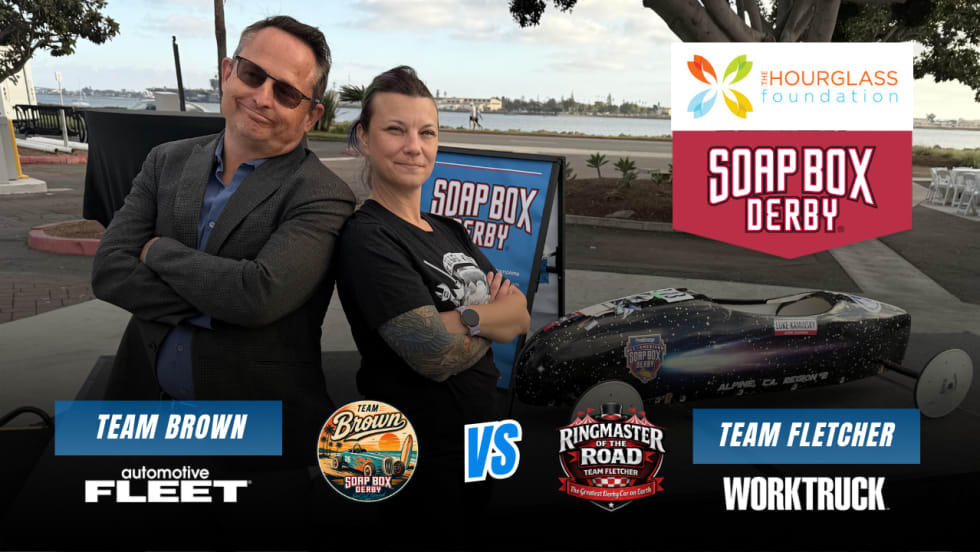
It's All Downhill from Here! Fleet Industry Raises $22,000 for Skilled Trades Scholarships
Work Truck’s Lauren Fletcher and Automotive Fleet’s Chris Brown turned a friendly racing rivalry into $22,000 for automotive technology and skilled trades scholarships.
Read More →
The Top 300 Commercial Fleets
The Top 300 Commercial Fleets: See the List
Read More →

Your Local Dealer Knows More Than You Think
Your local dealer can provide an information advantage that extends well beyond courtesy deliveries.
Read More →
Fleet Meets: Austin Schutte
Here are some industry insights, personal touches, and words of advice from the CEO and Founder of Anew Solutions.
Read More →
Soap Box Derby Challenge: What’s Powering Team Brown
The car is coming together, the students are solving real build problems, and the fleet industry is helping push Team Brown toward the starting line.
Read More →