




Ford Introduces 2007 Expedition EL
DEARBORN, MI – For full-size SUV customers who want even more cargo-carrying capability, Ford has extended its Expedition lineup with the new 2007 Expedition EL. With 14.8 inches of additional overall length, Expedition EL delivers 130.8 cubic feet of cargo space – including 24 cubic feet more behind the third-row seat than the Expedition. Expedition EL rides on a 131-inch wheelbase – 12 inches longer than the standard Expedition – to preserve the base model's superior ride and handli
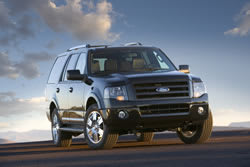
DEARBORN, MI – For full-size SUV customers who want even more cargo-carrying capability, Ford has extended its Expedition lineup with the new 2007 Expedition EL. With 14.8 inches of additional overall length, Expedition EL delivers 130.8 cubic feet of cargo space – including 24 cubic feet more behind the third-row seat than the Expedition. Expedition EL rides on a 131-inch wheelbase – 12 inches longer than the standard Expedition – to preserve the base model’s superior ride and handling. Expedition’s new design, inspired by Ford F-Series, melds ruggedness with expressive lines and a three-bar grille to the large blue oval mounted on the lift gate. New dual-beam headlamps feature the Ford-themed step-up design with the integrated side-marker lights wrapping around into the front fenders. Smooth sides and large wheel lips further define Expedition’s stance and frame its large wheels and tires. Expedition owners can choose from five wheel designs, including available 20-inch chrome-clad, six-spoke wheels wearing P275/55-R20 all-season tires. The new Expedition’s chassis features an all-new front suspension, front frame section, and modular front-end construction for ease of assembly and improved quality. The tube-through-tube frame construction increases frame stiffness to provide a solid foundation for improved driving dynamics. Ford’s patented porthole-through-frame design allows the drive shafts to feed through the frame rails, lowering the center of gravity for better ride and handling and maximizing passenger space in the third-row seat. Expedition’s 4x4 models have two-speed transfer cases with optional electronic shift-on-the-fly capability, controlled from a dash-mounted rotary knob. In low range, the electronic throttle control changes to off-road calibration for more precise torque management in the worst conditions. Expedition is powered by Ford’s 5.4L Triton V-8 engine. Rated at 300 horsepower and 365 lb.-ft. of torque, Expedition can tow up to 9,100 lbs. The Triton engine is paired with a new standard 6-speed automatic transmission. The 6R transmission has manual shift capability, and its wide 6.04:1 gear ratio and two overdrive gears deliver improved performance and fuel economy over the 4-speed it replaces. AdvanceTrac with RSC (Roll Stability Control) is standard on both Expedition and Expedition EL. Ford’s system utilizes a gyroscopic roll rate sensor to accurately measure the vehicle’s yaw and roll angles. If the roll rate sensor detects a significant roll angle, the system applies additional countermeasures – such as applying brakes to one or more wheels or reducing engine power – to help the driver maintain control. Dual-stage front airbags deploy with varying power based on crash severity, the driver’s seat position, and safety-belt usage. The available three-row Safety Canopy rollover detection system includes extended-duration side curtain airbags that extend down to the beltline, offering increased coverage, and features roll-fold deployment for enhanced protection.
More Operations

What's Best Handled by an FMC, and What's Better Done Directly?
Fleet managers continue to rely on FMCs for essential services but are taking a closer look at where working directly with suppliers can improve efficiency and responsiveness.
Read More →
Fleet Meets: Erin Gilchrist
Meet Erin Gilchrist, the inaugural Mike Antich Spirit of Fleet Award winner, as she shares insights on leadership, mentorship, the power of industry connections, and why people remain at the heart of fleet's future.
Read More →
How 2026 Fleet Visionary Jamie McKay Manages 2,400 Vehicles Across 37 States
How do you keep 2,400 vehicles running across 37 states? Fleet Visionary Award winner Jamie McKay shares how collaboration, flexibility, and a few simple strategies help her tackle fleet management challenges at Aptive Pest Control.
Read More →

Managing Fleet Costs in an Era of Permanent Volatility
Fleet operating costs have risen more than 20% since 2020, raising a key question: When does extending a vehicle's service life stop making financial sense?
Read More →
The Next Evolution of Fleet Management: Autonomous Operations
This opening keynote session at the Fleet Forward Conference highlights the future of autonomous driving for fleets.
Read More →
How to Reduce the Total Cost of Risk From Catalytic Converter Theft
A stolen catalytic converter can cost fleets far more in downtime and lost productivity than in repairs. A total-cost-of-risk approach can help fleet managers quantify their exposure and prioritize theft prevention.
Read More →
Personal-Use Charges Rise as Vehicle Values Fall | AF News Recap
Personal-use charges are climbing, wholesale used-vehicle values are declining, and commercial fleet sales growth is slowing. This week, we're breaking down the latest fleet data, plus how Element Fleet Management is helping Waymo prepare for its first Canadian robotaxi market.
Read More →
Here's When You Should Make an Exception to Fleet Policy
Fleet policies are designed to create consistency, but not every driver or situation fits neatly within standard rules.
Read More →
AI-Native or AI-Acquired: What Should Fleet Managers Look for in an AI Platform?
Six questions can help fleet managers look beyond AI marketing claims to evaluate integration, data access, and real-world operational performance.
Read More →
A buyer's guide to fleet management software in 2027
Buying fleet management software in 2027 means looking beyond features and price. As fleet operations, technology and expectations evolve, this guide explores what today’s fleet professionals should consider when choosing a system that can deliver value now and adapt to what comes next.
Read More →