




Ford F-150 Repeats as Fleet Truck of the Year
TORRANCE, CA – The 2007 Ford F-150 upheld its reputation among fleet industry professionals as it brought home Fleet Truck of the Year honors for the second straight year. Sponsored by Automotive Fleet and Business Fleet magazines, this year's annual Fleet Truck of the Year competition featured 38 domestic and import-badged 2007-MY light trucks.

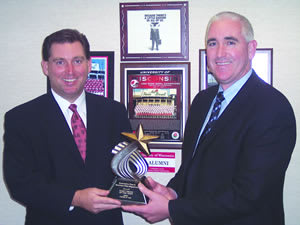
John Ruppert, general manager of commercial and government operations for Ford (right), accepts the 2007 Fleet Truck of the Year award from Bob Brown, associate publisher, Bobit Business Media.
TORRANCE, CA – The 2007 Ford F-150 upheld its reputation among fleet industry professionals as it brought home Fleet Truck of the Year honors for the second straight year. Sponsored by Automotive Fleet and Business Fleet magazines, this year’s annual Fleet Truck of the Year competition featured 38 domestic and import-badged 2007-MY light trucks. Qualified fleet buyers voted online via the magazines’ shared Web site, www.fleet-central.com. The best-selling pickup for 29 years, the F-150 is available in five series — XL, XLT, STX, FX4, and Lariat — and offers a variety of body configurations, including three cab choices (Regular, SuperCab, and SuperCrew), three box lengths (5.5, 6.5, and 8 feet), and two box styles. All versions are standard-equipped with tailgate assist. The SuperCab and SuperCrew feature two rows of seating and four doors for easy access. The 2007 F-150 is powered by either a 4.2L V-6 202-horsepower or 4.6L Triton V-8 248-horsepower engine in both 4x2 and 4x4 capacities. The F-150 also offers a 5.4L three-valve Triton V-8 300-horsepower engine with variable cam timing and electronic throttle control, also available as an E-85 option. The V-6 is mated to either a five-speed manual or four-speed automatic, while the V-8 is equipped with a four-speed automatic overdrive transmission. Torque-based electronic throttle control uses driver input from the accelerator pedal to actively modulate torque at the drive wheels. The technology produces seamless engine response and improved fuel economy. Earning the National Highway Traffic Safety Administration’s Five-Star rating for driver and right-front passenger frontal crash rating, safety features include Ford’s Personal Safety System and occupant-sensing technology for front-row passengers. The frontal airbag offers multiple deployment levels based on seat position, seatbelt use, and crash severity. Four-wheel vented-disc anti-lock brakes and a tire-pressure-monitoring system are offered as standard, while Traction Assist can be ordered on 4x2 V-8 models. The F-150 provides best-in-class towing at up to 10,500 lbs., with a maximum payload capacity of 3,050 lbs. The truck can also achieve up to 15/20-mpg city/highway, depending on engine and drivetrain. Inside, the F-150 features 40/20/40-split-front-bench seating, except in the Lariat. A modular overhead rail system allows more storage options.
More Operations

A buyer's guide to fleet management software in 2027
Buying fleet management software in 2027 means looking beyond features and price. As fleet operations, technology and expectations evolve, this guide explores what today’s fleet professionals should consider when choosing a system that can deliver value now and adapt to what comes next.
Read More →
What Will Shape the Next Era of Fleet Management?
EVs, AI, and autonomous vehicles are reshaping fleet management. Discover what’s ahead—and how fleet leaders can prepare for the next era.
Read More →
How Fleets Can Recruit and Train Veterans for Technician Roles
Here's how the technician shortage has affected uptime for fleets, and what to do about it.
Read More →

Avis Budget Group Deploys Neology Toll Management Technology Across Major Brands
Neology’s neoFleet platform will manage toll transactions and toll-authority operations for vehicles across Avis, Budget, Payless, Budget Truck and Zipcar.
Read More →
Fleet Personal-Use Charges Edge Higher in 2026
Nearly eight in 10 surveyed fleets allow personal use of company vehicles, while just over half of respondents report charging employees for the privilege.
Read More →
The Future of Fleet + What’s Changing Right Now | AF News Recap
Could developments overseas offer a preview of what’s coming for U.S. fleets? This week, we’re looking at the future of AI, autonomy, and electrification, plus Ford Pro’s new certified pre-owned program, smarter vehicle offboarding, and a new way for fleets to manage toll expenses.
Read More →
How to Handle Vehicle Offboarding
What do fleet managers need to do when a driver leaves?
Read More →
Fleet Manager’s Ultimate Playbook: Navigating the New Standard in OEM Connectivity
Rising operating costs, driver safety concerns, and unplanned downtime are putting unprecedented pressure on modern fleets. Discover how fleet managers use embedded OEM connectivity and real-time vehicle data to cut TCO, prevent downtime, and protect drivers without aftermarket telematics hardware.
Read More →
U.S. Bank Adds Verra Mobility Toll Management to Voyager Fleet Platform
The integration allows U.S. Bank Voyager fleet customers to manage toll payments and violations alongside fuel, EV charging and maintenance expenses.
Read More →
ADAS Prevents Crashes. But Repairs Cost More | AF News Recap
ADAS-equipped vehicles may crash less often, but they can cost more when they do. This week, we’re breaking down what that tradeoff means for fleets, plus Subaru’s first Forester Wilderness Hybrid, Nissan’s new e-POWER Rogue, and why Calstart has become Catalyst Mobility.
Read More →