




Ford Escape Hybrid Delivers Total Package for Los Angeles County Ocean Lifeguards
LOS ANGELES – Ford Motor Company teamed up with the Los Angeles County Lifeguards, a division of the Los Angeles County Fire Department, to help save lives while protecting the environment.
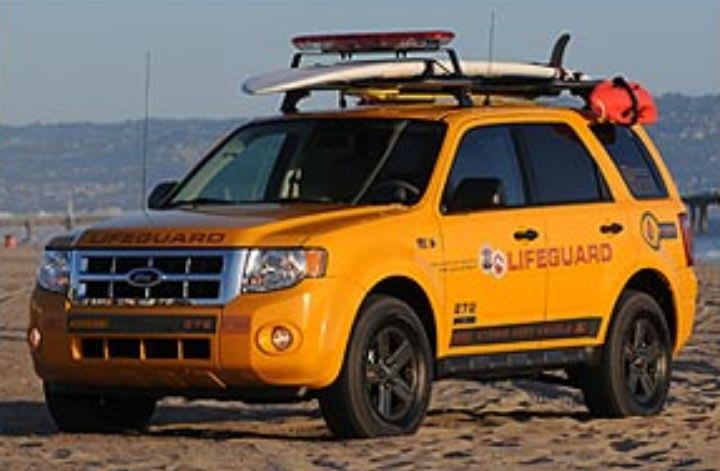
LOS ANGELES – Ford Motor Company teamed up with the Los Angeles County Lifeguards, a division of the Los Angeles County Fire Department, to help save lives while protecting the environment. Ford has presented the squad with the first 10 of a fleet of 45 eco-friendly Escape Hybrids with intelligent four-wheel-drive, specially equipped for use on rescue patrol along 72 miles of Southern California coastline.
"We are the largest lifeguard organization in the world, and we have always blazed the trail for the profession," said Mike Frazer, chief, Lifeguard Services, Los Angeles County Fire Department. "We wanted to be the first public safety agency in the country to go green."
The front-wheel-drive Ford Escape Hybrid returns 34 mpg in city driving and 30 mpg on the highway. Intelligent four-wheel-drive models, like the ones used by the lifeguards, return 29 mpg city and 27 highway.
Frazer said he knew that the Escape Hybrid was an ideal choice from an environmental standpoint, but he admits to having some initial reservations about whether an SUV would function as well on the beach as the compact pickup trucks the lifeguards were used to driving.
"The switch from a pickup to an SUV was something new to us, but when Ford brought the Escape Hybrid down to the beach, we were amazed at how well it performed," he said, adding that he was particularly surprised by the vehicle's ability to navigate through the sand without getting stuck.
With the Escape Hybrid, Frazer said he was also able to make more precise turns, enjoy extra headroom (he's 6'5") and gain greater visibility, which is a huge safety plus on the beach.
The Ford designers decided to remove 60 percent of the rear seat on the driver's side and replace it with a rescue equipment storage unit — an aluminum box with specially designated spaces for important emergency equipment, such as defibrillators, trauma boxes, and oxygen tanks. The remaining 40 percent of the seat was left intact in case the lifeguards had to transport someone, such as a lost child.
Ford designers also outfitted the Escape Hybrids with a custom-fit roof rack for the lifeguards' paddle board and spine board, and easy-to-clean rubber floor mats, and cargo liners.
When it came to the exterior, it was important to make the vehicle look "fresh but not trendy." The vehicles were painted a vibrant yellow — iconic for lifeguards — and then detailed with authoritative graphics and finished off with dark wheels.
More Safety

Tips for Driving Safely on Halloween Night
This video features a reminder from the Connecticut Department of Transportation (DOT) and the Connecticut Police Chiefs Association, urging drivers to prioritize safety this Halloween.
Read More →
IIHS Crash Avoidance Tests Reveal Safety Gaps in Cargo Vans and Work Trucks
New IIHS crash avoidance ratings show uneven performance among cargo vans and heavy-duty pickups, with most struggling to avoid vehicle-to-vehicle collisions.
Read More →
What’s Next for Fleet? Safety, AI & Industry Recognition | AF News Recap
Could your company's culture be encouraging distracted driving? This week, we're exploring how workplace expectations affect driver safety, what AI, EVs, and autonomous vehicles could mean for the future of fleet management, and how fleet professionals can strengthen their award nominations.
Read More →
Does Your Fleet's Culture Encourage Distracted Driving?
What happens when the people responsible for enforcing safety rules are the ones setting the wrong example? The answer may reveal why some of the biggest risks to fleet drivers have little to do with what's written in the employee handbook.
Read More →
Fleet Manager’s Ultimate Playbook: Navigating the New Standard in OEM Connectivity
Rising operating costs, driver safety concerns, and unplanned downtime are putting unprecedented pressure on modern fleets. Discover how fleet managers use embedded OEM connectivity and real-time vehicle data to cut TCO, prevent downtime, and protect drivers without aftermarket telematics hardware.
Read More →
From Driver Well-Being to EV Charging | AF News Recap
Mental health belongs in the fleet safety conversation. This week, we’re looking at five ways fleets can support employee well-being before a crisis, plus Holman’s expansion in Mexico, new one-day Fleet Forward passes, and why EV charging demand is outpacing infrastructure growth.
Read More →
Nexar-Nauto Merger Aims to Give Fleets Better Safety Intelligence Through Larger Driving Dataset
Stefan Heck tells Automotive Fleet that combining more than 10 billion miles of driving history with Nexar's AI models will give fleets deeper insights into driver risk and roadway conditions than either company could provide independently.
Read More →
Don't Wait for a Crisis: 5 Ways to Build Mental Health Into Your Fleet Safety Program
For Suicide Prevention Month, fleet and safety leaders have an opportunity to put mental health where it belongs: at the center of workplace safety.
Read More →
How Camera Data Can Strengthen a Fleet’s Insurance Renewal
Insights from a commercial insurance carrier and a broker show how fleets can turn video telematic data, driver coaching, and improved claims results into a stronger case at insurance renewal.
Read More →
The Safest Fleets Aren’t the Ones with the Most Technology
You’ve made the telematics investment. Here’s how to capture the other half of its value and build the safest fleet on the road.
Read More →