




In a story in The New York Times, Ford Motor Company released documents Sunday indicating that Bridgestone/Firestone began receiving numerous complaints of injuries and property damage involving certain Firestone tires that were not recalled until last Wednesday. Some of the recalled tires have rates of injury up to 100 times greater than the tires not recalled, yet Ford maintains that no notification was received from the tiremaker indicating the problems with the tires. Two-thirds of the tires in question equip many of Ford’s new vehicles, particularly the Explorer. Ford discovered the higher rates though its own computer analysis of the data sent by Bridgestone, and Bridgestone allegedly resisted the release of the analysis. The analysis also revealed that the tires in question mainly were produced at Bridgestone’s facility in Decatur, IL, which had experienced quality problems from 1994 through 1996. During that time, a labor dispute prompted Bridgestone to use replacement workers. Bridgestone officials did not take issue with Ford’s data but said the problem had not caught their attention until Ford began reviewing its files two weeks ago. According to Bridgestone, the overall rate of complaints from all its factories has not been unusually high, and it does not conduct the detailed, factory-specific analysis performed by Ford. Previously the two companies had enjoyed one of the oldest relationships among American businesses, as Firestone, purchased by Bridgestone in 1988, has supplied tires to Ford since 1906. Ralph Hoar, a cofounder of the consulting firm Safetyforum.com, which is coordinating lawsuits against the two companies, maintains that Ford is trying to obscure a defect in the design of the Explorer’s suspension which strains tires, a charge which Ford denies.
Ford Claims Bridgestone/Firestone Was Aware of Flaw in Its Tires by 1997
More Operations

BBL Fleet Acquires Velcor Leasing Corporation
BBL Fleet expanded its footprint in the fleet management industry with the acquisition of Velcor Leasing Corporation of Madison through a stock purchase agreement finalized Feb. 27, 2026.
Read More →
Lytx Introduces New AI Fleet Technologies at Protect 2026
The company introduced new AI-driven fleet safety and operations technologies during its annual user conference.
Read More →
Fleet Costs Are Rising: Here’s How Leaders Are Responding
Fleet leaders are under pressure to reduce costs, adapt to economic uncertainty, and make smarter decisions. See how peers across North America are responding with real data, proven strategies, and forward-looking insights. Download the 2026 Market Pulse Report to benchmark your strategy and uncover where you can gain an edge.
Read More →
From Waffle House to AI: Fleet Trends You Need to Know
In this AF news recap, host Faith Howell covers how Waffle House stepped up during disaster response and new AI tech on the market.
Read More →
Fleet Operations in the Age of AI: Navigating Ethical and Legal Challenges
AI is no longer a future concept for fleets—it’s already embedded in the tools, data, and decisions that operators rely on every day. In this episode of the Fleet Forward Podcast, recorded live at Fleet Forward, industry leaders take the conversation beyond hype to examine what responsible AI adoption really looks like in fleet operations.
Read More →
Factory Installed vs. Aftermarket: Choosing the Right Telematics Path & Managing the Data
As fleets rethink how they capture, manage, and act on vehicle data, telematics is at a major inflection point. In this episode of the Fleet Forward Podcast, we dive deep into one of the most pressing questions facing fleet leaders today: Should you rely on OEM factory-installed connectivity, aftermarket devices, or a hybrid of both?
Read More →
What Real-Time Data Reveals About EV Cost, Performance, and Scalability
Experts from telematics analytics, fleet-as-a-service operations, and national EV benchmarking share how real-time data is reshaping fleet strategy—dispelling assumptions, validating best practices, and exposing costly missteps.
Read More →
Planning Through Policy Shifts: What Fleets Must Track in 2026
A powerhouse panel featuring experts from the American Automotive Leasing Association, CalSTART, and municipal fleet leadership dives into the realities of navigating shifting emissions rules, regulatory waivers, federal agency actions, the future of the EPA’s endangerment finding, and the push for unified standards. They also examine the impacts of tariffs, autonomous vehicle policy, battery innovation, and the accelerating global EV market.
Read More →
Managing Market Turbulence with Strategic Fleet Insights
This episode kicks off with a deep dive into the technologies and market forces reshaping today’s fleet landscape. Host Chris Brown is joined by Laolu Adeola (Leke Services), Tyson Jomini (J.D. Power), and Richard Hall (ZappiRide) to break down real-world data, shifting incentives, and practical strategies fleet leaders can use right now.
Read More →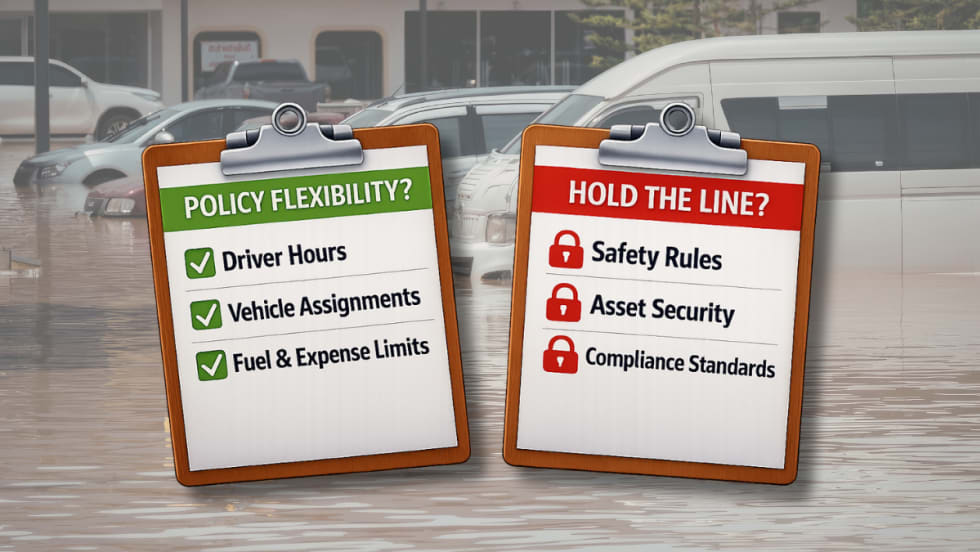
Adapting Fleet Policy When Disasters Strike
In the middle of natural disasters fleet managers must shift priorities to protect people and assets. What policy items should be loosened, and when should the line be held?
Read More →