




Related Photos: Ford Trucks Through the Years
Ford Celebrates 100 Years of Work Trucks
Ford is celebrating the centennial of its first purpose-built truck, the 1917 Model TT, which eventually led to the company producing many iconic work trucks, including the F-Series that has been the best-selling truck lineup for 35 years.
by Staff
July 27, 2017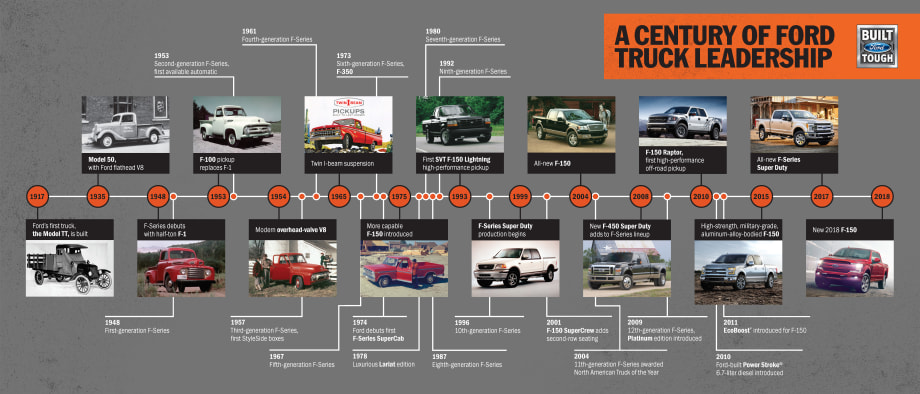
Timeline courtesy of Ford.
3 min to read
Timeline courtesy of Ford.
Ford is celebrating the centennial of its first purpose-built truck, the 1917 Model TT, which eventually led to the company producing many iconic work trucks, including the F-Series that has been the best-selling truck lineup for 35 years.
Henry Ford launched the Model TT nine years after his Model T sedan to provide a vehicle that could haul heavier loads and provide greater utility for work and deliveries, according to a Ford release. When it was introduced on July 27 of that year, it used the Model T cab and engine, but added a heavier-duty frame that could carry a 1 ton payload.
Ford sold 209 Model TT trucks in 1917 for $660 per vehicle.
At the time, Ford wanted a chassis that could accommodate third-part beds, cargo areas, and other add-ons that increased functionality for work. By 1928, Ford has sold 1.3 million Model TTs, when the company replaced the truck with the Model AA that offered a 1.5-ton chassis.
Henry Ford marketed his early trucks heavily in rural areas, said Bob Kreipke, Ford's historian.
"Model AA trucks in particular had a certain class to them," he said. "Customers could use them on the farm, yet still take them to church on Sunday."
In 1933, Ford replaced the Model AA with the Model BB that could be outfitted as a mail or freight vehicle, ambulance, or stake truck. Two years later, Ford introduced the Model 50 pickup that was powered by Ford's Flathead V-8 engine.
By 1941, Ford has sold more than 4 million trucks. The company shifted to war production and began building heavy-duty military trucks and four-wheel-drive personnel carriers.
Ford introduced its F-Series Bonus Built trucks in 1948, which offered vehicles with a range of capability from classes 2-7. The F-1 pickup was the entry model, while the F-8 arrived as a cabover. The F-1 became the F-100, while the F-2 and F-3 became the F-250. F-4 became the F-350. The Class 8 trucks were spun off into a new C-Series commercial truck unit that produced six lines, including C-, H-, L-, N-, T-, and W-Series models.
Ford began offering more features to the utilitarian trucks. In 1953, the F-100 came with armrests, dome lights, and sun visors. The truck came with integrated front fenders, a lower and wider cab, and a more aerodynamic design. In 1957, Ford tested a car-based truck known as the Falcon Ranchero.
Ford introduced the fourth-generation F-Series in 1961 with Ford's I-beam front suspension. An upscale Ranger package appeared in 1967. Ford trucks now offered power steering and brakes and a lower chassis profile. A larger SuperCab option introduced in 1974 was designed to attract dual-purpose work and family buyers.
The sixth-generation F-Series, in 1975, shed the F-100 model for the higher-capacity F-150 to better compete with General Motors' C/K trucks. In 1977, a copywriter came up with the model's now-familiar slogan, Built Ford Tough.
Ford began offering premium models in 1978 with the Lariat package, which added air conditioning, leather trim, and power windows and locks. 1982 brought Ford's compact Ranger pickup. The nameplate has been revived for 2019, seven years after it was discontinued.
Ford introduced its F-Series Super Duty trucks in 1998 for heavy-duty work use. The F-250 to F-750 provided a growing number of commercial applications.
The first EcoBoost V-6 debuted for 2011, and in 2015 Ford debuted an F-150 with a military-grade aluminum body. Two years later, Super Duty trucks arrived with aluminum-alloy bodies and reinforced frames to increase towing and hauling.
The 2017 model year also brought a redesigned Raptor, an off-road performance variant of the F-150 that has been used by the Border Patrol and several other law enforcement fleets.
"Ford trucks have carried the loads, the people and the products necessary to get the job done," Kreipke said.
More Operations

How Fleets Can Recruit and Train Veterans for Technician Roles
Here's how the technician shortage has affected uptime for fleets, and what to do about it.
Read More →
Avis Budget Group Deploys Neology Toll Management Technology Across Major Brands
Neology’s neoFleet platform will manage toll transactions and toll-authority operations for vehicles across Avis, Budget, Payless, Budget Truck and Zipcar.
Read More →
Fleet Personal-Use Charges Edge Higher in 2026
Nearly eight in 10 surveyed fleets allow personal use of company vehicles, while just over half of respondents report charging employees for the privilege.
Read More →
The Future of Fleet + What’s Changing Right Now | AF News Recap
Could developments overseas offer a preview of what’s coming for U.S. fleets? This week, we’re looking at the future of AI, autonomy, and electrification, plus Ford Pro’s new certified pre-owned program, smarter vehicle offboarding, and a new way for fleets to manage toll expenses.
Read More →
How to Handle Vehicle Offboarding
What do fleet managers need to do when a driver leaves?
Read More →
Sponsored•October 1, 2026
Fleet Manager’s Ultimate Playbook: Navigating the New Standard in OEM Connectivity
Rising operating costs, driver safety concerns, and unplanned downtime are putting unprecedented pressure on modern fleets. Discover how fleet managers use embedded OEM connectivity and real-time vehicle data to cut TCO, prevent downtime, and protect drivers without aftermarket telematics hardware.
Read More →
U.S. Bank Adds Verra Mobility Toll Management to Voyager Fleet Platform
The integration allows U.S. Bank Voyager fleet customers to manage toll payments and violations alongside fuel, EV charging and maintenance expenses.
Read More →
ADAS Prevents Crashes. But Repairs Cost More | AF News Recap
ADAS-equipped vehicles may crash less often, but they can cost more when they do. This week, we’re breaking down what that tradeoff means for fleets, plus Subaru’s first Forester Wilderness Hybrid, Nissan’s new e-POWER Rogue, and why Calstart has become Catalyst Mobility.
Read More →
Moventum Fleet Management Names Mark Iorillo Head of Sales
Iorillo brings nearly 20 years of fleet management and sales experience to the role, including previous positions at Element Fleet Management, CEI, Donlen and Ryder.
Read More →
Fleet Has a Talent Pipeline Problem. What Comes Next? | AF News Recap
Where will fleet’s next generation of leaders come from? This week, we’re looking at the industry’s talent pipeline, what certification can add to a fleet career, how to build an award-worthy track record, and the return of Automotive Fleet’s Personal Use Survey.
Read More →