




Ford Boosts Ranger Production in Mich.
Ford will invest $1.2 billion in three Michigan facilities to support production of the Bronco and Ranger, build an advanced data center, and add jobs for autonomous and electrified vehicles, the company announced.

Photo courtesy of Ford.
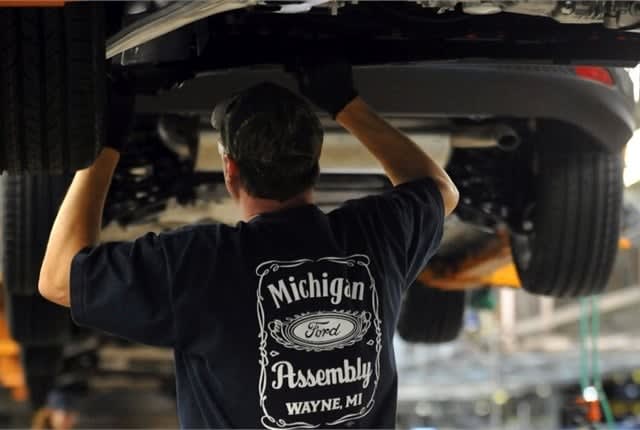
Photo courtesy of Ford.
Ford will invest $1.2 billion in three Michigan facilities to support production of the Bronco and Ranger, build an advanced data center, and add jobs for autonomous and electrified vehicles, the company announced. About $350 million of that is new investment.
Ford will invest $850 million in the Michigan Assembly Plant in Wayne to retool the plant to build the Ranger mid-size pickup and Bronco SUV. Ford will begin building the Ranger at the end of 2018 and the Bronco in 2020. The plant now builds the Focus and C-Max.
Ford will begin transforming the plant in May of 2018. The plant will be shut down for four weeks to remove and reinstall tooling needed to build the Ranger and Bronco.
Ford will also invest $150 million in the Romeo Engine Plant to expand capacity to support the Ranger and Bronco. The plant produces 6.2L V-8 engines for Super Duty trucks and the E-450 cutaway van.
Ford is also investing $200 million to develop an advanced data center at the Flat Rock Assembly Plant to support the company's expansion to an auto and mobility company. It would be the second Ford data center in Michigan. Ford has already announced it will invest $700 million in the Flat Rock plant and add 700 jobs. The plant now builds the Mustang and Lincoln Continental.
More Operations

Fleet Has a Talent Pipeline Problem. What Comes Next? | AF News Recap
Where will fleet’s next generation of leaders come from? This week, we’re looking at the industry’s talent pipeline, what certification can add to a fleet career, how to build an award-worthy track record, and the return of Automotive Fleet’s Personal Use Survey.
Read More →
Smith System Launches Driver Risk Management Program
Fleets have more driver data than ever, but identifying risky behavior doesn't necessarily correct it. Smith System's new Driver Risk Management program combines monitoring, training, and follow-up coaching to help fleets connect risk signals with driver intervention.
Read More →
Automotive Fleet Opens 2026 Personal Use Survey for Commercial Fleet Managers
Less than two weeks left! Commercial and corporate fleet managers are invited to share how their organizations handle company vehicle personal-use policies, charges, and driver eligibility.
Read More →
From AI Prompts to AI-Generated Safety Songs | AF News Recap
Can better prompts make AI more useful for fleet managers? This week, we’re breaking down smarter fleet analysis, an AI-assisted experiment that turned safety training into music, and what happened to fuel prices in August.
Read More →
How to Write Better AI Prompts for Fleet Analysis
Include these six elements in your fleet prompts to generate more relevant analysis and accurate answers.
Read More →
Fleet Meets: Eric Kilgore
This edition of the Fleet Meets series features one of the industry's best leaders driving multi-market and national operations.
Read More →
Why Reactive Fleet Management Is Becoming Too Expensive to Sustain
Research highlights a growing need for proactive management strategies to address rising costs in fleet operations effectively.
Read More →
What Your Fleet KPIs Aren’t Telling You
Tracking fleet metrics is only useful when the data leads to better decisions. This guide helps fleet leaders assess cost, utilization, and downtime more accurately, identify performance gaps, and prioritize the actions that can improve operational results.
Read More →
Hidden in Plain Sight: Fleet Compliance Risks
Fleet compliance isn't just about having policies — it's about consistently enforcing them. This practical guide reveals six hidden compliance risks common in public sector and shared fleet operations and outlines proven strategies to improve visibility, accountability, and audit readiness
Read More →
Turning Fleet Payment Data into Executive Insights
Does data alone drive results in operations?
Read More →