Automotive Fleet
MenuMENU
SearchSEARCH

Ford and Southern California Edison Partner on Plug-In Hybrid

DETROIT -- Ford Motor Co. and Southern California Edison will team up to test rechargeable hybrid vehicles in an effort to speed up mass production of the new technology.

by Staff
July 10, 2007
Ford and Southern California Edison Partner on Plug-In Hybrid

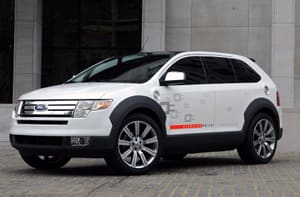
The Ford Edge with HySeries(TM) Drive is the world's first drivable fuel-cell hybrid-electric vehicle with plug-in capability. (CP/HO/Ford)

3 min to read


DETROIT -- Ford Motor Co. and Southern California Edison will team up to test rechargeable hybrid vehicles in an effort to speed up mass production of the new technology, according to the Web site, www.knbc.com.

The utility, which serves 13 million people in 11 central, coastal and Southern California counties outside Los Angeles, will get a Ford plug-in hybrid vehicle by the end of 2007 and as many as 20 by some time in 2009 to test durability, range and impact on the power grid, said Susan M. Cischke, Ford senior vice president for sustainability, environment and safety engineering.

Ad Loading...

Ford Chief Executive Alan Mulally and other company executives planned to be in California on Monday to make the announcement, which Cischke says is a unique partnership between a power provider and an automaker that should help bring plug-in hybrids to market more quickly.

Plug-in hybrids generally have batteries that power an electric motor, with an internal combustion engine for use when the batteries run low. The batteries can be recharged by plugging them into a standard wall outlet.

Southern California Edison will help Ford by placing the cars with consumers and collecting data, Cischke said in an interview with the Associated Press.

“They have the wire-side knowledge about the grid and all the issues there,” she said. “By partnering with these two industries ... we're hoping to accelerate the commercialization and certainly drive some of the cost issues down.”

Power shortages have been an issue in Southern California Edison's highly populated service area. The company is under a state mandate to build five power plants that would fire up during peak energy use periods. The plants would help avoid projected energy shortages.

Ad Loading...

Many automakers have plug-in hybrids similar to Ford's experimental vehicles, but mass production has been held back by cost and battery technology that limits the vehicle’s range. Manufacturers are racing to bring the technology to market as consumers seek alternatives to the internal combustion engine and high gasoline prices.

"We see electricity itself as an alternative fuel supporting transportation," said John Bryson, chairman of Rosemead, Calif.-based Edison International, parent company of Southern California Edison.

Bryson said the collaboration will allow Ford and the utility to better see how technology tested in the laboratory works in the real world. He said plug-in hybrids have the potential to put the power grid to better use, for example, by charging vehicles in overnight hours when electricity demand is lower.

Ford, Cischke said, already is testing two plug-in hybrids in its Dearborn labs that are based on the Escape small sport-utility vehicle, a model Ford offers as a gas-electric hybrid. Cischke said it's still too early to predict when Ford can mass produce the cars.

"That's one of the reasons for this program; to gather more data and fully understand the customer usage part," Cischke said.


Topics:Operations

More Operations

Cover of a whitepaper titled “The Hidden Costs of Departmentally Assigned Vehicles on Your Fleet” featuring a black fleet vehicle driving on a road at sunset. Subheadline reads: “Discover how your fleet can reduce costs and minimize risk by implementing vehicle sharing.” The document focuses on fleet optimization, vehicle sharing, cost reduction, utilization tracking, and risk management for fleet operations.
SponsoredMay 13, 2026

Why Fleet Managers Are Replacing Departmental Vehicles with Shared Motor Pools

Departmentally assigned vehicles often create hidden costs through underutilization, poor visibility, and increased administrative burden. This white paper explores how shared motor pool strategies help fleets reduce costs, improve accountability, and optimize vehicle utilization.

Read More →
Three team members in shop with Chris
Operationsby Chris BrownMay 12, 2026

Soap Box Derby Challenge: Assembling the Crew

Meet Gabriel, Matthew, and Angel — the team helping bring this soap box derby build to life.

Read More →
Handshake graphic featuring BBL Fleet and Velcor Leasing Corporation logos announcing BBL Fleet’s acquisition of Velcor to expand fleet management services nationwide.
Operationsby News/Media ReleaseMay 8, 2026

BBL Fleet Acquires Velcor Leasing Corporation

BBL Fleet expanded its footprint in the fleet management industry with the acquisition of Velcor Leasing Corporation of Madison through a stock purchase agreement finalized Feb. 27, 2026.

Read More →
Ad Loading...
Graphic reading “What’s New From Lytx at Protect 2026?” over a blue digital network background highlighting Lytx fleet technology and AI-powered safety solutions.
Operationsby News/Media ReleaseMay 6, 2026

Lytx Introduces New AI Fleet Technologies at Protect 2026

The company introduced new AI-driven fleet safety and operations technologies during its annual user conference.

Read More →
Cover image for the “5th Annual Market Pulse Report” by Element titled “Navigating fleet management in 2026: Data and insights shaping the future of fleet and mobility.” The design features an aerial view of a cable-stayed bridge with vehicles traveling on a highway beside a dense green forest. A teal graphic panel overlays the lower portion of the image, with the Element logo and tagline “Intelligence in motion” at the bottom.
SponsoredMay 6, 2026

Fleet Costs Are Rising: Here’s How Leaders Are Responding

Fleet leaders are under pressure to reduce costs, adapt to economic uncertainty, and make smarter decisions. See how peers across North America are responding with real data, proven strategies, and forward-looking insights. Download the 2026 Market Pulse Report to benchmark your strategy and uncover where you can gain an edge.

Read More →
A blue Automotive Fleet graphic representing the weekly AF News Recap series.
Operationsby Faith HowellMay 4, 2026

From Waffle House to AI: Fleet Trends You Need to Know

In this AF news recap, host Faith Howell covers how Waffle House stepped up during disaster response and new AI tech on the market.

Read More →
Ad Loading...
OperationsApril 30, 2026

Fleet Operations in the Age of AI: Navigating Ethical and Legal Challenges

AI is no longer a future concept for fleets—it’s already embedded in the tools, data, and decisions that operators rely on every day. In this episode of the Fleet Forward Podcast, recorded live at Fleet Forward, industry leaders take the conversation beyond hype to examine what responsible AI adoption really looks like in fleet operations.

Read More →
OperationsApril 30, 2026

Factory Installed vs. Aftermarket: Choosing the Right Telematics Path & Managing the Data

As fleets rethink how they capture, manage, and act on vehicle data, telematics is at a major inflection point. In this episode of the Fleet Forward Podcast, we dive deep into one of the most pressing questions facing fleet leaders today: Should you rely on OEM factory-installed connectivity, aftermarket devices, or a hybrid of both?

Read More →
OperationsApril 30, 2026

What Real-Time Data Reveals About EV Cost, Performance, and Scalability

Experts from telematics analytics, fleet-as-a-service operations, and national EV benchmarking share how real-time data is reshaping fleet strategy—dispelling assumptions, validating best practices, and exposing costly missteps.

Read More →
Ad Loading...
OperationsApril 30, 2026

Planning Through Policy Shifts: What Fleets Must Track in 2026

A powerhouse panel featuring experts from the American Automotive Leasing Association, CalSTART, and municipal fleet leadership dives into the realities of navigating shifting emissions rules, regulatory waivers, federal agency actions, the future of the EPA’s endangerment finding, and the push for unified standards. They also examine the impacts of tariffs, autonomous vehicle policy, battery innovation, and the accelerating global EV market.

Read More →