




Fleet Safety Video Tip: Wet Weather Driving
With rain forecast this week for many areas, this is a good time for fleet drivers to review safety measures for wet weather driving.
With showers forecast for the coming week in many areas, now is a good time to remind your fleet drivers of what safety measures they should take during wet weather. Here are 10 tips, culled from AAA materials, which you can pass along.
Make sure your vehicle is ready for the rigors of the rainy season, including good tire tread, firm brakes and streak-free wipers.
Consider practicing reduced-traction driving skills in a safe, secluded area. Remember, conditions are most dangerous during the first 10 minutes of a heavy downpour because oil and debris on the pavement first rise up and then wash away.
Keep windshield, windows and headlights clean to maintain optimal visibility.
To reduce the chances of hydroplaning, you need to slow down, avoid hard braking or turning sharply, and drive in the tracks of the vehicle ahead of you when possible.
Allow ample stopping distance between your vehicle and the vehicles ahead. Increase your following distance and also begin slowing down to stop for intersections, turns and other traffic early.
When turning, make an effort to do these things one at a time: brake, then turn, then accelerate.
If you feel your vehicle beginning to skid, don’t panic. Continue to look and steer in the direction in which you want the vehicle to go. Avoid slamming on the brakes – that will upset the vehicle’s balance further and make it more difficult to control.
Don’t use cruise control in rainy conditions – it can increase your chances of losing control of the vehicle. To prevent loss of traction in wet weather, you may need to reduce the car’s speed by lifting off the accelerator.
If you’re driving in a storm and visibility is so limited you can’t see the edges of the road or other vehicles at a safe distance, it’s time to pull off and wait for the rain to ease up. Try to stop at a rest area or exit the freeway and go to a protected area. If the roadside is your only option, pull off the road as far as you can.
If your vehicle gets stuck in the mud or a soft shoulder, apply power slowly and keep the wheels pointed straight ahead so the vehicle can move in a straight line. If the vehicle can’t move forward, try backing out and steering in the vehicle’s tracks. If that doesn’t work, try rocking your way out. Move forward until the vehicle stops, then shift into reverse and move backwards until momentum stops. Repeat this process, moving ahead a little more each time. Use minimum power to keep the wheels from spinning and digging in deeper. But if rocking doesn’t work and the wheels just spin, find a way to create traction. Try mats, gravel, kitty litter, branches, etc. Shovel a space in front of the drive wheels and spread your materials there. Apply power slowly, using second or low gear.
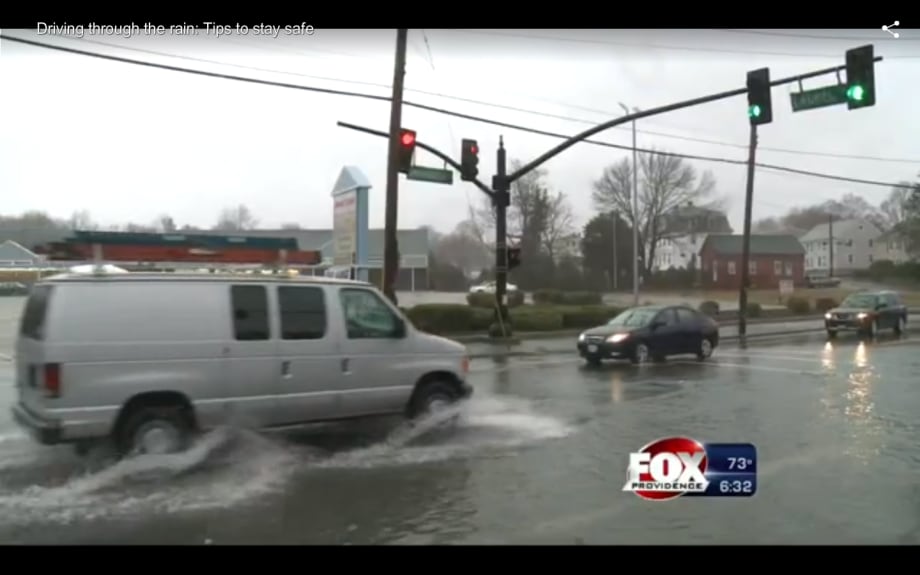
To watch a video offering wet weather driving tips, click on the photo or link above. Fox Providence Eyewitness News speaks with Anthony Ricci, president of Advanced Driving & Security in Rhode Island, for advice.
More Safety

Fleet Manager’s Ultimate Playbook: Navigating the New Standard in OEM Connectivity
Rising operating costs, driver safety concerns, and unplanned downtime are putting unprecedented pressure on modern fleets. Discover how fleet managers use embedded OEM connectivity and real-time vehicle data to cut TCO, prevent downtime, and protect drivers without aftermarket telematics hardware.
Read More →
From Driver Well-Being to EV Charging | AF News Recap
Mental health belongs in the fleet safety conversation. This week, we’re looking at five ways fleets can support employee well-being before a crisis, plus Holman’s expansion in Mexico, new one-day Fleet Forward passes, and why EV charging demand is outpacing infrastructure growth.
Read More →
Nexar-Nauto Merger Aims to Give Fleets Better Safety Intelligence Through Larger Driving Dataset
Stefan Heck tells Automotive Fleet that combining more than 10 billion miles of driving history with Nexar's AI models will give fleets deeper insights into driver risk and roadway conditions than either company could provide independently.
Read More →
Don't Wait for a Crisis: 5 Ways to Build Mental Health Into Your Fleet Safety Program
For Suicide Prevention Month, fleet and safety leaders have an opportunity to put mental health where it belongs: at the center of workplace safety.
Read More →
How Camera Data Can Strengthen a Fleet’s Insurance Renewal
Insights from a commercial insurance carrier and a broker show how fleets can turn video telematic data, driver coaching, and improved claims results into a stronger case at insurance renewal.
Read More →
The Safest Fleets Aren’t the Ones with the Most Technology
You’ve made the telematics investment. Here’s how to capture the other half of its value and build the safest fleet on the road.
Read More →
Hidden in Plain Sight: Fleet Compliance Risks
Fleet compliance isn't just about having policies — it's about consistently enforcing them. This practical guide reveals six hidden compliance risks common in public sector and shared fleet operations and outlines proven strategies to improve visibility, accountability, and audit readiness
Read More →
NETS Sets 2026 Fleet Safety Benchmark Conference for Indianapolis
The Sept. 15–17 program will feature fleet benchmarking data, case studies, emerging technologies, and implementation strategies while running alongside the NSC Safety Congress & Expo.
Read More →
Off-the-Job Crashes Account for 43% of Employers’ $61.7 Billion Crash Burden
NETS quantifies costs dispersed across fleet, risk, HR, and other departments while providing new per-crash benchmarks for employers.
Read More →
Ram Recalls More Than 1.27 Million 1500 Pickups for Seat Belt Anchor Issue
The recall affects certain 2019-2026 Ram 1500 pickups that may have improperly attached second-row seat belt buckle anchors.
Read More →