




Fleet Safety Conference: Leader Behavior Drives Safety Culture
In his opening keynote address at the 2015 Fleet Safety Conference, Shell Global Road Safety Manager Mike Watson describes the controls and leadership necessary to foster a successful corporate safety culture.
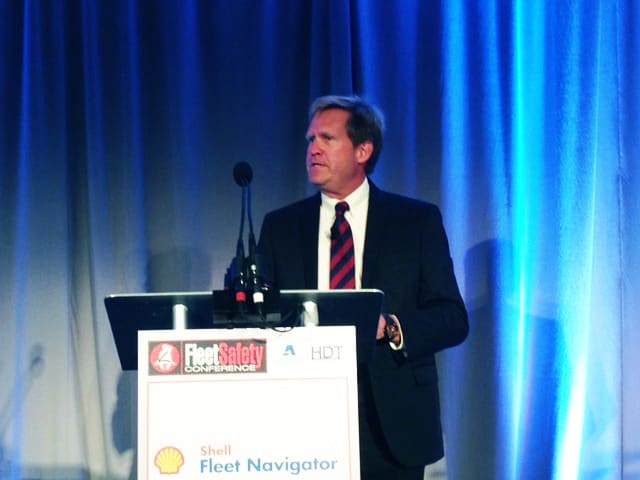
Shell Global Road Safety Manager Mike Watson addresses the 2015 Fleet Safety Conference. Photo by Chris Wolski.
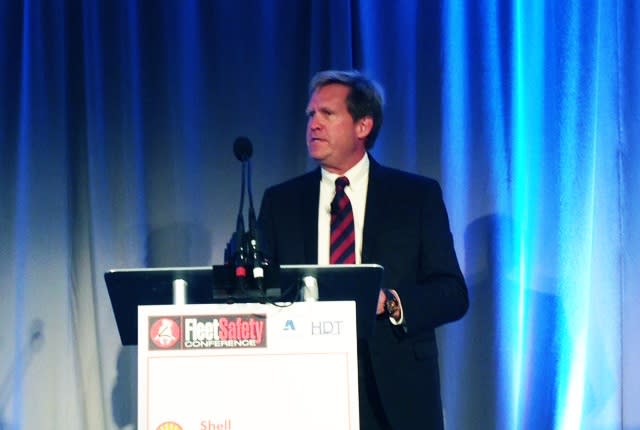
Shell Global Road Safety Manager Mike Watson addresses the 2015 Fleet Safety Conference. Photo by Chris Wolski.
Speaking to a room full of fleet safety professionals, Shell Global Road Safety Manager Mike Watson readily acknowledged the breadth of responsibility that he and his colleagues assume — and the higher standards by which they’re judged.
"Leaders are role models, whether they choose to be or not," he said. "A leader's behavior impacts those around them and creates the culture of the organization."
With the right focus, discipline and shared vision with others, safety leaders can nurture, and continue to strengthen, a corporate safety culture that helps protect employees, contractors and the public. That was one of the messages in Watson’s opening keynote address at the 2015 Fleet Safety Conference.
The Fleet Safety Conference is now under way at the Renaissance Schaumburg Convention Center Hotel in Schaumburg, Ill. Watson gave his presentation about Shell’s corporate safety culture on July 14.
The energy and petrochemical giant is headquartered in the Netherlands. With activities in more than 90 countries, more than 93,000 full-time employees and 450,000 contractors, Shell racks up more than 1.1 billion kilometers traveled annually. The corporation takes a holistic approach to road safety.
Safety is always the company’s top priority, Watson said. This overall effort is known as Goal Zero. The aim is zero fatalities and no incidents that harm people or put neighbors or facilities at risk, Watson said. Company leadership at all levels embraces these goals.
To drive the point home, Watson repeated a quote from Peter Voser, former CEO of Royal Dutch Shell, "Poor safety is nothing more than a lack of leadership."
"If a company is going to have a policy, they better follow it," Watson said. "This is where leadership has to walk the talk."
To foster safety and environmental standards compliance, Shell in 2009 launched its HSSE (health, safety, security, environment) and SP (social performance) control framework. This framework helps ensure compliance among Shell companies, the corporation’s contractors, and joint ventures under Shell’s operational control.
Shell’s holistic approach to road safety is also reflected in the corporation’s road safety management system, 12 life-saving rules, use of in-vehicle monitoring systems, and driver training.
Drivers are prohibited from using the phone while operating a vehicle, exceeding speed limits, and consuming alcohol or drugs while working or driving. They’re also required to wear their seat belts and follow prescribed journey management plans, Watson said.
A single violation might result in employee termination. "This has been our step-change improvement," Watson said.
To further curb risk when necessary, managers can refer to a hierarchy of controls: eliminate the journey, change to a lower risk transportation mode, or apply driver, vehicle and journey controls.
Shell has taken full advantage of technology advances such as in-vehicle monitoring systems (IVMS), which can reduce incidents by 20-30 percent. IVMS also reduces speeding by up to 90 percent, Watson said.
Additionally, these systems can monitor and manage driving hours and rest break regulations. The result is less driver fatigue, Watson said. Shell has made driver fatigue prevention a major focus because drowsiness is a factor in approximately 20 percent of fatal road transport incidents.
Shell driver training focuses on driver behavior and includes instructor-led training as well as e-learning modules.
Safety leaders don’t have an easy job. They can face tough choices when their safety goals become complicated by cost and schedule considerations, Watson said. But committed leadership can dramatically strengthen a corporate safety culture, even under extremely difficult circumstances.
Watson cited Shell’s Pearl GTL (gas-to-liquids) project in Qatar as an example. During construction of the plant, thousands of workers from more than 50 countries were involved. Early risk assessments estimated there could be eight road-related fatalities on the project, Watson said. But management commitment to Goal Zero resulted in a broad range of policies, controls and training to drive safety compliance.
The Pearl GTL project reached 77 million hours without an injury that led to time off work. That achievement represented a record for both Shell and Qatar.
For more information about the Fleet Safety Conference, visit the event page here.
More Safety
IIHS Crash Avoidance Tests Reveal Safety Gaps in Cargo Vans and Work Trucks
New crash-avoidance ratings from the Insurance Institute for Highway Safety reveal inconsistent performance among commercial vehicles, with several popular cargo vans and heavy-duty pickups struggling to avoid collisions with other vehicles and pedestrians.
Read More →
What’s Next for Fleet? Safety, AI & Industry Recognition | AF News Recap
Could your company's culture be encouraging distracted driving? This week, we're exploring how workplace expectations affect driver safety, what AI, EVs, and autonomous vehicles could mean for the future of fleet management, and how fleet professionals can strengthen their award nominations.
Read More →
Does Your Fleet's Culture Encourage Distracted Driving?
What happens when the people responsible for enforcing safety rules are the ones setting the wrong example? The answer may reveal why some of the biggest risks to fleet drivers have little to do with what's written in the employee handbook.
Read More →
Fleet Manager’s Ultimate Playbook: Navigating the New Standard in OEM Connectivity
Rising operating costs, driver safety concerns, and unplanned downtime are putting unprecedented pressure on modern fleets. Discover how fleet managers use embedded OEM connectivity and real-time vehicle data to cut TCO, prevent downtime, and protect drivers without aftermarket telematics hardware.
Read More →
From Driver Well-Being to EV Charging | AF News Recap
Mental health belongs in the fleet safety conversation. This week, we’re looking at five ways fleets can support employee well-being before a crisis, plus Holman’s expansion in Mexico, new one-day Fleet Forward passes, and why EV charging demand is outpacing infrastructure growth.
Read More →
Nexar-Nauto Merger Aims to Give Fleets Better Safety Intelligence Through Larger Driving Dataset
Stefan Heck tells Automotive Fleet that combining more than 10 billion miles of driving history with Nexar's AI models will give fleets deeper insights into driver risk and roadway conditions than either company could provide independently.
Read More →
Don't Wait for a Crisis: 5 Ways to Build Mental Health Into Your Fleet Safety Program
For Suicide Prevention Month, fleet and safety leaders have an opportunity to put mental health where it belongs: at the center of workplace safety.
Read More →
How Camera Data Can Strengthen a Fleet’s Insurance Renewal
Insights from a commercial insurance carrier and a broker show how fleets can turn video telematic data, driver coaching, and improved claims results into a stronger case at insurance renewal.
Read More →
The Safest Fleets Aren’t the Ones with the Most Technology
You’ve made the telematics investment. Here’s how to capture the other half of its value and build the safest fleet on the road.
Read More →
Hidden in Plain Sight: Fleet Compliance Risks
Fleet compliance isn't just about having policies — it's about consistently enforcing them. This practical guide reveals six hidden compliance risks common in public sector and shared fleet operations and outlines proven strategies to improve visibility, accountability, and audit readiness
Read More →