




Fiat Brand to Fill Chrysler’s Small Car Category in U.S.
LOS ANGELES - With the introduction of the Fiat 500 to U.S. shores, the Italian automaker is building its brand presence in the U.S. at the same time it’s bringing a vehicle to market.
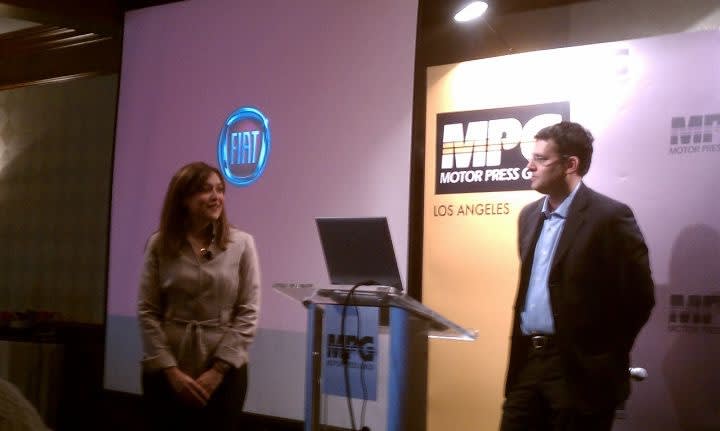
Fiat's Laura Soave and Fabio DiMura, chief engineer for the Fiat 500, provided an overview of how the automaker intends to position the Fiat brand in the US.
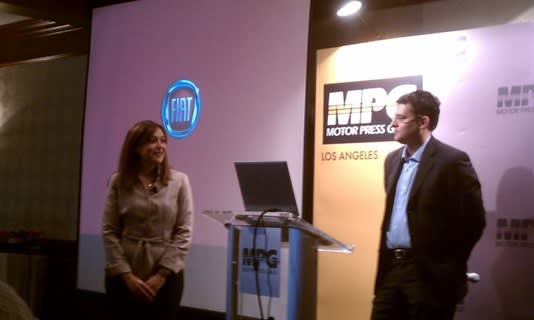
LOS ANGELES – With the introduction of the Fiat 500 to U.S. shores, the Italian automaker is building its brand presence in the U.S. at the same time it’s bringing a vehicle to market. Fiat’s North American head Laura Soave gave a presentation about the 500 and how Fiat intends to market the vehicle in the U.S. at a meeting of the Motor Press Guild in Los Angeles. She said that the Fiat brand will fill Chrysler’s small-car market position in the U.S. In addition, the company reiterated its plan to introduce a fully electric version of the 500 in 2012 to the U.S. marketplace.
With regard to the company's brand strategy, Soave said that at first the 500 will be associated with Fiat in the US, but that as time goes on they intend to separate the two through the introduction of a wider range of small car models.
Currently, the 500 is slated for availability in 37 states and is on its way to the U.S. and Soave said that two cargo ships carrying Fiat 500s are on their way to U.S. shores to fill preorders. The 500 will come in three trim levels, the Pop, Sport, and Lounge, starting at an MSRP of $15,500 for the Pop, $17,500 MSRP for the Sport, and $19,500 MSRP for the Lounge.
Whether the car will succeed in the U.S. marketplace remains to be seen, but Soave said that Fiat has a great deal of experience in the small car market and that a number of other vehicle features are likely to drive sales in the U.S. For fleet managers, the primary features of interest are the 500’s safety characteristics, including seven air bags; fuel economy, MPG of 27 city/34 highway; and customization, including 14 exterior color options and 14 interior seating color options, which could help a fleet manager maintain the company’s or organization’s corporate branding with fewer additional modifications.
Fiat’s Soave and the chief engineer for the Fiat, Fabio DiMura, brought up the 500’s 1.4L MultiAir engine, which comes to the U.S. for the first time in this vehicle, and how it helps the vehicle achieve better fuel economy a new type of intake valve system (which Fiat calls a Fully Variable Valve Actuation, FVVA, system), which replaces a traditional overhead cam with four hydraulic solenoids for instantaneous air-fuel adjustment at any time in the engine cycle to produce the power needed based on driving conditions, which improves engine efficiency.
In addition the MultiAir engine, the 2012 Fiat 500 also features the eco:Drive Application, which collects vehicle data for future analysis by drivers. A user can download this information onto a USB drive via the vehicle’s BLUE&ME USB port. The eco:Drive Application provides a detailed look at emissions, the driver’s driving style, and recommends driving style changes to improve fuel efficiency and reduce emissions.
By Greg Basich
More Operations

Company Vehicle or Reimbursement? How Fleets Are Rethinking Assignments
As fleet costs and insurance pressures rise, fleet managers are taking a closer look at which employees need company-provided vehicles and when a reimbursement program may make more sense.

Fleetio, ASE Launch Scholarship Program for Automotive Technicians
The second annual program will award 15 scholarships totaling $35,000 to support ASE certification, testing fees, and equipment costs.

Reading the Global Signals: What AI and the Energy Transition Mean for Fleets Now
In this opening keynote of the 2026 Fleet Forward Conference, John Rossant, founder of CoMotion, How can fleet managers navigate a never-ending, changing industry landscape?

90% Use Telematics. Are Fleets Getting Safer? | AF News Recap
This week, we're breaking down which industries have the highest rates, how Jamie McKay manages 2,400 vehicles, what's happening with the 2027 fleet awards, and why software-defined vehicles could introduce new costs.

What's Best Handled by an FMC, and What's Better Done Directly?
Fleet managers continue to rely on FMCs for essential services but are taking a closer look at where working directly with suppliers can improve efficiency and responsiveness.

Fleet Meets: Erin Gilchrist
Meet Erin Gilchrist, the inaugural Mike Antich Spirit of Fleet Award winner, as she shares insights on leadership, mentorship, the power of industry connections, and why people remain at the heart of fleet's future.

How 2026 Fleet Visionary Jamie McKay Manages 2,400 Vehicles Across 37 States
How do you keep 2,400 vehicles running across 37 states? Fleet Visionary Award winner Jamie McKay shares how collaboration, flexibility, and a few simple strategies help her tackle fleet management challenges at Aptive Pest Control.

Managing Fleet Costs in an Era of Permanent Volatility
Fleet operating costs have risen more than 20% since 2020, raising a key question: When does extending a vehicle's service life stop making financial sense?

The Next Evolution of Fleet Management: Autonomous Operations
This opening keynote session at the Fleet Forward Conference highlights the future of autonomous driving for fleets.

How to Reduce the Total Cost of Risk From Catalytic Converter Theft
A stolen catalytic converter can cost fleets far more in downtime and lost productivity than in repairs. A total-cost-of-risk approach can help fleet managers quantify their exposure and prioritize theft prevention.