




FedEx Increases Quarterly Profit 23%
Trucking and package delivery giant FedEx Corp. on Wednesday reported a big jump in profit for its fiscal year second quarter.
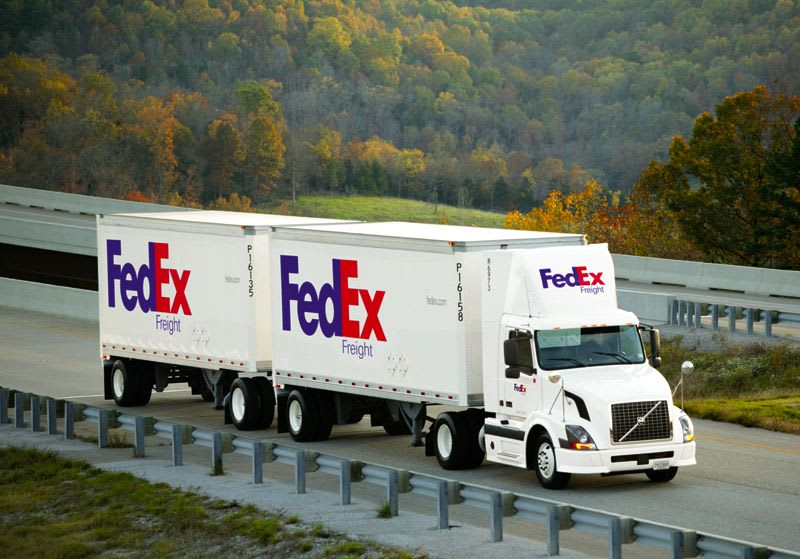
Trucking and package delivery giant FedEx Corp. on Wednesday reported a big jump in profit for its fiscal year second quarter.
The Tennessee-based operation reported net income of $616 million, up 23% from last year’s $500 million, with earnings of $2.14 per diluted share for the second quarter ended November 30, up 36% from last year’s $1.57 per share.
Revenue during the period totaled $11.9 billion, up 5% from $11.4 billion the previous year, while operating income was $1.01 billion, up 22% from $827 million last year.
“FedEx posted strong results and a higher operating margin in the second quarter, with continued growth in volumes and base yields in each of our transportation segments,” said Frederick W. Smith, FedEx Corp. chairman, president and chief executive officer.
Operating income and margin increased primarily due to higher volumes and base yields in all three transportation segments, according to FedEx. Results in the second quarter also included benefits from the company’s profit improvement programs, lower pension expense and a slightly positive net impact from fuel. These benefits were partially offset by higher aircraft maintenance expense due to the timing of aircraft maintenance events.
FedEx also reaffirmed its 2015 earnings forecast of $8.50 to $9.00 per diluted share. The outlook assumes continued moderate economic growth and a modest net benefit from fuel.
For the second quarter of the fiscal year, the company’s trucking operation FedEx Freight segment reported:
Revenue of $1.59 billion, up 11% from last year’s $1.43 billion,
Operating income of $112 million, up 35% from $83 million a year ago an
Operating margin of 7.1%, up from 5.8% the previous year.
Less-than-truckload average daily shipments increased 8%, including a 10% increase in demand for priority service, according to FedEx. LTL revenue per shipment grew 3% due to higher weight per shipment, higher rates and increased fuel surcharges. Operating results improved due to increased LTL revenue per shipment and higher average daily LTL shipments.
The FedEx Express segment reported for the second fiscal year quarter:
Revenue of $7.02 billion, up 3% from last year’s $6.84 billion,
Operating income of $484 million, up 36% from $357 million a year ago and
Operating margin of 6.9%, up from 5.2% the previous year.
Revenue increased due to higher U.S. domestic package volume and international export package base revenue, partially offset by lower fuel surcharges and exchange rates, FedEx said. U.S. domestic package volume grew by 7%, including a 10% increase in U.S. overnight box shipments. U.S. domestic revenue per package declined 2% due to decreased fuel surcharges and lower weight.
For the second fiscal year quarter, the FedEx Ground segment reported:
Revenue of $3.06 billion, up 8% from last year’s $2.85 billion,
Operating income of $465 million, up 6% from $439 million a year ago and
Operating margin of 15.2%, down from 15.4% the previous year.
FedEx Ground average daily volume grew 5% in the second quarter, driven by growth in both business-to-business and FedEx Home Delivery services, according to FedEx. Revenue per package increased 3% due to rate increases and higher residential surcharges.
Operating income increased due to higher revenue per package and volume, partially offset by higher network expansion costs.
More Operations

Here's When You Should Make an Exception to Fleet Policy
Fleet policies are designed to create consistency, but not every driver or situation fits neatly within standard rules.
Read More →
AI-Native or AI-Acquired: What Should Fleet Managers Look for in an AI Platform?
Six questions can help fleet managers look beyond AI marketing claims to evaluate integration, data access, and real-world operational performance.
Read More →
A buyer's guide to fleet management software in 2027
Buying fleet management software in 2027 means looking beyond features and price. As fleet operations, technology and expectations evolve, this guide explores what today’s fleet professionals should consider when choosing a system that can deliver value now and adapt to what comes next.
Read More →

What Will Shape the Next Era of Fleet Management?
EVs, AI, and autonomous vehicles are reshaping fleet management. Discover what’s ahead—and how fleet leaders can prepare for the next era.
Read More →
How Fleets Can Recruit and Train Veterans for Technician Roles
Here's how the technician shortage has affected uptime for fleets, and what to do about it.
Read More →
Avis Budget Group Deploys Neology Toll Management Technology Across Major Brands
Neology’s neoFleet platform will manage toll transactions and toll-authority operations for vehicles across Avis, Budget, Payless, Budget Truck and Zipcar.
Read More →
Fleet Personal-Use Charges Edge Higher in 2026
Nearly eight in 10 surveyed fleets allow personal use of company vehicles, while just over half of respondents report charging employees for the privilege.
Read More →
The Future of Fleet + What’s Changing Right Now | AF News Recap
Could developments overseas offer a preview of what’s coming for U.S. fleets? This week, we’re looking at the future of AI, autonomy, and electrification, plus Ford Pro’s new certified pre-owned program, smarter vehicle offboarding, and a new way for fleets to manage toll expenses.
Read More →
How to Handle Vehicle Offboarding
What do fleet managers need to do when a driver leaves?
Read More →
Fleet Manager’s Ultimate Playbook: Navigating the New Standard in OEM Connectivity
Rising operating costs, driver safety concerns, and unplanned downtime are putting unprecedented pressure on modern fleets. Discover how fleet managers use embedded OEM connectivity and real-time vehicle data to cut TCO, prevent downtime, and protect drivers without aftermarket telematics hardware.
Read More →