




EVAOS Showcases F-150 Multi-Mode Hybrid
NORTH HILLS, CA – Green Fleet had an opportunity to check out a hybrid-electric version of the Ford F-150 from EVAOS (Electric Vehicle Add-On Systems).
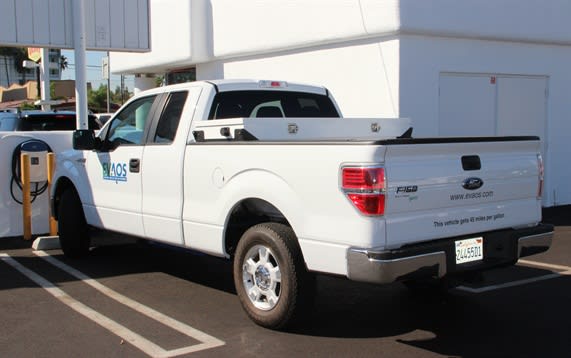
The EVAOS EV add-on system will be available initially for F-150, F-250, and F-350 Ford pickup trucks.
NORTH HILLS, CA – Green Fleet editors had an opportunity to check out the latest technology from EVAOS (Electric Vehicle Add-On Systems) — a hybrid-electric version of the Ford F-150.
The Santa Clara, Calif.-based startup company — founded by Don Matheson, former Tesla Motors director of engineering operations — is conducting demonstrations of its new system for fleet operators in the Los Angeles area this week as part of its Green Fleet Demo Tour. The pre-production model was on site Sept. 24-26 at the Galpin Ford dealership in North Hills, Calif.
Designed to double the fuel mileage of a regular gasoline-powered model while providing the power and towing capability of a diesel truck, vehicles equipped with the add-on system can achieve 45 mpg and travel up to 900 miles on a single tank of gasoline — positioning it to meet CAFE requirements through 2016 and beyond, according to the company.
EVAOS’ approach leaves the original engine, transmission, and electronic control system (ECM) unmodified. “We don’t touch the OEM engine and transmission,” according to Darrell Musick, VP of sales and marketing.
The company’s hybrid-electric system allows a straightforward installation that will be handled by any number of truck outfitters, upfitters, dealers, service shops, and fleet maintenance departments trained and certified by EVAOS. Basic installation will take about eight hours and doesn’t require any specialized tools, Musick said.
The EVAOS EV add-on system will be available initially for F-150, F-250, and F-350 Ford pickup trucks; however, the system’s interchangeability makes it flexible enough to work with any OEM. Matheson said the F-150 was selected for the initial model based on its proven sales record in the U.S. and because a hybrid version wasn’t currently offered in Ford’s truck lineup.
Inside, a flip-up touchscreen tablet allows drivers to select one of the vehicle’s multi-modes (hybrid, all-electric, ICE). The multiple operating modes provide fleets “the best of all worlds,” Musick said. “The operator selects the mode which best meets the needs of a given route.”
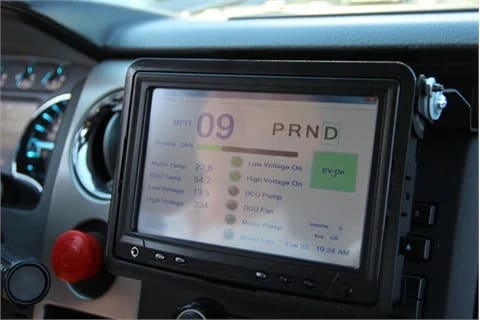
A flip-up touchscreen tablet allows drivers to select one of the vehicle’s multi-modes (hybrid, all-electric, ICE).
Outside, three electrical outlets (a 110V, 220V, and 12V USB port) are located on the side of the box that contains the batteries. All outlets are lockable and include a metal cover. The battery pack can be recharged from any Level 2 EV charging station or while in operation, with regenerative braking available. The vehicle also has a Re-Gen Mode that allows the battery to be recharged while driving.
The EVAOS system can be installed on the F-150, F-250, and F-350 models, starting at $38,000.
The company is planning to build six to eight units and is so far working with several fleets in California.
Click here to view a photo gallery of the EVAOS F-150.
By Grace Suizo, photos by Lauren Fletcher
More Green Fleet

EV Charging Use Is Outpacing Infrastructure Growth
ChargePoint’s 2026 Charging Forward Report points to rising charger use, higher-powered charging, commercial vehicle electrification, and energy-management technology. Here’s what fleets should know.
Read More →
Merchants Fleet Reports 290M EV Miles as Fleets Navigate Changing Electrification Market
From millions in operating savings to hundreds of millions of EV miles, Merchants Fleet’s latest report reveals what’s working and what’s changing in fleet electrification.
Read More →
The EV Breakdown Nobody's Talking About: Why Most Electric Vehicle Roadside Calls Aren't Mechanical Failures
Here's why EV breakdowns are widely misunderstood.
Read More →
ChargePoint Now Available in Energy Pass
ChargePoint and additional planned charging network integrations were added to GM's Energy Pass.
Read More →

First Look: Slate Auto's Electric Fleet Pickup
Could an affordable, modular EV pickup make electrification more practical for fleets?
Read More →
Slate Debuts Colorful, Unique EV Models
A recent media and client event, studded with electric vehicles dressed up on platforms, planted a new position for the manufacturer in the wider EV market. Fleets will find cost-saving advantages.
Read More →
Slate Electric SUV, Pickup Switchable Model Aims For Light-Duty Fleets
Everything about this EV is counterintuitive and understated, making it stand out from the crowd.
Read More →
Inspiration Mobility Acquires Key Electrada Assets
Inspiration Mobility Group has acquired select assets of Electrada, adding the fleet electrification provider's team, technology, and charging infrastructure development capabilities to its energy management business.
Read More →
Turning Connected Vehicle Data Into Decisions That Matter
Fleet leaders have more data than ever, but turning that data into clear, actionable decisions remains a challenge. This white paper shows how leading organizations are using connected vehicle data to improve safety, reduce costs, and optimize fleet performance. Learn how to turn insight into action across your fleet.
Read More →