




Errata: Ram ProMaster Commercial Van
A listing for the 2014 Ram ProMaster Commercial Van was inadvertently omitted from Automotive Fleet’s Advanced Fleet 2014 Planning Guide, which ran as a supplement to the July 2014 issue of Automotive Fleet.
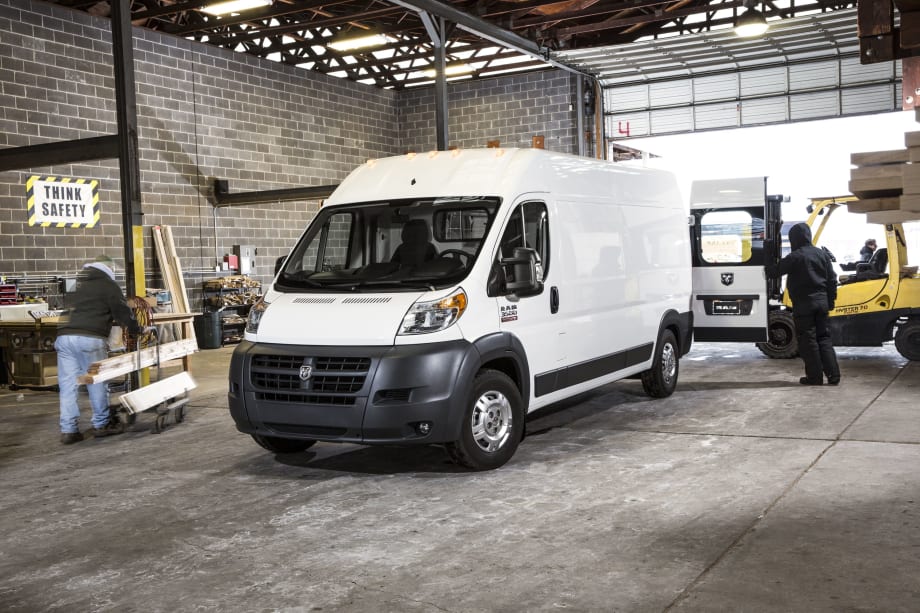
The 2014 Ram ProMaster. Photo courtesy Chrysler.
The 2014 Ram ProMaster. Photo courtesy Chrysler.
A listing for the 2014 Ram ProMaster Commercial Van was inadvertently omitted from Automotive Fleet’s Advanced Fleet 2014 Planning Guide, which ran as a supplement to the July 2014 issue of Automotive Fleet.
Conceived and developed in a first-ever shared truck collaboration with Fiat Professional in Italy and assembled at Ram’s Saltillo Commercial Truck Assembly Plant in Saltillo, Mexico, the ProMaster includes a 3.6L Pentastar V-6 rated at 280 hp with a peak torque of 258 lb.-ft. The 2014 Ram ProMaster marks the North American introduction of a 174-hp 3.0L inline four-cylinder EcoDiesel engine, which generates peak torque of 295 lb.-ft. at just 1,400 rpm. The engine includes a number of refinements, including internal engine components, turbo, and emissions controls.
The ProMaster features two transmission options: the 62TE automatic transmission and the M40 automated manual transmission (which is exclusive to the 3.0L EcoDiesel). The trailer/tow program comes standard with the 62TE automatic transmission.
The ProMaster offers two roof heights (90 inches and 101 inches), three wheelbases (118 inches, 136 inches, and 159 inches), and four body lengths (195 inches, 213 inches, 236 inches, and 250 inches).
Additionally, the ProMaster offers both a chassis cab and cutaway from the factory. The van’s segment-exclusive front-wheel-drive system and its unibody frame architecture make the van signficantly lighter than others in its segment, according to Ram.
The ProMaster can achieve a payload capacity up to 5,145 lbs. and a maximum towing capacity up to 5, 100 lbs. The GCWR is 11,500 lbs. for the 3.6L V-6 and 12,500 lbs. for the 3.0L I-4 EcoDiesel.
The ProMaster also features more than 35 active and passive safety and security features. It also includes standard electronic stability control (ESC), hosting a number of technologies such as trailer-sway control. The ProMaster features a ParkView backup camera and ParkSense with audible warning, all of which are useful when maneuvering a large van.
Production of the ProMaster recently commenced at the Saltillo, Mexico, production facility. The ProMaster is currently available for fleet orders.
More Operations

Fleet Has a Talent Pipeline Problem. What Comes Next? | AF News Recap
Where will fleet’s next generation of leaders come from? This week, we’re looking at the industry’s talent pipeline, what certification can add to a fleet career, how to build an award-worthy track record, and the return of Automotive Fleet’s Personal Use Survey.
Read More →
Smith System Launches Driver Risk Management Program
Fleets have more driver data than ever, but identifying risky behavior doesn't necessarily correct it. Smith System's new Driver Risk Management program combines monitoring, training, and follow-up coaching to help fleets connect risk signals with driver intervention.
Read More →
Automotive Fleet Opens 2026 Personal Use Survey for Commercial Fleet Managers
Less than two weeks left! Commercial and corporate fleet managers are invited to share how their organizations handle company vehicle personal-use policies, charges, and driver eligibility.
Read More →
From AI Prompts to AI-Generated Safety Songs | AF News Recap
Can better prompts make AI more useful for fleet managers? This week, we’re breaking down smarter fleet analysis, an AI-assisted experiment that turned safety training into music, and what happened to fuel prices in August.
Read More →
How to Write Better AI Prompts for Fleet Analysis
Include these six elements in your fleet prompts to generate more relevant analysis and accurate answers.
Read More →
Fleet Meets: Eric Kilgore
This edition of the Fleet Meets series features one of the industry's best leaders driving multi-market and national operations.
Read More →
Why Reactive Fleet Management Is Becoming Too Expensive to Sustain
Research highlights a growing need for proactive management strategies to address rising costs in fleet operations effectively.
Read More →
What Your Fleet KPIs Aren’t Telling You
Tracking fleet metrics is only useful when the data leads to better decisions. This guide helps fleet leaders assess cost, utilization, and downtime more accurately, identify performance gaps, and prioritize the actions that can improve operational results.
Read More →
Hidden in Plain Sight: Fleet Compliance Risks
Fleet compliance isn't just about having policies — it's about consistently enforcing them. This practical guide reveals six hidden compliance risks common in public sector and shared fleet operations and outlines proven strategies to improve visibility, accountability, and audit readiness
Read More →
Turning Fleet Payment Data into Executive Insights
Does data alone drive results in operations?
Read More →