Automotive Fleet
MenuMENU
SearchSEARCH

Electrified Fleets Could Save 37-44% in Energy Costs

A white paper from AMPLY Power quantifies the vast cost savings in fuel, health effects, and pollution in the 25 largest U.S. metro areas.

August 4, 2021
Electrified Fleets Could Save 37-44% in Energy Costs

The environmental benefits of these efforts can fortify the economic benefits, where each fleet transition can substantially reduce carbon into the atmosphere. For each 15-vehicle fleet that transitions to electrification, AMPLY has uncovered that as many as two million kilograms of CO2 emissions can be avoided.

Graphic: AMPLY Power

3 min to read


Government agencies, school districts, and private fleet operators alike are all seeking solutions to save on fuel costs while reducing greenhouse gas emissions.

AMPLY Power, a provider of charge management services and software for fleets, on Aug. 3 released its 2021 white paper, Managed Charging Accelerates Cost and Health Benefits of EVs, assessing the cost saving potential of transitioning to an electric vehicle (EV) fleet in the top 25 U.S. metro areas.

Ad Loading...

The white paper also examines the correlation between the effects of local pollution from fossil fuel fleets and the economics of transitioning to zero emission fleets, with the potential of avoiding $72 billion in adverse health effects, according to a news release summarizing the white paper.

The white paper uses AMPLY’s proprietary dollar per gallon-equivalent (DPGe) metric, which is the dollars needed to drive an EV the same number of miles compared to an internal combustion engine (ICE) vehicle, expressed in a per gallon basis and adjusted for city-specific electricity rates structures and vehicle efficiencies.

In all of the top 25 metro areas, a charge management system (CMS) can offer EV fleets savings of up to 83% compared to diesel and unmanaged electric fleet charging operations. AMPLY developed an interactive DPGe map which directly compares these different fueling types.

Findings of the DPGe calculation across the top 25 U.S. Metros reveal the following for different fleet vehicle types:

  • In 22 metros, powering light-duty vehicles with electricity is 44% cheaper than fueling with gasoline.

  • In all 25 of the top 25 U.S. metros, electric power is 43% cheaper than gasoline for medium-duty vehicles.

  • In 24 of the Top 25 U.S. Metros, electric charging is 37% cheaper than diesel to fuel heavy-duty fleets.

  • In all 25 of the top 25 U.S. metros, switching from diesel to electricity for city bus fleets reveals a cost savings of 63%.

“In order to give a more complete picture of the costs involved for fleets considering the transition to electric, we expanded our study this year to include community health and medical expense impacts,” said Vic Shao, CEO and founder of AMPLY Power, in the news release. “The findings and implications of this assessment should influence how fleet managers, electric utilities, policymakers, and regulators think about electric vehicle fleets in their businesses, states, or regions.”

The environmental benefits of these efforts can fortify the economic benefits, where each fleet transition can substantially reduce carbon into the atmosphere. For each 15-vehicle fleet that is electrified, AMPLY has uncovered that up to two million kilograms of CO2 emissions can be avoided.

Ad Loading...

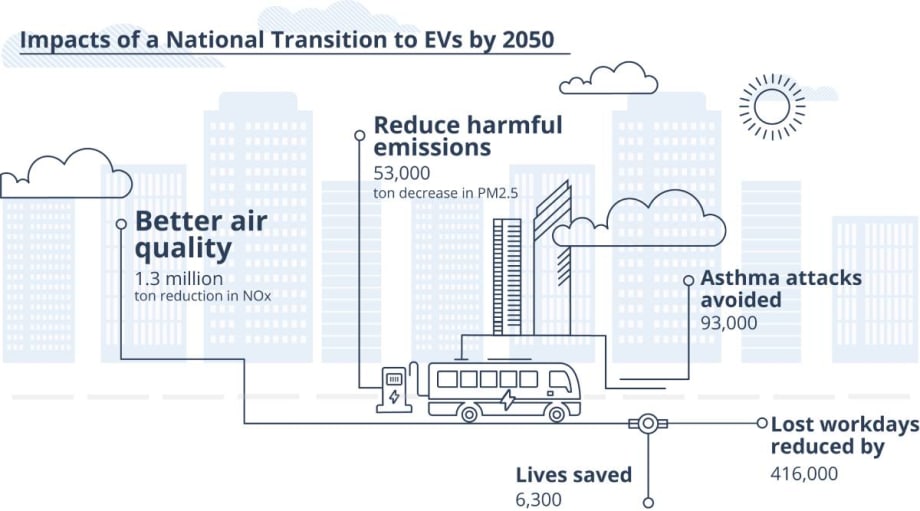
Widespread electrification has positive health impacts on frontline communities.  As an example, working with data from The Journal of Allergy and Clinical Immunology, AMPLY’s analysis indicates an economic impact of $.01 per vehicle mile travelled (VMT) in the cost of treating children affected by traffic-related asthma for Los Angeles County. Further, the white paper points out that a national transition to electric vehicles could produce emission reductions by 2050 that equate to $72 billion in avoided health effects, which can be attributed to a 1.3 million ton decrease in NOx and a 53,000 ton decrease in PM2.5.

“Our DPGe results show there is real economic value to electrifying vehicle fleets, but that value must be understood in locational- and operational-specific terms,” Shao said. “Because there is still variability due to utility rate structures and peak charging windows, fleets need to consider a managed charging approach so that energy and electric fleet operating costs can be significantly reduced.”

AMPLY Power supports fleets as they consider switching to electric vehicles. Recently, AMPLY unveiled its initiative to transition all California customers, including Tri Delta Transit, Solano County Transit, Palermo Union School District and Anaheim Transportation Network, to 100% renewable energy. Additionally, AMPLY partnered with Duke Energy earlier this year to assist in delivering clean electricity for customers using a patent-pending solar canopy mount. In 2021 alone, the company has made strides toward promoting the adoption of fleet electrification with their partnerships with UES, U.S. Gain, BYD, and CPower.


Originally posted on Charged Fleet

More Operations

A blue Automotive Fleet graphic representing the weekly AF News Recap series.
Operationsby Faith HowellMay 4, 2026

From Waffle House to AI: Fleet Trends You Need to Know

In this AF news recap, host Faith Howell covers how Waffle House stepped up during disaster response and new AI tech on the market.

Read More →
OperationsApril 30, 2026

Fleet Operations in the Age of AI: Navigating Ethical and Legal Challenges

AI is no longer a future concept for fleets—it’s already embedded in the tools, data, and decisions that operators rely on every day. In this episode of the Fleet Forward Podcast, recorded live at Fleet Forward, industry leaders take the conversation beyond hype to examine what responsible AI adoption really looks like in fleet operations.

Read More →
OperationsApril 30, 2026

Factory Installed vs. Aftermarket: Choosing the Right Telematics Path & Managing the Data

As fleets rethink how they capture, manage, and act on vehicle data, telematics is at a major inflection point. In this episode of the Fleet Forward Podcast, we dive deep into one of the most pressing questions facing fleet leaders today: Should you rely on OEM factory-installed connectivity, aftermarket devices, or a hybrid of both?

Read More →
Ad Loading...
OperationsApril 30, 2026

What Real-Time Data Reveals About EV Cost, Performance, and Scalability

Experts from telematics analytics, fleet-as-a-service operations, and national EV benchmarking share how real-time data is reshaping fleet strategy—dispelling assumptions, validating best practices, and exposing costly missteps.

Read More →
OperationsApril 30, 2026

Planning Through Policy Shifts: What Fleets Must Track in 2026

A powerhouse panel featuring experts from the American Automotive Leasing Association, CalSTART, and municipal fleet leadership dives into the realities of navigating shifting emissions rules, regulatory waivers, federal agency actions, the future of the EPA’s endangerment finding, and the push for unified standards. They also examine the impacts of tariffs, autonomous vehicle policy, battery innovation, and the accelerating global EV market.

Read More →
OperationsApril 30, 2026

Managing Market Turbulence with Strategic Fleet Insights

This episode kicks off with a deep dive into the technologies and market forces reshaping today’s fleet landscape. Host Chris Brown is joined by Laolu Adeola (Leke Services), Tyson Jomini (J.D. Power), and Richard Hall (ZappiRide) to break down real-world data, shifting incentives, and practical strategies fleet leaders can use right now.

Read More →
Ad Loading...
Clipboards with flooded cars in background.
Disaster Responseby Chris BrownApril 30, 2026

Adapting Fleet Policy When Disasters Strike

In the middle of natural disasters fleet managers must shift priorities to protect people and assets. What policy items should be loosened, and when should the line be held?

Read More →
OperationsApril 24, 2026

EV Reality Check: How Fleets Are Managing Policy Shifts, Safety, and Scaling Challenges

In this episode, fleet leaders from municipal, university, and private-sector organizations share a candid EV reality check. From infrastructure setbacks and policy whiplash to grant funding, total cost of ownership, and charging resiliency, this conversation dives into what it actually takes to scale electrification in the real world.

Read More →
2019 Automotive Fleet Hall of Fame inductees Joe LaRosa Bob Miesen Bud Morrison Theresa Ragozine portraits
Operationsby StaffApril 21, 2026

Fleet Hall of Fame Honorees Through the Years

A running list of the fleet industry’s most influential leaders, recognized for their lasting impact on commercial fleet management.

Read More →
Ad Loading...
Operationsby Chris BrownApril 20, 2026

2026 Salary Survey: Six-Figure Fleet Manager Salaries Become the Norm

After a decade of lagging compensation, fleet manager pay is climbing. But expanding responsibilities, larger fleets, and growing complexity continue to redefine the role.

Read More →