




DOT Issues Emergency Declaration for Commercial Vehicles Delivering Coronavirus Relief
In a historic first, the Federal Motor Carrier Safety Administration issued a national emergency declaration to provide hours-of-service regulatory relief to commercial vehicle drivers transporting emergency relief in response to the nationwide coronavirus (COVID-19) outbreak.

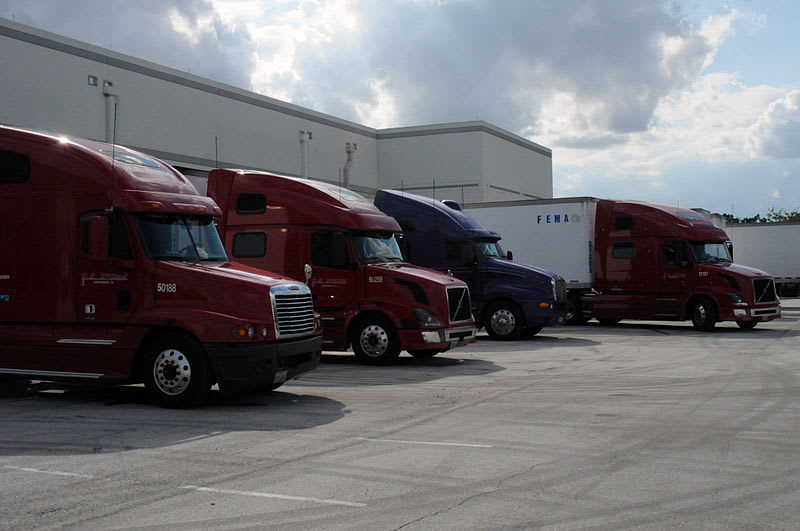
Commercial drivers delivering supplies needed for the COVID-19 get relief from hours-of-service rules under the emergency declaration.
Photo via Wikimedia, George Armstrong/FEMA Photo Library.
In a historic first, the Federal Motor Carrier Safety Administration issued a national emergency declaration to provide hours-of-service regulatory relief to commercial vehicle drivers transporting emergency relief in response to the nationwide coronavirus (COVID-19) outbreak.
Such emergency declarations previously have been issued for state or regional emergencies such as hurricanes or drought, but FMCSA officials confirmed to us that this is the first time a national declaration like this has been issued.
FMCSA’s declaration provides for regulatory relief for commercial motor vehicle operations providing direct assistance supporting emergency relief efforts intended to meet immediate needs for:
Medical supplies and equipment related to the testing, diagnosis and treatment of COVID-19.
Supplies and equipment, including masks, gloves, hand sanitizer, soap and disinfectants, necessary for healthcare worker, patient and community safety, sanitation, and prevention of COVID-19 spread in communities.
Equipment, supplies, and food for emergency restocking of stores.
Persons necessary for establishment and management of temporary housing and quarantine facilities related to COVID-19.
Persons designated by federal, state or local authorities for transport for medical, isolation or quarantine purposes.
Personnel to provide medical or other emergency services.
The emergency declaration stipulates that once a driver has completed his or her delivery, the driver must receive a minimum of 10 hours off duty if transporting property, and eight hours if transporting passengers.
The transportation attorneys at Scopelitis note that, "Importantly, the exemption does not cover routine commercial deliveries or transportation of mixed loads that include essential supplies, equipment and persons, along with supplies, equipment and persons that are not being transported in support of emergency relief efforts related to the COVID-19 outbreaks."
To read FMCSA’s national emergency declaration, visit here.
Some states are implementing additional measures.
Michigan: The Michigan Department of Transportation announced Sunday that the department will exempt motor carriers and drivers providing direct assistance in support of relief efforts related to the COVID-19 outbreaks from seasonal weight restrictions. Direct assistance according to MDOT means transportation and other relief services provided by a motor carrier or its driver to the immediate restoration of essential services, such as medical care, or essential supplies such as food, related to COVID-19 outbreaks during the emergency.
MissourI: The Missouri Department of Transportation on March 15 announced an allowance for heavier-than-normal truckloads of supplies and equipment to travel on Missouri highways in the direct effort to prevent, contain, mitigate and treat the effects of the COVID-19 virus. The waiver allows private and for-hire motor carriers to haul up to 10% more than their licensed weight on Missouri highways and remains in effect through April 30.
Ohio: Hours of service rules have been suspended for motor carriers providing intrastate transportation of relief supplies — including consumer goods and medical supplies — as part of the Coronavirus/COVID-19 response. “Unless otherwise directed, drivers must keep a written or electronic copy of this notice in each vehicle affected by this grant of regulatory relief. This regulatory relief will not apply to vehicles that do not have a copy of this notice.”
Texas: In Texas, three sets of statutes are suspended, subject to federal law and DMV safety limitations:
The oversize and overweight permitting requirements under Transportation Code, Chapters 621 through 623, as well as Title 43, Chapter 219 of the Texas Administrative Code, for all divisible and non-divisible vehicles and loads;
The International Registration Plan (IRP) vehicle registration under Transportation Code § 502.091 and 43 Tex. Admin. Code § 217.56, as long as the vehicle is registered in one of the 48 contiguous states of the United States; and
The 72-hour and 144-hour temporary registration permits under Transportation Code § 502.094 and 43 Tex. Admin. Code § 217.40(b)(3), as long as the vehicle is registered in one of the states of the United States.
Originally posted on Work Truck Online
More Operations

Fleet Has a Talent Pipeline Problem. What Comes Next? | AF News Recap
Where will fleet’s next generation of leaders come from? This week, we’re looking at the industry’s talent pipeline, what certification can add to a fleet career, how to build an award-worthy track record, and the return of Automotive Fleet’s Personal Use Survey.
Read More →
Smith System Launches Driver Risk Management Program
Fleets have more driver data than ever, but identifying risky behavior doesn't necessarily correct it. Smith System's new Driver Risk Management program combines monitoring, training, and follow-up coaching to help fleets connect risk signals with driver intervention.
Read More →
Automotive Fleet Opens 2026 Personal Use Survey for Commercial Fleet Managers
Less than two weeks left! Commercial and corporate fleet managers are invited to share how their organizations handle company vehicle personal-use policies, charges, and driver eligibility.
Read More →
From AI Prompts to AI-Generated Safety Songs | AF News Recap
Can better prompts make AI more useful for fleet managers? This week, we’re breaking down smarter fleet analysis, an AI-assisted experiment that turned safety training into music, and what happened to fuel prices in August.
Read More →
How to Write Better AI Prompts for Fleet Analysis
Include these six elements in your fleet prompts to generate more relevant analysis and accurate answers.
Read More →
Fleet Meets: Eric Kilgore
This edition of the Fleet Meets series features one of the industry's best leaders driving multi-market and national operations.
Read More →
Why Reactive Fleet Management Is Becoming Too Expensive to Sustain
Research highlights a growing need for proactive management strategies to address rising costs in fleet operations effectively.
Read More →
What Your Fleet KPIs Aren’t Telling You
Tracking fleet metrics is only useful when the data leads to better decisions. This guide helps fleet leaders assess cost, utilization, and downtime more accurately, identify performance gaps, and prioritize the actions that can improve operational results.
Read More →
Hidden in Plain Sight: Fleet Compliance Risks
Fleet compliance isn't just about having policies — it's about consistently enforcing them. This practical guide reveals six hidden compliance risks common in public sector and shared fleet operations and outlines proven strategies to improve visibility, accountability, and audit readiness
Read More →
Turning Fleet Payment Data into Executive Insights
Does data alone drive results in operations?
Read More →