




DOT Awards Nearly $800 Million for Transportation Infrastructure Projects
Secretary of Transportation Anthony Foxx announced on Sept. 7 that almost $800 million in inaugural FASTLANE federal grants has been awarded to 18 transportation infrastructure projects in 15 states and the District of Columbia.

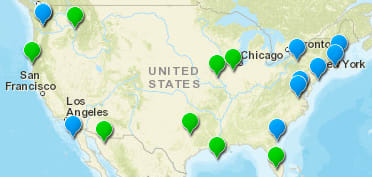
Map indicates location of 18 infrastucture projects awarded FASTLANE grants for FY 2016. Image: U.S. DOT

Map indicates location of 18 infrastucture projects awarded FASTLANE grants for FY 2016. Image: U.S. DOT
Secretary of Transportation Anthony Foxx announced on Sept. 7 that almost $800 million in inaugural FASTLANE federal grants has been awarded to 18 transportation infrastructure projects in 15 states and the District of Columbia.
In a call with reporters, Secretary Foxx said the grants will be combined with other funding from federal, state, local, and private sources “to support $3.6 billion in infrastructure investment.”
The FASTLANE grant program was established by the Fixing America’s Surface Transportation (FAST) Act highway bill passed late last year.
The program is administered by DOT’s newly launched Build America Bureau. Per DOT, the bureau will streamline credit and grant opportunities while providing technical assistance and encouraging best practices in project planning, financing, delivery, and monitoring of transportation infrastructure projects.
“The FAST Act gave us a set of tools to begin addressing America’s infrastructure deficit, and we have been moving full speed ahead to get critical road, rail, and port projects off the ground across the country,” said Foxx. “From eliminating traffic bottlenecks and enhancing port capacity to overhauling a major freight corridor, the 18 inaugural FASTLANE grants will enable people and goods to move more efficiently.”
Among the projects that are receiving grants through the inaugural batch of FASTLANE awards are:
The Atlantic Gateway project in Virginia is a corridor approach to improving mobility across the Eastern seaboard. Combining a $165 million FASTLANE grant with public and private funding from multiple partners, DOT said it will improve and expand key segments of the corridor.
The Oklahoma Department of Transportation will be awarded $62 million to improve safety and efficiency of high-volume freight traffic along the US 69/75 corridor in southern Oklahoma. The project will implement grade separations, remove railroad/local street crossing conflicts, and increase speeds to increase mobility.
The ArizonaDepartment of Transportation will be awarded $54 million for bottleneck improvements along I-10 between Phoenix and Tucson. To increase driver safety, new dust storm early warning technology will also be installed along I-10.
The Maine Department of Transportation will be awarded $7 million to improve the infrastructure, equipment, and technology at the Port of Portland. With improvements to the access and connectivity, the Port upgrades will replace truck shipments from Canada via congested interstates.
Foxx said that FASTLANE grant recipients were selected through a review process to identify projects that will have “significant regional and national impacts by reducing congestion, expanding capacity, using innovative technology, improving safety, or moving freight more efficiently.”
FASTLANE grants will address many of the challenges outlined in DOT’s Beyond Traffic report, including increased congestion on the nation’s highways and the need for a strong multimodal transportation system to support the expected growth in freight movement both by ton and value, Foxx noted.
DOT said it awarded these 18 Fiscal Year 2016 grants, in the amounts noted, to the following entities to make improvements to:
Interstate 10 Phoenix to Tucson Improvements Arizona Department of Transportation Pinal County, Arizona, Rural Amount: $54,000,000
SR-11 Segment 2 and Southbound Connectors California Department of Transportation and San Diego Association of Governments San Diego County, California, Urban Proposed Grant Amount: $49,280,000
Arlington Memorial Bridge Reconstruction Project National Park Service and District of Columbia Department of Transportation District of Columbia, Urban Amount: $90,000,000
Port of Savannah International Multi-Modal Connector Georgia Ports Authority Savannah, Georgia, Urban Amount: $44,000,000
I-10 Freight Corridor Rehabilitation and Expansion (CoRE) Louisiana Department of Transportation and Development Lafayette, Louisiana, Rural Amount: $60,000,000
Conley Terminal Intermodal Improvements and Modernization Massachusetts Port Authority (MASSPORT) Boston, Massachusetts, Urban Amount: $42,000,000
I-390/I-490/Route 31 Interchange, Lyell Avenue Corridor Project New York State Department of Transportation Town of Gates, New York, Urban Amount: $32,000,000
US 69/75 Bryan County Oklahoma Department of Transportation Calera, Oklahoma, Rural Amount: $62,000,000
Atlantic Gateway: Partnering to Unlock the I-95 Corridor Virginia Department of Transportation Commonwealth of Virginia, Urban Amount: $165,000,000
South Lander Street Grade Separation and Railroad Safety Project City of Seattle Seattle, Washington, Urban Amount: $45,000,000
I/39/90 Corridor Project Wisconsin Department of Transportation Janesville, Wisconsin, Rural Amount: $40,000,000
Truck Parking Availability Systems Florida Department of Transportation State of Florida, Rural (Small Project) Amount: $10,778,237
Cedar Rapids Logistics Park Iowa Department of Transportation Cedar Rapids, Iowa, Rural (Small Project) Amount: $25,650,000
U.S. 95 North Corridor Access Improvement Project Idaho Department of Transportation Kootenai County, Idaho, Rural (Small Project) Amount: $5,100,000
Maine Intermodal Port Productivity Project Maine Department of Transportation Portland, Maine, Rural (Small Project) Amount: $7,719,173
Cross Harbor Freight Program Port Authority of New York and New Jersey Jersey City, New Jersey and New York, New York, Urban (Small Project) Amount: $10,672,590
Coos Bay Rail Line – Tunnel Rehabilitation Project Oregon International Port of Coos Bay Lane, Douglas, and Coos Counties, Oregon, Rural (Small Project) Amount: $11,000,000
Strander Boulevard Extension and Grade Separation Phase 3 City of Tukwila, Washington City of Tukwila, Washington, Urban (Small Project) Amount: $5,000,000
More Operations

Company Vehicle or Reimbursement? How Fleets Are Rethinking Assignments
As fleet costs and insurance pressures rise, fleet managers are taking a closer look at which employees need company-provided vehicles and when a reimbursement program may make more sense.

Fleetio, ASE Launch Scholarship Program for Automotive Technicians
The second annual program will award 15 scholarships totaling $35,000 to support ASE certification, testing fees, and equipment costs.

Reading the Global Signals: What AI and the Energy Transition Mean for Fleets Now
In this opening keynote of the 2026 Fleet Forward Conference, John Rossant, founder of CoMotion, How can fleet managers navigate a never-ending, changing industry landscape?

90% Use Telematics. Are Fleets Getting Safer? | AF News Recap
This week, we're breaking down which industries have the highest rates, how Jamie McKay manages 2,400 vehicles, what's happening with the 2027 fleet awards, and why software-defined vehicles could introduce new costs.

What's Best Handled by an FMC, and What's Better Done Directly?
Fleet managers continue to rely on FMCs for essential services but are taking a closer look at where working directly with suppliers can improve efficiency and responsiveness.

Fleet Meets: Erin Gilchrist
Meet Erin Gilchrist, the inaugural Mike Antich Spirit of Fleet Award winner, as she shares insights on leadership, mentorship, the power of industry connections, and why people remain at the heart of fleet's future.

How 2026 Fleet Visionary Jamie McKay Manages 2,400 Vehicles Across 37 States
How do you keep 2,400 vehicles running across 37 states? Fleet Visionary Award winner Jamie McKay shares how collaboration, flexibility, and a few simple strategies help her tackle fleet management challenges at Aptive Pest Control.

Managing Fleet Costs in an Era of Permanent Volatility
Fleet operating costs have risen more than 20% since 2020, raising a key question: When does extending a vehicle's service life stop making financial sense?

The Next Evolution of Fleet Management: Autonomous Operations
This opening keynote session at the Fleet Forward Conference highlights the future of autonomous driving for fleets.

How to Reduce the Total Cost of Risk From Catalytic Converter Theft
A stolen catalytic converter can cost fleets far more in downtime and lost productivity than in repairs. A total-cost-of-risk approach can help fleet managers quantify their exposure and prioritize theft prevention.