




Related: 3 Reasons AV Fleets Will Proliferate Private Sites First
Defining the Catalysts to Autonomous Adoption
Although most of the headlines today on autonomy are about personal transportation, the key motivators to advancing the technology involve specific applications that reduce high-cost labor and expand connections to services in controlled-speed, fixed-route deployments.
by Joe Moye
January 21, 2020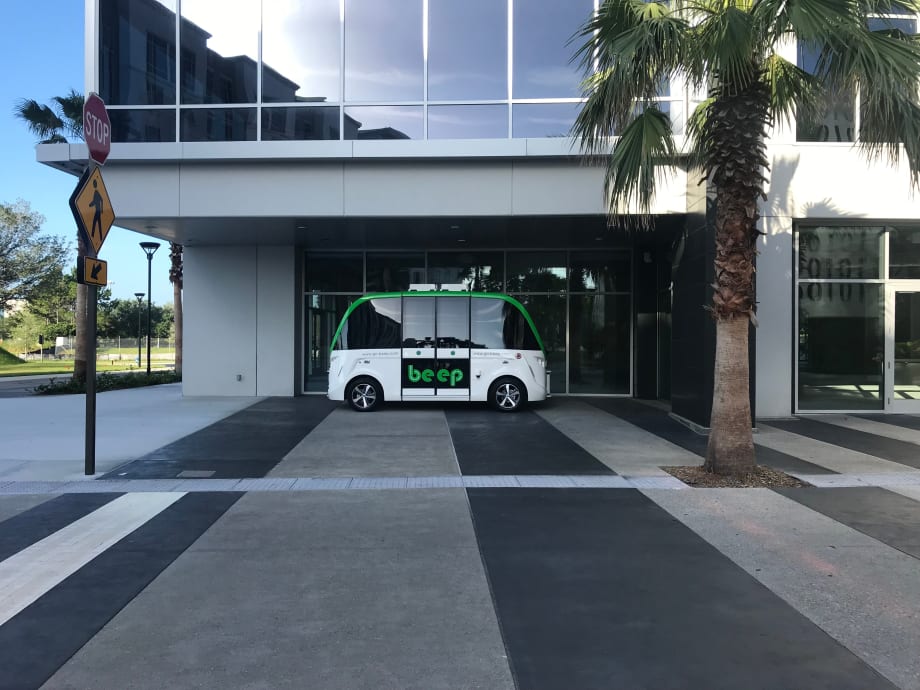
Driverless vehicles and fleets are the disruptors of the transportation industry as we know it today. But the actual “disruption” will happen over time.
Photo courtesy of Bestmile.
4 min to read
For generations, autonomous vehicles have been seen as the de facto mode of transportation for the future, from the iconic Batmobile to The Jetsons and other iconic action movies, cartoons, and television shows.
However, as the future of travel is decidedly pointing to autonomous services, there is still much debate on how the future of mobility and mass transportation will evolve and in what timeframe.
When it comes to autonomous mobility, the term “disruption” often comes to mind. Driverless vehicles and fleets are the disruptors of the transportation industry as we know it today. But the actual “disruption” will happen over time.
We’re still in the early stages of the evolution of this technology. Even the controlled speed, fixed-course autonomous shuttle vehicles are in their infancy as true transportation solutions, with many of today’s deployments being “firsts” for a number of cities and communities.
The initial, regulated deployments that are underway right now are advancing the testing and proof points of safe autonomous mobility. Interacting with pedestrians, mixed traffic, and other surroundings are some of the important learnings to be gained from these deployments that will greatly advance the anywhere, anytime, any-speed autonomous services.
However, the full-scale adoption timeframe to ultimately realize the “robo-taxi” anywhere, anytime, any-speed transportation service is a minimum of a decade away for true autonomous SAE level 5 deployments.
What are the catalysts that will drive these initial deployments to the next levels, and where?
Business Impacts
In addition to fixed-route deployments, there are other autonomous applications such as farm equipment, maritime, highway trucking, package delivery, and industrial equipment that are also important to the testing and perfecting of autonomy.
Each of these use cases are examples where human intervention can be eliminated, and that’s where industry disruption is currently the most prevalent. Although most of the headlines today are about personal transportation, the impact for many businesses will also be substantial.
For example, a report released by Bloomberg in May of 2019 highlights a farmer who estimates he can save 80% on his farm chemical costs through using autonomous equipment. In the transportation of goods, labor represents a large percentage of the cost profile that will be significantly impacted with autonomous solutions.
Another reality driving the transformation of mobility is the need to serve a new generation of riders.
According to recent data released by Deloitte, millennials are less likely to purchase cars than past generations. The data states that 46% of millennials and Gen Z question the benefits of car ownership when rideshare is so easy. They also embrace new technology, making them very well aligned with the future of autonomous vehicles.
Widespread use of new transportation solutions will also help the baby boomer generation, especially for those who have difficulty driving. Connecting residents or constituents with various services through convenient and cost-effective mobility services will be an absolute requirement for attracting and retaining new residents and businesses to all communities.
Safety First
The first question consumers and legislators ask is always around safety. When a vehicle is autonomous, it is a fact that the vehicle does not see and interpret its surroundings today exactly as a human would, and therefore it lacks a certain level of intuition.

Photo courtesy of Beep.
But, on the other hand, autonomous vehicles react to motion and events at a rate of two to three times faster than a human can, and the use of artificial intelligence will continually improve the needed interpretive logic. Most importantly, autonomous vehicles don’t get distracted by their surroundings or mobile devices. Human error and poor judgement are the leading causes of traffic accidents and deaths on our roadways.
There is plenty of research to validate that autonomous vehicles and equipment will dramatically improve safety in all applications. That being said, the immediate, safe use cases such as controlled-speed, fixed-route applications in a controlled environment will be the guidepost for advancing into more complex, faster, and wider spread applications in our communities and towns.
Ultimately, safety will be the key determinant for the timeline of future deployments and expanded use of autonomous transportation solutions.
The future of mobility is here today in the form of autonomous transportation but it will continue to evolve over many years before we are able to experience the George Jetson effect. We believe that autonomous solutions represent one of the most transformational technologies we will see in a lifetime. The use cases will expand and extend into many new transportation services in the coming years to great benefit for businesses and consumers alike.
Joe Moye is CEO of Beep, an Orlando, Fla.-based autonomous mobility solution company. Moye has over 30 years of technology leadership and management consulting experience in both the private and public sectors.
More Fleet Forward

Erin Gilchrist Receives Mike Antich Spirit of Fleet Award
Last week at AFLA in Vegas, Erin Gilchrist received the inaugural, brand-new Spirit of Fleet Award.
Read More →
Dominika Leja Named the 2026 Fleet Manager of the Year
The AstraZeneca associate director of fleet was recognized for her leadership in fleet electrification, cost savings, and operational transformation.
Read More →
Jamie McKay Named the 2026 Fleet Visionary Award Winner
The Aptive Pest Control fleet manager was recognized for her approach to operations, data, lifecycle management, and driver needs.
Read More →
Fleet Forward Conference Introduces One-Day Passes for 2026
New one-day registration gives fleet professionals the flexibility to attend Tuesday, Wednesday, or Thursday, with passes available for $199 through Sept. 18.
Read More →
Vibe Coding: When Fleet Managers Become Software Builders
Five fleet professionals — none with programming skills — discuss how they’re using AI to build fleet solutions in-house and in a fraction of the time.
Read More →
Fleet Forward Conference Tackles Fleet Industry’s Growing Leadership Gap
This session will examine succession planning, knowledge transfer, and the skills the next generation of fleet leaders will need as veteran professionals leave the industry.
Read More →
2026 Fleet Manager of the Year Finalists Announced
Who are the 2026 Fleet Manager of the Year finalists?
Read More →
John Rossant to Deliver Opening Keynote at 2026 Fleet Forward Conference
The CoMotion founder will draw on developments across Europe, China, the Middle East, and other international markets to identify trends that could influence how U.S. fleets plan for the coming decade.
Read More →
How to Build Custom Fleet Tools With AI and Vibe Coding [Webinar]
A new Automotive Fleet webinar explores how fleet managers are using AI and vibe coding to automate routine work and create simple operational tools without traditional programming skills.
Read More →