




Daimler Chrysler announced on September 21 that it will test a plug-in hybrid-electric drive train with an internal combustion engine in its Dodge Sprinter vans in early 2005. Featuring technology spearheaded by the Palo Alto-based Electric Power Research Institute (EPRI), the U.S. test marks the domestic launch of a collaborative venture that will gauge the technological feasibility of such vehicles and monitor market acceptance. The current program includes the design, building and testing of three Sprinter vehicles. One will be a diesel version to be operated by the Kansas City Regional Transit Authority. Two gasoline versions will be fleet-tested by Southern California Edison and South Coast Air Quality Management District. Test, performance and operating data will be captured and reported at the conclusion of this program. Plug-in hybrid vehicles combine an internal combustion engine with an electric motor and rechargeable battery. Both systems operate in parallel, forming an economical and low-emission vehicle. Hybrid power makes it possible to drive vehicles on gas and electric power simultaneously, or on electric power only, thus ensuring zero-emission operations. A hybrid-drive van can provide zero-emission, exceptionally quiet operation when traveling in towns and other emissions-sensitive areas. Other advantages include an unrestricted operating range, thanks to the internal combustion engine, familiar operation, which is largely the same as for a conventional vehicle, and fuel consumption savings of 10-50 percent, depending on the type of operation. The plug-in hybrid system also reduces greenhouse gas emissions and is especially efficient driving in congested, stop-and-go urban traffic. A rechargeable battery provides the electric power for the hybrid drive train. It can be charged through a standard 110- or 220-volt outlet. Running on electricity alone, the Dodge Sprinter will travel up to 20 miles before the engine is needed. The 20-mile range represents 50 percent of all daily travel driven by Americans, who drive on average 12,000 miles annually, EPRI reports. "These EPRI-led studies have shown that plugging in each night at home would save the consumer 50- 75 percent on operating costs," said Ed Kjaer, director of Electric Transportation at Southern California Edison. The plug-in hybrid vans are being manufactured at DaimlerChrysler's Competence Center for Low-emission Commercial Vehicles in Mannheim, Germany. The center's staff is known for its development of alternative propulsion systems, including commercial vehicles operating on natural or liquefied gas and vehicles powered by fuel cells, batteries and hybrid systems. In addition to DaimlerChrysler and EPRI, the Dodge Sprinter hybrid test in the U.S. includes underwriting and research assistance from the Air Quality Management District (AQMD) in California, Southern California Edison, New York Power Authority, the US Department of Transportation, Kansas City Regional Transport Authority as well as technology partners ZF-Sachs and Johnson Controls / VARTA. The Sprinter with plug-in hybrid drive is on display at the 2004 Commercial Vehicle Show in Hanover. The van will be marketed under the Mercedes-Benz brand in Europe and the Dodge brand in the U.S. Additional information and news from DaimlerChrysler is available on the Internet at www.media.daimlerchrysler.com/.
DaimlerChrysler Begins First Plug-in Hybrid Electric Van Demonstration Project in U.S.
Daimler Chrysler announced on September 21 that it will test a plug-in hybrid-electric drive train with an internal combustion engine in its Dodge Sprinter vans in early 2005.
More Operations

BBL Fleet Acquires Velcor Leasing Corporation
BBL Fleet expanded its footprint in the fleet management industry with the acquisition of Velcor Leasing Corporation of Madison through a stock purchase agreement finalized Feb. 27, 2026.
Read More →
Lytx Introduces New AI Fleet Technologies at Protect 2026
The company introduced new AI-driven fleet safety and operations technologies during its annual user conference.
Read More →
Fleet Costs Are Rising: Here’s How Leaders Are Responding
Fleet leaders are under pressure to reduce costs, adapt to economic uncertainty, and make smarter decisions. See how peers across North America are responding with real data, proven strategies, and forward-looking insights. Download the 2026 Market Pulse Report to benchmark your strategy and uncover where you can gain an edge.
Read More →
From Waffle House to AI: Fleet Trends You Need to Know
In this AF news recap, host Faith Howell covers how Waffle House stepped up during disaster response and new AI tech on the market.
Read More →
Fleet Operations in the Age of AI: Navigating Ethical and Legal Challenges
AI is no longer a future concept for fleets—it’s already embedded in the tools, data, and decisions that operators rely on every day. In this episode of the Fleet Forward Podcast, recorded live at Fleet Forward, industry leaders take the conversation beyond hype to examine what responsible AI adoption really looks like in fleet operations.
Read More →
Factory Installed vs. Aftermarket: Choosing the Right Telematics Path & Managing the Data
As fleets rethink how they capture, manage, and act on vehicle data, telematics is at a major inflection point. In this episode of the Fleet Forward Podcast, we dive deep into one of the most pressing questions facing fleet leaders today: Should you rely on OEM factory-installed connectivity, aftermarket devices, or a hybrid of both?
Read More →
What Real-Time Data Reveals About EV Cost, Performance, and Scalability
Experts from telematics analytics, fleet-as-a-service operations, and national EV benchmarking share how real-time data is reshaping fleet strategy—dispelling assumptions, validating best practices, and exposing costly missteps.
Read More →
Planning Through Policy Shifts: What Fleets Must Track in 2026
A powerhouse panel featuring experts from the American Automotive Leasing Association, CalSTART, and municipal fleet leadership dives into the realities of navigating shifting emissions rules, regulatory waivers, federal agency actions, the future of the EPA’s endangerment finding, and the push for unified standards. They also examine the impacts of tariffs, autonomous vehicle policy, battery innovation, and the accelerating global EV market.
Read More →
Managing Market Turbulence with Strategic Fleet Insights
This episode kicks off with a deep dive into the technologies and market forces reshaping today’s fleet landscape. Host Chris Brown is joined by Laolu Adeola (Leke Services), Tyson Jomini (J.D. Power), and Richard Hall (ZappiRide) to break down real-world data, shifting incentives, and practical strategies fleet leaders can use right now.
Read More →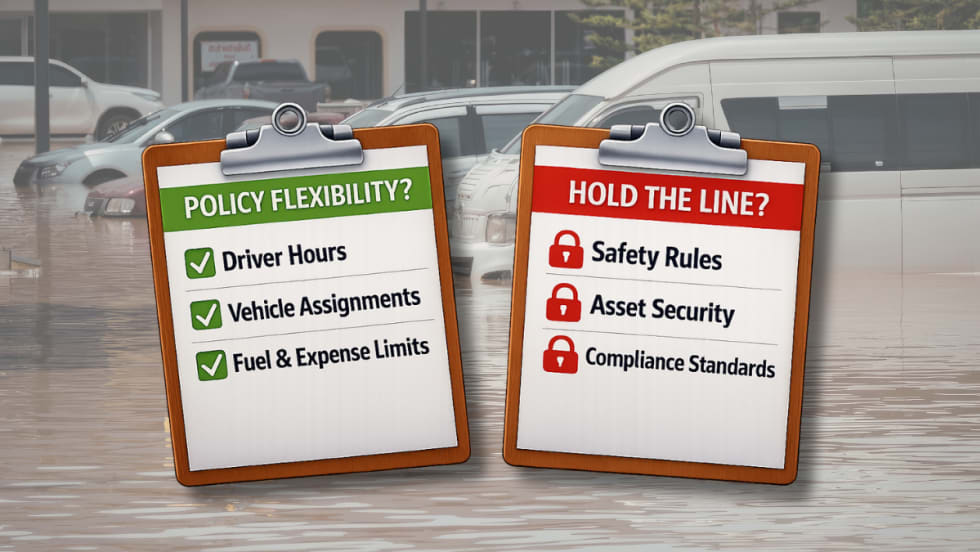
Adapting Fleet Policy When Disasters Strike
In the middle of natural disasters fleet managers must shift priorities to protect people and assets. What policy items should be loosened, and when should the line be held?
Read More →