




Related: Answers to 3 Key Questions on the 2 New Oil Categories
CK-4 and FA-4 Engine Oils on Store Shelves Now, API Says
The organization has licensed about 400 CK-4 oils and more than 60 FA-4 oils submitted by marketers, making the robust new classifications available to operators of new and older diesels.
by Staff
March 31, 2017
3 min to read
The American Petroleum Institute (API) says it has licensed approximately 400 CK-4 oils and more than 60 FA-4 oils submitted by marketers, making the robust new classifications available to operators of new and older diesels.
API expects availability to grow substantially over the next few years as more oil marketers add products meeting the new standards to address the needs of a variety of engine technologies in use both on- and off-highway.
“New API CK-4 and FA-4 oils should be readily available in bulk through diesel oil distributors for trucking fleets and other operators of diesel vehicles,” said Kevin Ferrick, senior manager of API’s Engine Oil Licensing and Certification System. “They are also available in packages through local retailers.”
CK-4 oils are “backward-compatible,” intended for diesels previously using CJ-4 oils, and FA-4 oils are intended for newer engines, typically 2017 model-year and beyond. The upgraded oil specifications have been eligible for licensing since December 1, 2016 and the new oil products also help diesel engine manufacturers meet more stringent emissions requirements.
CK-4’s introduction is long overdue, as CJ-4 oils have been around for more than 10 years while diesels have changed, the institute said. CK-4 provides a number of improvements over CJ-4: improved shear stability, oxidation resistance, and aeration control, as well as protection against catalyst poisoning, particulate filter blocking, engine wear, piston deposits, degradation of low- and high-temperature properties, and soot-related viscosity increase.
FA-4 oils provide similar improvements over CJ-4 oils, but are not backward-compatible. FA-4 oils are intended only for use in newer on-highway diesel engines. The API FA-4 oil standard was developed specifically to provide engine manufacturers with a tool for meeting more stringent greenhouse gas emission standards.
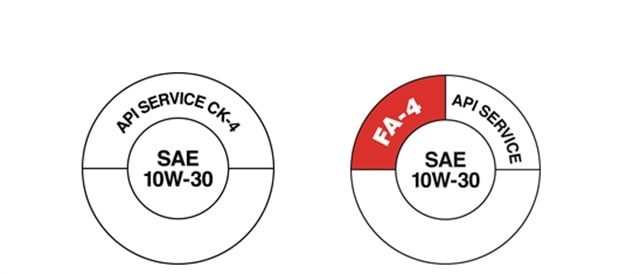
API has also developed a different API Service Symbol “donut” for API FA-4 so that consumers can easily distinguish between CK-4 and FA-4. The new API FA-4 Donut features a shaded section (either black or in color) to differentiate FA-4 oils from CK-4 oils. The CK-4 donut looks the same as the CJ-4 Donut.
With the introduction of the new FA-4 oil category, fleets, shops, and technicians may have to learn how to manage CJ-4, CK-4, and FA-4 oils in their shops. API offers the following suggestions to ensure the new oils are being installed as recommended:
Engine requirements - FA-4 oils may not be recommended for all new engines, so be sure to check with engine manufacturers to find out which engines are supposed to use FA-4 oil.
Bulk tanks - Replacing CJ-4 with CK-4 should be a simple transition because CK-4 is backward-compatible and an improvement over CJ-4. Oil change facilities and fleets should drain down their CJ-4 bulk tanks before adding the new CK-4 oil.
Dispensing equipment - All dispensing equipment should be properly labeled with the product name, viscosity grade, and API standard to prevent misapplication.
Education - Technicians should be made aware of the changes to the oil categories and the requirements for each.
Visit www.DieselOilMatters.com for more information about the new API CK-4 and FA-4 Service Categories and their use in on- and off-highway diesel vehicles and equipment.
API is the national trade association representing all facets of the oil and natural gas industry, which supports 9.8 million U.S. jobs and 8% of the U.S. economy, the institute said. API’s more than 625 members include large integrated companies as well as exploration and production, refining, marketing, pipeline, and marine businesses and the service and supply firms that support the industry and provide most of the nation’s energy.
More Maintenance

Sponsored•October 1, 2026
Fleet Manager’s Ultimate Playbook: Navigating the New Standard in OEM Connectivity
Rising operating costs, driver safety concerns, and unplanned downtime are putting unprecedented pressure on modern fleets. Discover how fleet managers use embedded OEM connectivity and real-time vehicle data to cut TCO, prevent downtime, and protect drivers without aftermarket telematics hardware.
Read More →
How Can Fleet Managers Tell Which Repairs Require Closer Review?
Fleetio’s Brianna Perry demonstrates how Service Advisor evaluates maintenance requests, identifies pricing anomalies, and provides the context fleet managers need to focus their attention on potential problems.
Read More →
Why Roadside Assistance Belongs in a Fleet Risk Strategy
Roadside assistance is more than a tow. See how the right partner can protect drivers, uncover fleet trends, and strengthen your risk strategy.
Read More →
Sponsored•August 7, 2026
Hidden in Plain Sight: Fleet Compliance Risks
Fleet compliance isn't just about having policies — it's about consistently enforcing them. This practical guide reveals six hidden compliance risks common in public sector and shared fleet operations and outlines proven strategies to improve visibility, accountability, and audit readiness
Read More →
How Maintenance Costs Compare Across 27 Fleet Vehicles
Vincentric’s three-year, 60,000-mile projections reveal wide differences for both scheduled and unscheduled maintenance among selected vehicle categories. Projected maintenance visits also play a factor.
Read More →
The EV Breakdown Nobody's Talking About: Why Most Electric Vehicle Roadside Calls Aren't Mechanical Failures
Here's why EV breakdowns are widely misunderstood.
Read More →
How Stellantis Plans to Get Ahead of Fleet Downtime
Keeping fleet vehicles on the road has become as important as buying them. Darren Bradshaw of Mopar North America explains how connected vehicle data, AI, and proactive service strategies are helping Stellantis reduce downtime and move closer to predictive maintenance.
Read More →
Merchants Fleet Expands Maintenance Network with Pep Boys
Merchants Fleet has expanded its relationship with Pep Boys, increasing the service provider's role within its national maintenance network. The move is intended to enhance maintenance coordination and support commercial fleets through Pep Boys' nationwide footprint.
Read More →
The Two Biggest Summer Downtime Threats for Fleets
A conversation with a maintenance expert reveals the two most common summer maintenance pains and how to prevent them.
Read More →
From Marine Corps Motor Pool to Managing 460 Fleet Vehicles
Cesar Ayala of O’Connell Landscape Maintenance shares how he transitioned from the Marine Corps to managing a 460-vehicle fleet—and the real-world challenges of maintenance, compliance, and driver management in California.
Read More →