




DETROIT – The 2007 Chevy HHR Panel, designed for commercial and private uses, adds a new dimension of functionality to the HHR lineup. The HHR Panel features windowless side panels and rear cargo doors in place of conventional rear doors. A flat load floor provides more than 57 cubic feet (1,614 L) of cargo space, along with approximately 5 cubic feet (141 L) of additional covered, under-floor storage. HHR Panel production is expected to start late in first quarter 2007. It will be offered in LS and LT trims, with 2.2L and 2.4L engines — both of which help the HHR deliver 30 mpg in highway driving. HHR’s styling draws upon inspiration from the original 1949 Chevy Suburban, which was built on a platform that also offered panel models — vehicles that became essential tools for urban and small businesses. Over the years, vintage panel vehicles have become prized by collectors and street rodders. The body of the HHR Panel features steel inserts in place of side windows and cargo doors in place of conventional rear doors. Cargo doors open wide to enable cargo access from both sides of the vehicle, as well as from the rear liftgate. The cargo doors don’t have external handles; they are opened via a dashboard release button. The continuous “canvas” created by the windowless cargo doors and rear panels provide a large area for business logos, advertising, or personalization. An auxiliary power outlet is available in the rear of the cargo area, with available 40-amp service for a variety of specialty equipment needs. This also answers the call of upfitters, who asked for an additional power source to suit their specialty vehicles. Inside, the HHR Panel has seating for two and a large, flat cargo floor. Tie-down points are located strategically on the floor and the available floor mats enable easier movement of cargo. Two large storage compartments, with a lockable option, are located under the cargo floor — in the approximate place of the rear seats of passenger models. The compartments are secure and large enough to hold small computer equipment, flashlights, service manuals, and other valuable equipment that is more secure when hidden. The LS model comes with a fuel-efficient 2.2L engine rated at 149 horsepower (111 kW). The LT model is equipped with a 2.4L engine rated at 175 horsepower (130 kW). With either engine, the HHR is rated at 30 mph in highway driving and can provide up to 450 miles of cruising range on a tank of gas. Since its launch, HHR has received five-star crash ratings – the highest rating awarded by the National Highway Traffic Safety Administration’s (NHTSA) New Car Assessment Program. The five-star ratings were awarded for the driver and right-front passenger in a frontal crash, as well as five-star side-impact crash ratings for front seat and rear seat passengers. The HHR also was the highest-rated SUV for the 2006-model year in NHTSA rollover testing.
Chevy HHR Panel Delivers New Segment-Exclusive Configuration
DETROIT – The 2007 Chevy HHR Panel, designed for commercial and private uses, adds a new dimension of functionality to the HHR lineup. The HHR Panel features windowless side panels and rear cargo doors in place of conventional rear doors.
More Operations

BBL Fleet Acquires Velcor Leasing Corporation
BBL Fleet expanded its footprint in the fleet management industry with the acquisition of Velcor Leasing Corporation of Madison through a stock purchase agreement finalized Feb. 27, 2026.
Read More →
Lytx Introduces New AI Fleet Technologies at Protect 2026
The company introduced new AI-driven fleet safety and operations technologies during its annual user conference.
Read More →
Fleet Costs Are Rising: Here’s How Leaders Are Responding
Fleet leaders are under pressure to reduce costs, adapt to economic uncertainty, and make smarter decisions. See how peers across North America are responding with real data, proven strategies, and forward-looking insights. Download the 2026 Market Pulse Report to benchmark your strategy and uncover where you can gain an edge.
Read More →
From Waffle House to AI: Fleet Trends You Need to Know
In this AF news recap, host Faith Howell covers how Waffle House stepped up during disaster response and new AI tech on the market.
Read More →
Fleet Operations in the Age of AI: Navigating Ethical and Legal Challenges
AI is no longer a future concept for fleets—it’s already embedded in the tools, data, and decisions that operators rely on every day. In this episode of the Fleet Forward Podcast, recorded live at Fleet Forward, industry leaders take the conversation beyond hype to examine what responsible AI adoption really looks like in fleet operations.
Read More →
Factory Installed vs. Aftermarket: Choosing the Right Telematics Path & Managing the Data
As fleets rethink how they capture, manage, and act on vehicle data, telematics is at a major inflection point. In this episode of the Fleet Forward Podcast, we dive deep into one of the most pressing questions facing fleet leaders today: Should you rely on OEM factory-installed connectivity, aftermarket devices, or a hybrid of both?
Read More →
What Real-Time Data Reveals About EV Cost, Performance, and Scalability
Experts from telematics analytics, fleet-as-a-service operations, and national EV benchmarking share how real-time data is reshaping fleet strategy—dispelling assumptions, validating best practices, and exposing costly missteps.
Read More →
Planning Through Policy Shifts: What Fleets Must Track in 2026
A powerhouse panel featuring experts from the American Automotive Leasing Association, CalSTART, and municipal fleet leadership dives into the realities of navigating shifting emissions rules, regulatory waivers, federal agency actions, the future of the EPA’s endangerment finding, and the push for unified standards. They also examine the impacts of tariffs, autonomous vehicle policy, battery innovation, and the accelerating global EV market.
Read More →
Managing Market Turbulence with Strategic Fleet Insights
This episode kicks off with a deep dive into the technologies and market forces reshaping today’s fleet landscape. Host Chris Brown is joined by Laolu Adeola (Leke Services), Tyson Jomini (J.D. Power), and Richard Hall (ZappiRide) to break down real-world data, shifting incentives, and practical strategies fleet leaders can use right now.
Read More →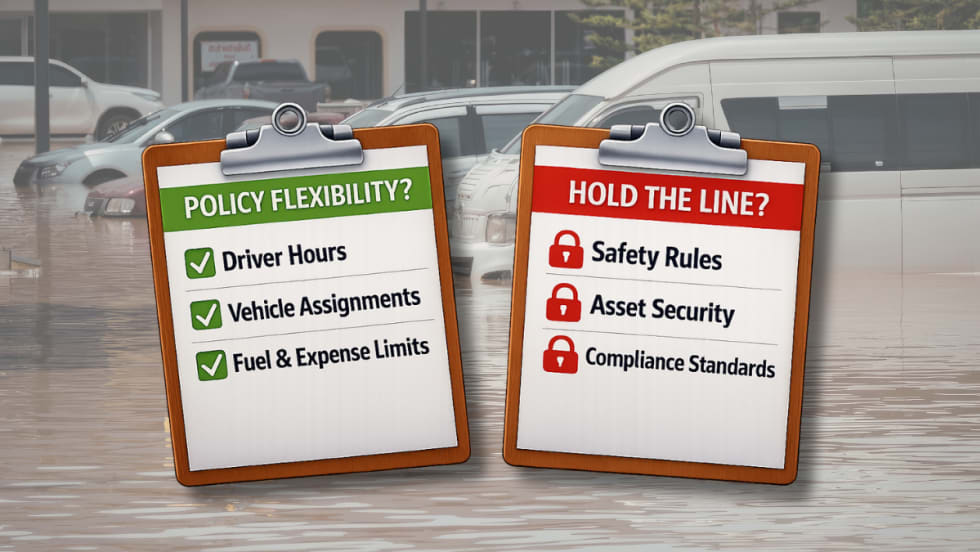
Adapting Fleet Policy When Disasters Strike
In the middle of natural disasters fleet managers must shift priorities to protect people and assets. What policy items should be loosened, and when should the line be held?
Read More →