




Calif. Superior Court: Turo Is a Car Rental Company
The ruling stems from a 2018 lawsuit regarding Turo’s San Francisco International Airport (SFO) operations and the collection of the airport’s permit fees.

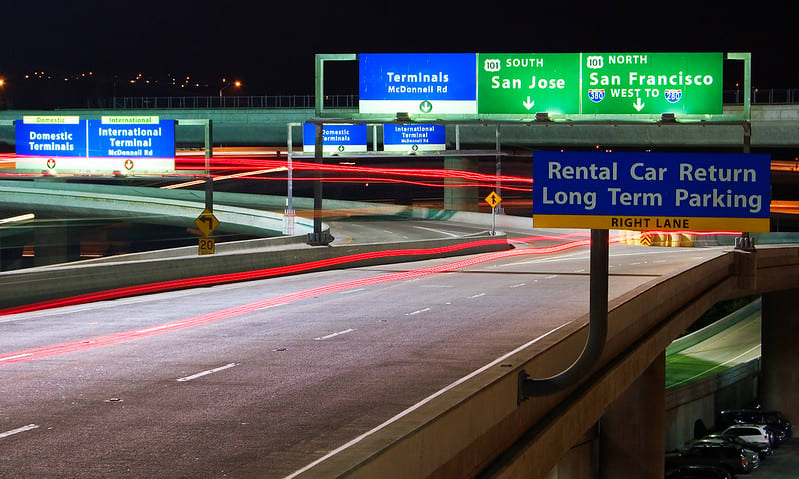
Signs direct travelers out of San Francisco International Airport.
Photo via Flickr/Waymond C.
On April 23, the San Francisco Superior Court ruled that as a matter of law peer-to-peer carsharing platform Turo “is a rental car company.”
The ruling stems from the civil lawsuit People of The State of California v. Turo Inc., filed Jan. 24, 2018. In the suit, the City of San Francisco contended that although Turo relinquished its off-airport permit at San Francisco International Airport (SFO), it continued to operate at the airport.
The lawsuit contended that Turo flouted SFO’s permit requirements, giving Turo an unfair advantage over off-airport rental car companies.
At the time, Turo was picking up customers curbside but not paying fees from its customers, as required of off-airport rental car companies, for the use of the airport-mandated bus or light-rail transit systems.
(On-airport rental car companies lease space at SFO’s consolidated rental car facility and have different permitting and fee requirements.)
Turo insisted that it is not a rental car company within the meaning of this provision, but rather, “an online carsharing platform” that enables “peer-to-peer carsharing” and is therefore not subject to the fees.
The court concluded that Turo’s central argument — whether Turo owns the vehicles or they are owned by other individuals — is not determinative of whether Turo is in the business of renting vehicles.
“Nothing in the language of (civil code) specifies that a rental car company must own the rented vehicles in order to be considered in the business of renting passenger vehicles to the public,” the order states.
In finding that Turo is a rental car company, the court noted the similarities with Turo’s model compared to incumbent car rental companies: Turo’s internet-based platform allows customers to rent specific passenger vehicles; Turo receives a percentage of the proceeds from each rental transaction; Turo sells insurance coverage to car owners and renters; and it has a detailed terms of service contract governing rentals.
The ruling states that Turo admitted it competes with traditional on-airport and off-airport rental car companies and does not dispute it has used phrases like ‘rent’ and ‘rental car’ in advertisements. Further, the average cost is similar to that of a traditional car rental transaction at SFO.
Turo had tried to separate itself from car rental based on an insurance code ruling in 2010 that defined “personal vehicle sharing” as “the use of private passenger motor vehicles by persons other than the vehicle’s owner.” The code change was to allow drivers to use their cars in carsharing platforms such as Turo’s (then RelayRides) without invalidating their personal car insurance policies.
The court rejected that argument, concluding that the insurance legislation was intended only for insurance purposes and did not amend the definition of a car rental company.
This ruling does not address the issue of fees that would’ve been collected by the airport after the lawsuit’s filing or moving forward.
It appears Turo will appeal: On April 28, Turo filed for a 10-day extension above the usual 20-day deadline to file a writ petition seeking a review of the ruling. If granted, the deadline for appeal would be May 26.
When reached for comment, Turo responded to Auto Rental News: "The court, recognizing that these are novel issues, chose to ask the appellate court to review its order. We believe the appellate court will find that Turo is not a rental car company under California law."
Related: City Attorney Files Lawsuit Against Turo, Alleges Permit Violations at SFO
Originally posted on Auto Rental News
More Global Fleet
GeoFencing Adds to Your Truck Security Arsenal
Geofencing is a familiar fleet tool today, but its early adoption marked a major shift in vehicle tracking, route monitoring, and the debate over employee privacy.
Read More →
Holman Takes Full Ownership of ARIZA in Mexico
Holman is bringing its Mexican fleet management operation fully under its own brand after more than 30 years as a joint venture. The change gives multinational fleet customers a single Holman operation across the U.S., Canada, and Mexico.
Read More →
5 Tire Maintenance Tips to Help Prevent Work Truck Downtime
Regular tire checks can do more than extend tread life. These five maintenance practices can help work truck fleets catch problems early, reduce costs, and prevent downtime.
Read More →

Proven Ways to Reduce Work Truck Downtime
The age-old problem of downtime will always be a reality, but with new strategies at hand, fleets have more ways to keep trucks on the road longer.
Read More →


Cameras, Safety and Insurance: From Reactive Claims to Real-Time Prevention (Part 2 of 2)
Part Two: Commercial auto remains one of the most challenging and costly lines of coverage for fleet operators and insurers alike. Continue learning more about how to effectively address these issues from Onur Aksan, Enterprise Business Development Executive, Geotab
Read More →
Cameras, Safety and Insurance: From Reactive Claims to Real-time Prevention
Commercial auto remains one of the most challenging and costly lines of coverage for fleet operators and insurers alike. Learn more about how to effectively address these issues from Onur Aksan, Enterprise Business Development Executive, Geotab.
Read More →
Fleet Costs Are Rising: Here’s How Leaders Are Responding
Fleet leaders are under pressure to reduce costs, adapt to economic uncertainty, and make smarter decisions. See how peers across North America are responding with real data, proven strategies, and forward-looking insights. Download the 2026 Market Pulse Report to benchmark your strategy and uncover where you can gain an edge.
Read More →
Enterprise Fleet Management Surpasses 900,000 Vehicles in U.S. & Canada
Enterprise Mobility connects with mobility solutions around the globe
Read More →