




Autonomous Vehicles Will Clog Cities Unless Lawmakers Step Up
Autonomous vehicles will increase, not decrease, traffic in already overcrowded downtown areas. That is one of the main findings of a joint World Economic Forum and Boston Consulting Group study with the city of Boston.

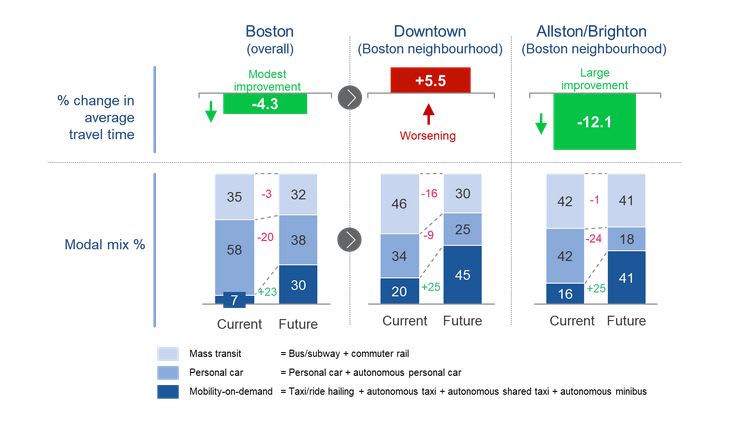
A new study analyzed how autonomous vehicles will impact on-demand mobility, personal cars, and mass transit.
Chart courtesy of Boston Consulting Group.
Autonomous vehicles will increase, not decrease, traffic in already overcrowded downtown areas. That is one of the main findings of a joint World Economic Forum and Boston Consulting Group (BCG) study with the city of Boston, released today.
While AVs will reduce the numbers of cars and overall travel times across cities as a whole, the effect is not evenly distributed, with concentrated downtown areas potentially seeing a deterioration in traffic flow. City and state governments can intervene to encourage higher sharing of AVs and avoid a significant move away from mass transit systems, which remain essential for urban mobility.
“Cities can’t follow a ‘wait and see’ approach towards autonomous vehicles,” said John Moavenzadeh, member of the Executive Committee of the World Economic Forum and co-author of the study. “Cities need to actively explore policies and incentives, such as dynamic pricing, dedicated lanes and redesign of the kerb to ensure that autonomous vehicles will achieve the full value for society that they promise. If such choices are not made, cities risk losing more than they will gain from autonomous vehicles.”A sophisticated traffic simulation model for the City of Boston showed that both the number of vehicles on the road and travel times would change markedly. While neighbourhoods outside the downtown core, such as Allston, would see a reduction in traffic and decreased travel time, travellers downtown would face increased traffic and travel time. The study also indicated that a shift to autonomous mobility would reduce by 48% the number of parking spaces required in Boston, which unlocks tremendous opportunities to rethink streets and overall urban design.
The team conducted a large-scale conjoint analysis asking thousands of residents in the Boston area what types of autonomous and non-autonomous vehicles they were likely to drive in certain situations (e.g., travelling to work when raining, etc.). The analysis predicts a clear shift to mobility-on-demand (both AVs like robo-shuttles and non-AVs like today’s taxi and ride-share services), which will account for 30% of all trips in the greater Boston area (up from 7% today) and 40% of trips within the city limits in the future. The results of this consumer study were used as the input assumptions for a traffic simulation model.
"Autonomous mobility on demand provides a very convenient door-to-door service with a guaranteed seat and convenient mobile booking – all this at very competitive prices,” said Nikolaus Lang, senior partner at BCG and co-author of the study. "For trips shorter than four miles, it is likely that travellers would opt for low-capacity autonomous taxis or shuttles rather than taking high-capacity mass transit options like buses or trains."
This, in turn, would increase the number of cars on the road and average travel time by 5.5% in Boston’s downtown neighbourhood.Policy-makers must expect the impact of AVs to vary not only city by city but also neighbourhood by neighbourhood, the study concluded. Policies and incentives will be needed to foster the technology’s innovation while ensuring that its benefits far outweigh its challenges. Potential measures to improve citywide travel time include:
Introduction of occupancy-based pricing schemes to discourage riding alone — this could improve travel time by 15%
Conversion of what was once on-street parking to dedicated pick-up or drop-off areas, surface mass transit or driving lanes — this could lead to a decrease in travel time by 10%
Similarly, designation of dedicated lanes for shared autonomous vehicles — this could decrease travel time by 8%
The report, "Reshaping Urban Mobility with Autonomous Vehicles: Lessons from the City of Boston," details the findings from collaboration with BCG in partnership with the city of Boston and the project’s community of working group members.
Editor's note: This story first appeared on Metro-Magazine.com.
Related: 7 Questions for Geotab's Colin Sutherland
More Operations

U.S. Bank Adds Verra Mobility Toll Management to Voyager Fleet Platform
The integration allows U.S. Bank Voyager fleet customers to manage toll payments and violations alongside fuel, EV charging and maintenance expenses.
Read More →
ADAS Prevents Crashes. But Repairs Cost More | AF News Recap
ADAS-equipped vehicles may crash less often, but they can cost more when they do. This week, we’re breaking down what that tradeoff means for fleets, plus Subaru’s first Forester Wilderness Hybrid, Nissan’s new e-POWER Rogue, and why Calstart has become Catalyst Mobility.
Read More →
Moventum Fleet Management Names Mark Iorillo Head of Sales
Iorillo brings nearly 20 years of fleet management and sales experience to the role, including previous positions at Element Fleet Management, CEI, Donlen and Ryder.
Read More →
Fleet Has a Talent Pipeline Problem. What Comes Next? | AF News Recap
Where will fleet’s next generation of leaders come from? This week, we’re looking at the industry’s talent pipeline, what certification can add to a fleet career, how to build an award-worthy track record, and the return of Automotive Fleet’s Personal Use Survey.
Read More →
Smith System Launches Driver Risk Management Program
Fleets have more driver data than ever, but identifying risky behavior doesn't necessarily correct it. Smith System's new Driver Risk Management program combines monitoring, training, and follow-up coaching to help fleets connect risk signals with driver intervention.
Read More →
Automotive Fleet Opens 2026 Personal Use Survey for Commercial Fleet Managers
Less than two weeks left! Commercial and corporate fleet managers are invited to share how their organizations handle company vehicle personal-use policies, charges, and driver eligibility.
Read More →
From AI Prompts to AI-Generated Safety Songs | AF News Recap
Can better prompts make AI more useful for fleet managers? This week, we’re breaking down smarter fleet analysis, an AI-assisted experiment that turned safety training into music, and what happened to fuel prices in August.
Read More →
How to Write Better AI Prompts for Fleet Analysis
Include these six elements in your fleet prompts to generate more relevant analysis and accurate answers.
Read More →
Fleet Meets: Eric Kilgore
This edition of the Fleet Meets series features one of the industry's best leaders driving multi-market and national operations.
Read More →
Why Reactive Fleet Management Is Becoming Too Expensive to Sustain
Research highlights a growing need for proactive management strategies to address rising costs in fleet operations effectively.
Read More →