




Audi Among Safety Leaders in the U.S.
AUBURN HILLS, MI – The current line-up of Audi vehicles sold in the United States are some of the safest according to results from tests conducted by the Insurance Institute for Highway Safety (IIHS) and the National Highway Traffic Safety Administration (NHTSA).
AUBURN HILLS, MI – The current line-up of Audi vehicles sold in the United States are some of the safest according to results from tests conducted by the Insurance Institute for Highway Safety (IIHS) and the National Highway Traffic Safety Administration (NHTSA). Recent crash tests by both organizations have demonstrated that Audi is among the best in the industry in terms of passenger safety and vehicle crash worthiness.
For 2008, the IIHS added the Audi A3 to the list of Audi models designated as “Top Safety Pick” in the Midsize category. 2007 “Top Safety Pick” winners A4 and A6 continued into 2008 in the Midsize and Large car category, respectively.
Audi is the only German luxury auto manufacturer with the distinction of having three models listed as a “Top Safety Pick.” To achieve this distinction, vehicles must receive a top rating of “Good” for passenger protection in off-set frontal, side, and rear crash tests. In addition, IIHS vehicle tests now include occupant safety measures and crash prevention criterion. Vehicles must have an available electronic stability program, which Audi has standard on every model it produces.
The Audi Q7 SUV was also tested in 2007 for crash worthiness. The NHTSA awarded the Audi Q7 the highest possible rating of “Five-stars” for driver and passenger in a frontal collision, and front and rear passengers in a side collision. A “Five-star” indicates that there is less than a 5% chance of serious injury to passengers in a collision. Frontal tests measure the forces on the head, neck, chest, and pelvis on front passengers, while side tests indicate the chance of a serious chest injury for both front and rear seat passengers.
Audi’s commitment to safety also includes a comprehensive list of active safety features. Every Audi sold in the U.S. has standard four-wheel disc brakes with anti-lock braking system (ABS), an electronic stability program and daytime running lights (DRL). New for 2008 on all models is a standard tire pressure monitoring system. All of these features are designed to help reduce the chances of a collision.
There are many standard passive safety features in Audi vehicles that are designed to protect occupants in the event of a collision. Several key optional convenience features also enhance the driving experience. New for 2008 on the A6/S6, A8/S8, and Audi Q7 models is an optional Audi lane assist feature. When equipped, a camera monitors the vehicle’s path of travel, and will slightly vibrate the steering wheel should the driver veer from their current lane without signaling. This alerts the driver that they are changing lanes should their attention be diverted from the road. The sensitivity of the lane sensor can be adjusted using the Audi MMI controller.
In 2006, Audi Q7 broke ground in the automotive industry to be equipped with blind spot protection which is called Audi side assist. Now available on the 2008 A6/S6 and A8/S8 models, this system monitors up to 165 feet behind the vehicle and alerts the driver when someone is in their blind spot. A directional amber LED appears in the inner housing of the exterior mirror to inform the Audi driver that someone is in their blind spot. Should the Audi driver attempt to merge into the lane occupied by a vehicle in their blind spot, the LED will flash brightly when the turn signal is pushed. This is to insure the driver is aware that changing lanes could be dangerous, and to use extra caution.
More Operations
Managing Fleet Costs in an Era of Permanent Volatility
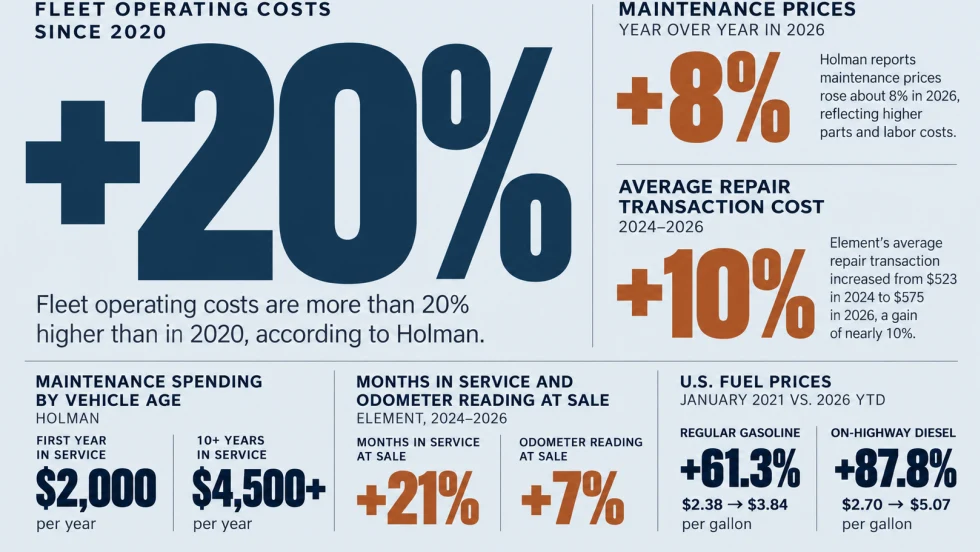
Fleet operating costs have risen more than 20% since 2020, raising a key question: When does extending a vehicle's service life stop making financial sense?
Read More →
The Next Evolution of Fleet Management: Autonomous Operations
This opening keynote session at the Fleet Forward Conference highlights the future of autonomous driving for fleets.
Read More →
How to Reduce the Total Cost of Risk From Catalytic Converter Theft
A stolen catalytic converter can cost fleets far more in downtime and lost productivity than in repairs. A total-cost-of-risk approach can help fleet managers quantify their exposure and prioritize theft prevention.
Read More →

Personal-Use Charges Rise as Vehicle Values Fall | AF News Recap
Personal-use charges are climbing, wholesale used-vehicle values are declining, and commercial fleet sales growth is slowing. This week, we're breaking down the latest fleet data, plus how Element Fleet Management is helping Waymo prepare for its first Canadian robotaxi market.
Read More →
Here's When You Should Make an Exception to Fleet Policy
Fleet policies are designed to create consistency, but not every driver or situation fits neatly within standard rules.
Read More →
AI-Native or AI-Acquired: What Should Fleet Managers Look for in an AI Platform?
Six questions can help fleet managers look beyond AI marketing claims to evaluate integration, data access, and real-world operational performance.
Read More →
A buyer's guide to fleet management software in 2027
Buying fleet management software in 2027 means looking beyond features and price. As fleet operations, technology and expectations evolve, this guide explores what today’s fleet professionals should consider when choosing a system that can deliver value now and adapt to what comes next.
Read More →
What Will Shape the Next Era of Fleet Management?
EVs, AI, and autonomous vehicles are reshaping fleet management. Discover what’s ahead—and how fleet leaders can prepare for the next era.
Read More →
How Fleets Can Recruit and Train Veterans for Technician Roles
Here's how the technician shortage has affected uptime for fleets, and what to do about it.
Read More →
Avis Budget Group Deploys Neology Toll Management Technology Across Major Brands
Neology’s neoFleet platform will manage toll transactions and toll-authority operations for vehicles across Avis, Budget, Payless, Budget Truck and Zipcar.
Read More →