




As Workforce Ages, So Do Drivers
A ValuePenguin study evaluates the correlation between the number of older drivers on U.S. roadways and the rate of fatal crashes among drivers ages 65 and up.


Those ages 70 and up represent 14.5% of the driving population. That’s compared with 2013’s 23.6 million, or 11.1% of drivers.
Photo: Pixabay/Trang Nguyen
As the large workforce of Baby Boomers ages, the share of older drivers on U.S. roadways goes up too.
The share of licensed drivers ages 70 and older has risen 30.1% in the last decade. At the same time, the portion of fatal crashes involving drivers 65 and older has also increased, from 22.8% in 2013 to 24.4% in 2022. That's according to the latest ValuePenguin study.
Aging Baby Boomers Leads to Older Driving Workforce
Those ages 70 and up represent 14.5% of the driving population. That’s compared with 2013’s 23.6 million, or 11.1% of drivers.
All told, it's an increase of 30.1%. According to the U.S. Census Bureau, the 65-and-older demographic grew by 38.6% between 2010 and 2020 — the fastest for that population in over a hundred years. More elders means older drivers.
There's no doubt that among the older drivers are fleet drivers who are still working in what would otherwise be their retirement years. Among people age 75 years and older, the labor force is expected to grow by 96.5% over the next decade.
Rate of Fatal Crashes Involving Older Adults Rises
As the share of older drivers has increased, so too has the percentage of fatal car crashes involving older drivers. ValuePenguin defines that as those ages 65 and older. In 2013, 22.8% of fatal crashes involved an older driver, but that figure was up to 24.4% as of 2022.
The study's authors noted that while the increase isn't completely linear, it does follow an upward trend. In total, there were 123,072 fatal car crashes involving an older driver between 2013 and 2022 — with 14,647 in 2022 alone.
However, not all drivers 70 and older are unsafe, ValuePenguin Auto Insurance Expert Divya Sangameshwar stressed. "And there’s no set age when someone should stop driving."
What Might Contribute to an Increase in Fatal Crashes?
In a 2021 article, the Insurance Institute for Highway Safety pointed to recent studies showing that older drivers are more likely to drive outdated vehicles that lack new and emerging safety technologies.
Studies have revealed that as driver age increased, vehicles were less likely to be equipped with electronic stability control (ESC) and head-protecting side airbags as standard features.
Vehicles without ESC were associated with 37% higher odds of driver fatality for drivers 70 and over, while vehicles without standard head-protecting side airbags were associated with double the odds of an older driver fatality.
Sedans and hatchbacks have also been proven to be more common among older drivers, with the proportion of people driving midsize passenger cars increasing and the numbers driving SUVs declining with age.
Along with vehicle design and safety features, vehicle size and weight are important factors in crash survival. That's because the occupants of smaller vehicles are exposed to greater forces in collisions with larger ones.
Drivers ages 75 and older are also significantly less likely to drive vehicles with good ratings in the IIHS moderate overlap front and original side crash tests.
A survey revealed one reason older drivers use these vehicles is because they don't understand the value of advanced safety features or good safety ratings.
Where are America's Oldest Drivers?
While the share of drivers ages 70 and older is up across the country, some states are home to more older drivers than others. West Virginia tops the list, with 20.1% of its licensed drivers having already celebrated their 70th birthday.
New Hampshire and its neighbor Vermont take second and third, with 19.1% and 18.9% of their drivers falling into this age category, respectively.
According to Census data, all three states have proportionally higher populations of adults 65 and older. Nationwide, that demographic makes up 17.3% of the population; in all three states, the share is north of 20%.
ValuePenguin noted that all three states are also fairly sparsely populated, making driving more necessary.
These three states also suffered higher-than-average rates of fatal crashes involving drivers 65 and older. Over the decade studied, 23.6% of deadly crashes in the U.S. involved an older driver. In New Hampshire, that figure rose to 29.9%, followed by Vermont at 29.6% and West Virginia at 28.3%.
The states with the lowest rate of drivers ages 70 and above are the District of Columbia, with only 9.6% having turned 70. Utah follows at 10.8%, and Alaska is behind it at 11.5%.
More Safety

Fleet Manager’s Ultimate Playbook: Navigating the New Standard in OEM Connectivity
Rising operating costs, driver safety concerns, and unplanned downtime are putting unprecedented pressure on modern fleets. Discover how fleet managers use embedded OEM connectivity and real-time vehicle data to cut TCO, prevent downtime, and protect drivers without aftermarket telematics hardware.
Read More →
From Driver Well-Being to EV Charging | AF News Recap
Mental health belongs in the fleet safety conversation. This week, we’re looking at five ways fleets can support employee well-being before a crisis, plus Holman’s expansion in Mexico, new one-day Fleet Forward passes, and why EV charging demand is outpacing infrastructure growth.
Read More →
Nexar-Nauto Merger Aims to Give Fleets Better Safety Intelligence Through Larger Driving Dataset
Stefan Heck tells Automotive Fleet that combining more than 10 billion miles of driving history with Nexar's AI models will give fleets deeper insights into driver risk and roadway conditions than either company could provide independently.
Read More →
Don't Wait for a Crisis: 5 Ways to Build Mental Health Into Your Fleet Safety Program
For Suicide Prevention Month, fleet and safety leaders have an opportunity to put mental health where it belongs: at the center of workplace safety.
Read More →
How Camera Data Can Strengthen a Fleet’s Insurance Renewal
Insights from a commercial insurance carrier and a broker show how fleets can turn video telematic data, driver coaching, and improved claims results into a stronger case at insurance renewal.
Read More →
The Safest Fleets Aren’t the Ones with the Most Technology
You’ve made the telematics investment. Here’s how to capture the other half of its value and build the safest fleet on the road.
Read More →
Hidden in Plain Sight: Fleet Compliance Risks
Fleet compliance isn't just about having policies — it's about consistently enforcing them. This practical guide reveals six hidden compliance risks common in public sector and shared fleet operations and outlines proven strategies to improve visibility, accountability, and audit readiness
Read More →
NETS Sets 2026 Fleet Safety Benchmark Conference for Indianapolis
The Sept. 15–17 program will feature fleet benchmarking data, case studies, emerging technologies, and implementation strategies while running alongside the NSC Safety Congress & Expo.
Read More →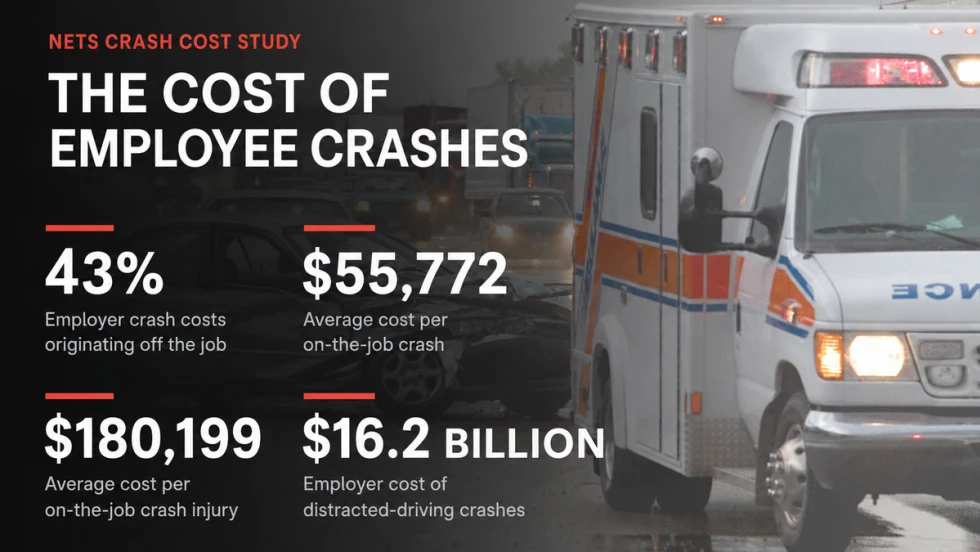
Off-the-Job Crashes Account for 43% of Employers’ $61.7 Billion Crash Burden
NETS quantifies costs dispersed across fleet, risk, HR, and other departments while providing new per-crash benchmarks for employers.
Read More →
Ram Recalls More Than 1.27 Million 1500 Pickups for Seat Belt Anchor Issue
The recall affects certain 2019-2026 Ram 1500 pickups that may have improperly attached second-row seat belt buckle anchors.
Read More →