




A Strike Exposes an Industry's Divide
NEW YORK – While it may have been hard at times to hail a cab during a two-day taxi strike that was expected to end this morning, it was harder still for many New Yorkers to understand the bitter dynamic the work stoppage revealed in a deeply divided industry.
NEW YORK – While it may have been hard at times to hail a cab during a two-day taxi strike that was expected to end this morning, it was harder still for many New Yorkers to understand the bitter dynamic the work stoppage revealed in a deeply divided industry, according to the New York Times.
“Cab driving historically has been heavily fragmented,” said Graham Hodges, a history professor at Colgate University, and author of the book Taxi! A Social History of the New York City Cabdriver (Johns Hopkins University Press, 2007).
The strike centered on a dispute over a high-tech credit card and vehicle tracking system being mandated for all cabs. It was led by the New York Taxi Workers Alliance, which says it represents 10,000 drivers. The group’s energetic executive director, Bhairavi Desai, has become an easily recognizable voice for New York taxi drivers since she began an organizing campaign in the 1990s.
But the alliance has been opposed, sometimes with strong language, by many others in the industry. One of the most vocal groups has been the New York State Federation of Taxi Drivers, which claims to have 7,000 yellow-cab drivers among a membership that also includes drivers of livery cabs and black cars. Fernando Mateo, the group’s founder, urged drivers not to strike, and asked the police to protect drivers who went out on the street. Others who had opposed the strike included groups representing taxi fleet owners and others in the industry.
Ms. Desai said that her group would try to add members and build on what she called “an unprecedented mobilization in this industry,” hinting at possible future actions. “We basically had two solid days that have given us the experience to perfect our skills,” she said.
Mayor Michael R. Bloomberg has said he will not change course on the taxi technology, and City Hall officials said that they were not negotiating with Ms. Desai. Mr. Bloomberg said that about 82 percent of fleet cabs were rolling yesterday, up from 75 percent the day before. The city had instituted an emergency fare system for the duration of the strike, dividing the city into fare zones, and many drivers who worked said that it allowed them to make far more money than on a typical day.
“They’re working very hard out there and maybe they deserve it,” the mayor said yesterday at a news conference.
The Port Authority of New York and New Jersey, which tracks cabs at Kennedy International and La Guardia Airports, said that in an average day there are a total of about 17,000 yellow cab pickups at the two airports. On Wednesday, the authority said there were about half that number, and yesterday there was about two-thirds of the regular volume. A spokesman said that dispatchers were still placing more than one rider in many cabs to make up for the shortfall and that as a result, waits were minimal. Throughout Midtown, there were visibly more cabs on the streets as well.
A city official said the emergency fare measures were expected to be lifted this morning.
But Mr. Hodges said that given the nature of the taxi industry, it was significant that several thousand drivers appeared to have stayed home over two days. He said that many drivers were living day to day and that “these are people who just can’t afford to strike.”
“They don’t have any strike fund,” he said. “That’s why you have a two-day strike rather than one that’s extended. The fact that they got as many as they have is quite impressive.”
The Taxi and Limousine Commission says that there are 13,087 taxi medallions. More than 3,200 of the medallions are affixed to cabs run by fleet operators, the commission said. A large portion of the remainder are leased by people who own their cabs, although they may lease the vehicle out to other drivers. About 44,000 drivers hold a hack license, but not all drive full time, the commission says.
Edward G. Rogoff, a professor of management at Baruch College who has studied the taxi industry, said that it had increasingly become divided between a small group of wealthy medallion owners and a vast pool of drivers who occupied one of the lower positions in the city’s economy.
“They’re urban transportation sharecroppers,” Mr. Rogoff said. “They lease a medallion for a fixed price for a fixed period of time and they absorb all the risk as to whether it rains. And they’re unhappy because the system is fundamentally unfair to them and they know that.”
More Operations

Turn Fleet Data Into Smarter Decisions
Fleet leaders have access to more operational data than ever, but disconnected systems and unclear metrics often slow decision-making instead of improving it. This article outlines five practical steps fleets can take to transform fragmented data into actionable insights that improve planning, safety, utilization, and long-term performance.
Read More →
Hybrids: Electrification Without the Challenges
For fleet managers, fuel is one of the biggest line items in the budget — and it's one hybrids can shrink without changing how your people work. Download the eBook to see the numbers, understand the technology, and get a step-by-step guide to making the switch.
Read More →
How NOV Uses Telematics to Improve Fleet Safety Across 160 Locations
James Victory of NOV discusses how the company manages fleet safety, maintenance, and telematics across more than 150 locations supporting oilfield operations throughout the U.S.
Read More →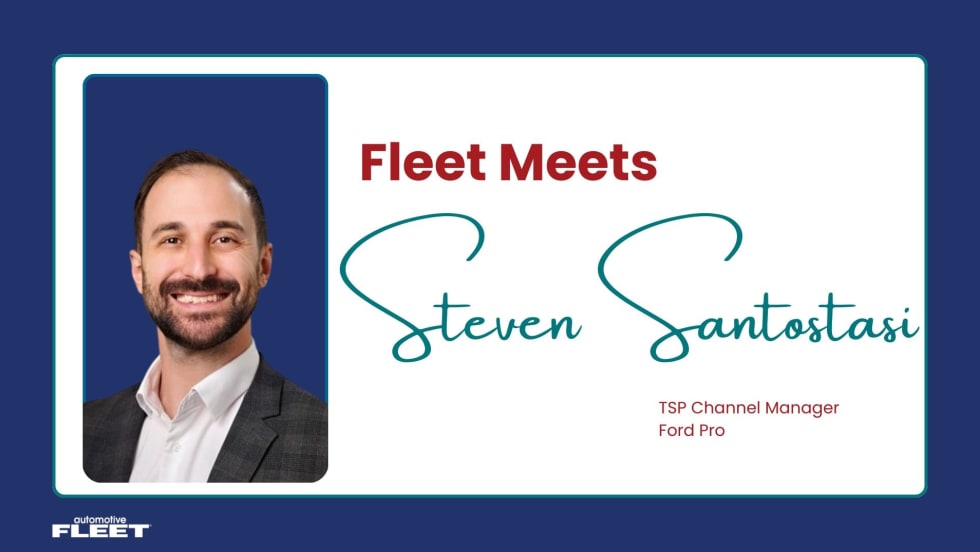
Fleet Meets: Steven Santostasi
This edition of the Fleet Meets series features Steven Santostasi, the current TSP channel manager for Ford Pro.
Read More →
Why Fleet Managers Are Replacing Departmental Vehicles with Shared Motor Pools
Departmentally assigned vehicles often create hidden costs through underutilization, poor visibility, and increased administrative burden. This white paper explores how shared motor pool strategies help fleets reduce costs, improve accountability, and optimize vehicle utilization.
Read More →
Soap Box Derby Challenge: Assembling the Crew
Meet Gabriel, Matthew, and Angel — the team helping bring this soap box derby build to life.
Read More →
BBL Fleet Acquires Velcor Leasing Corporation
BBL Fleet expanded its footprint in the fleet management industry with the acquisition of Velcor Leasing Corporation of Madison through a stock purchase agreement finalized Feb. 27, 2026.
Read More →
Lytx Introduces New AI Fleet Technologies at Protect 2026
The company introduced new AI-driven fleet safety and operations technologies during its annual user conference.
Read More →
Fleet Costs Are Rising: Here’s How Leaders Are Responding
Fleet leaders are under pressure to reduce costs, adapt to economic uncertainty, and make smarter decisions. See how peers across North America are responding with real data, proven strategies, and forward-looking insights. Download the 2026 Market Pulse Report to benchmark your strategy and uncover where you can gain an edge.
Read More →
From Waffle House to AI: Fleet Trends You Need to Know
In this AF news recap, host Faith Howell covers how Waffle House stepped up during disaster response and new AI tech on the market.
Read More →