




Related: FCA Teases 2018 Jeep Wrangler
2018 Wrangler Enhances Connectivity, Open-Air Options
Jeep revealed its newly designed 2018 Wrangler at the Los Angeles Auto Show. It features more fuel-efficient powertrains and is loaded with safety features and technology.
by Staff
November 29, 2017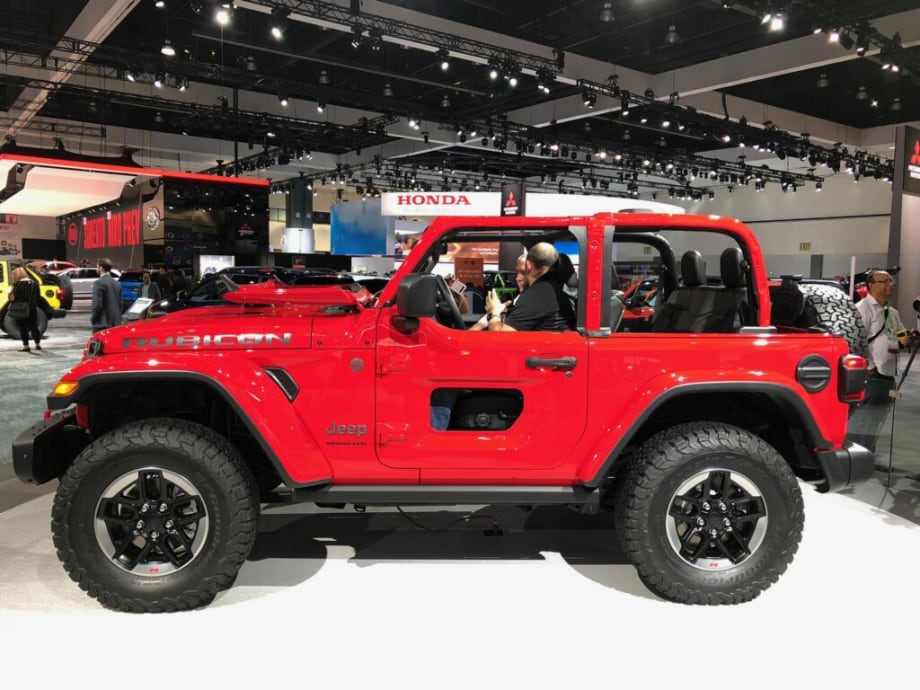
Jeep's 2018 Wrangler Rubicon on display at the Los Angeles Auto Show. Photo by Paul Clinton.
2 min to read
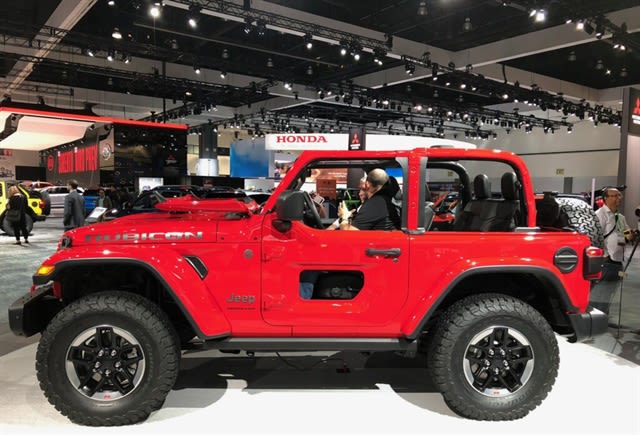
Jeep's 2018 Wrangler Rubicon on display at the Los Angeles Auto Show. Photo by Paul Clinton.
Jeep revealed its newly designed 2018 Wrangler at the Los Angeles Auto Show. The two-door model is available in three different trims: Sport, Sport S, and Rubicon. Wrangler four-door models are offered in four trim configurations: Sport, Sport S, Sahara, and Rubicon.
The 3.0-liter EcoDiesel V-6 and all-new 2.0-liter turbocharged inline four-cylinder engines join the Wrangler lineup. The 3.6-liter Pentastar V-6 engine is upgraded for 2018; it delivers 285 horsepower (hp) and 260 pound-feet (lb.-ft.) of torque and now features engine stop-start as standard. The new 2.0-liter four-cylinder engine with eTorque technology is rated at 270 hp and 295 lb.-ft. of torque. And the 3.0-liter EcoDiesel engine delivers 260 hp and 442 lb.-ft. of torque.
The new eTorque system improves fuel economy and launch performance. The system’s hybrid functions include auto stop/start, electric power assist, extended fuel shutoff, intelligent battery charging, and regenerative braking.
A new six-speed manual transmission is standard on all Wrangler models equipped with the 3.6-liter Pentastar V-6. A new-to-Wrangler eight-speed automatic transmission is optional.
When it comes to safety, the new Wrangler offers more than 75 available active and passive safety and security features, including blind-spot monitoring and rear cross path detection, ParkView rear backup camera with grid lines, electronic stability control with electronic roll mitigation, and four standard air bags.
The 2018 Wrangler delivers off-road capability with two 4x4 systems. The Command-Trac 4x4 system offers a two-speed transfer case with a 2.72:1 low-range gear ratio and Dana front and rear axles. On the Wrangler Rubicon, a Rock-Trac 4x4 provides heavy-duty Dana 44 front and rear axles. Both 4x4 systems provide full-time torque management.
Production of the 2018 Wrangler has started at the company’s Ohio assembly plant. The new model is expected in showrooms early next year.
More Operations

Fleet Has a Talent Pipeline Problem. What Comes Next? | AF News Recap
Where will fleet’s next generation of leaders come from? This week, we’re looking at the industry’s talent pipeline, what certification can add to a fleet career, how to build an award-worthy track record, and the return of Automotive Fleet’s Personal Use Survey.
Read More →
Smith System Launches Driver Risk Management Program
Fleets have more driver data than ever, but identifying risky behavior doesn't necessarily correct it. Smith System's new Driver Risk Management program combines monitoring, training, and follow-up coaching to help fleets connect risk signals with driver intervention.
Read More →
Automotive Fleet Opens 2026 Personal Use Survey for Commercial Fleet Managers
Less than two weeks left! Commercial and corporate fleet managers are invited to share how their organizations handle company vehicle personal-use policies, charges, and driver eligibility.
Read More →
From AI Prompts to AI-Generated Safety Songs | AF News Recap
Can better prompts make AI more useful for fleet managers? This week, we’re breaking down smarter fleet analysis, an AI-assisted experiment that turned safety training into music, and what happened to fuel prices in August.
Read More →
How to Write Better AI Prompts for Fleet Analysis
Include these six elements in your fleet prompts to generate more relevant analysis and accurate answers.
Read More →
Fleet Meets: Eric Kilgore
This edition of the Fleet Meets series features one of the industry's best leaders driving multi-market and national operations.
Read More →
Why Reactive Fleet Management Is Becoming Too Expensive to Sustain
Research highlights a growing need for proactive management strategies to address rising costs in fleet operations effectively.
Read More →
Sponsored•August 12, 2026
What Your Fleet KPIs Aren’t Telling You
Tracking fleet metrics is only useful when the data leads to better decisions. This guide helps fleet leaders assess cost, utilization, and downtime more accurately, identify performance gaps, and prioritize the actions that can improve operational results.
Read More →
Sponsored•August 7, 2026
Hidden in Plain Sight: Fleet Compliance Risks
Fleet compliance isn't just about having policies — it's about consistently enforcing them. This practical guide reveals six hidden compliance risks common in public sector and shared fleet operations and outlines proven strategies to improve visibility, accountability, and audit readiness
Read More →
Turning Fleet Payment Data into Executive Insights
Does data alone drive results in operations?
Read More →