




Related: Genesis G90 Highlights Safety Tech, Advanced Powertrain
2017 Genesis G90 Offers Non-Equus V-6
The 2017 Genesis G90 will offer a new 3.3L direct-injected twin-turbo V-6 alongside the 5.0L V-8 that powers the 2016 Hyundai Equus, Hyundai's luxury brand has announced.
by Staff
August 9, 2016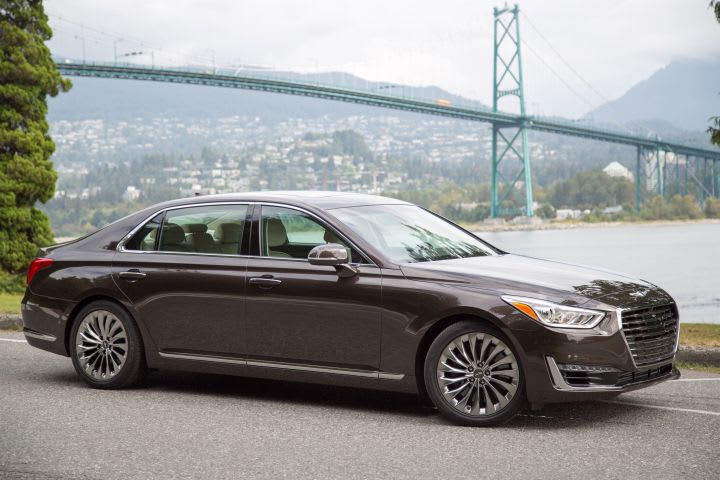
Photo of the 2017 G90 courtesy of Genesis.
2 min to read
Photo of the 2017 G90 courtesy of Genesis.
The 2017 Genesis G90 will offer a new 3.3L direct-injected twin-turbo V-6 alongside the 5.0L V-8 that powers the 2016 Hyundai Equus, Hyundai's luxury brand has announced.
The G90's Lambda V-6 will make 365 hp and 376 lb.-ft. of torque at through an RPM range of 1,300 to 4,500 rpm. Genesis will also offer the 5.0L direct-injected Tau V-8 that makes 420 hp and 383 lb.-ft. of torque at 5,000 rpm.
Both G90 powerplants employ electric thermostats and mid-position-lock continuously variable valve timing to enhance responsiveness and fuel efficiency. Genesis recommends running the engines run on premium fuel, but the engines will also burn regular fuel with only a small reduction in peak power.
The G90 will arrive slightly longer than the Equus with a length of 204.9 inches compared to the 203.1-inch Equus. The wheelbase grows to 124.4 inches compared to the 119.9 inches of the Equus.
The G90 will offer adaptive control suspension, a multi-link design that minimizes camber and toe changes through the suspension travel range.
A Dynamic Stability Damping Control (DSDC) feature provides independent damping control in both rebound and compression strokes of suspension travel for improved body and yaw control. The DSDC integrates with the Electronic Stability Control (ESC) to increase agility and stability by effectively managing the front and rear wheel damping forces, according to a Genesis release.
The G90 will also offer more standard safety features, including automatic emergency braking, driver attention alert, smart blind sport detection, lane keep assist, smart cruise control with stop/start, a multi-view camera, high beam assist, front and rear parking sensors, a haptic steering wheel, and pre-active seat belt.
The G90 is expected to achieve a 5-star safety rating (NHTSA) and a Top Safety Pick+ (IIHS) standards, based on preliminary internal crash tests, according to the release.
View the full vehicle specifications here.
More Operations

Fleet Has a Talent Pipeline Problem. What Comes Next? | AF News Recap
Where will fleet’s next generation of leaders come from? This week, we’re looking at the industry’s talent pipeline, what certification can add to a fleet career, how to build an award-worthy track record, and the return of Automotive Fleet’s Personal Use Survey.
Read More →
Smith System Launches Driver Risk Management Program
Fleets have more driver data than ever, but identifying risky behavior doesn't necessarily correct it. Smith System's new Driver Risk Management program combines monitoring, training, and follow-up coaching to help fleets connect risk signals with driver intervention.
Read More →
Automotive Fleet Opens 2026 Personal Use Survey for Commercial Fleet Managers
Less than two weeks left! Commercial and corporate fleet managers are invited to share how their organizations handle company vehicle personal-use policies, charges, and driver eligibility.
Read More →
From AI Prompts to AI-Generated Safety Songs | AF News Recap
Can better prompts make AI more useful for fleet managers? This week, we’re breaking down smarter fleet analysis, an AI-assisted experiment that turned safety training into music, and what happened to fuel prices in August.
Read More →
How to Write Better AI Prompts for Fleet Analysis
Include these six elements in your fleet prompts to generate more relevant analysis and accurate answers.
Read More →
Fleet Meets: Eric Kilgore
This edition of the Fleet Meets series features one of the industry's best leaders driving multi-market and national operations.
Read More →
Why Reactive Fleet Management Is Becoming Too Expensive to Sustain
Research highlights a growing need for proactive management strategies to address rising costs in fleet operations effectively.
Read More →
Sponsored•August 12, 2026
What Your Fleet KPIs Aren’t Telling You
Tracking fleet metrics is only useful when the data leads to better decisions. This guide helps fleet leaders assess cost, utilization, and downtime more accurately, identify performance gaps, and prioritize the actions that can improve operational results.
Read More →
Sponsored•August 7, 2026
Hidden in Plain Sight: Fleet Compliance Risks
Fleet compliance isn't just about having policies — it's about consistently enforcing them. This practical guide reveals six hidden compliance risks common in public sector and shared fleet operations and outlines proven strategies to improve visibility, accountability, and audit readiness
Read More →
Turning Fleet Payment Data into Executive Insights
Does data alone drive results in operations?
Read More →