




2013 Cadillac XTS to Feature Active Safety & Driver Assistance System
DETROIT – The all-new 2013 Cadillac XTS introduces an advanced active safety and driver assistance system. According to General Motors, the system represents a significant milestone toward the development of self-driving vehicles.
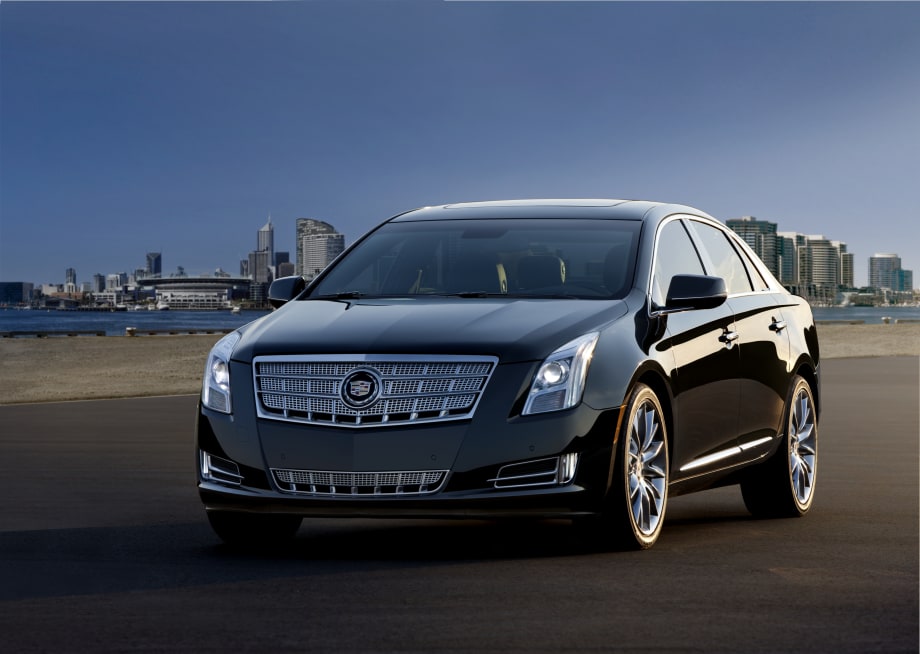
2013 Cadillac XTS
DETROIT – The all-new 2013 Cadillac XTS introduces an advanced active safety and driver assistance system. According to General Motors, the system represents a significant milestone toward the development of self-driving vehicles.
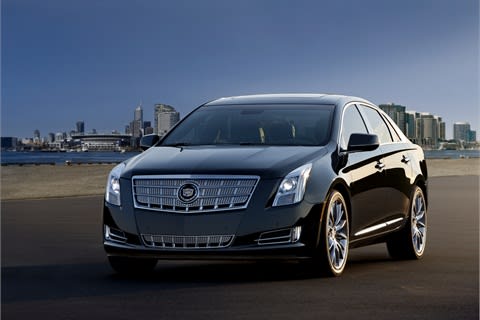
2013 Cadillac XTS
Coming this fall to XTS, the available Driver Assistance Package is the first General Motors system of its kind to use sensor fusion, which enables integration of a broad range of sensing and positioning technologies that can alert drivers of road hazards and help them avoid crashes.
The system’s use of radar, cameras and ultrasonic sensors enables advanced safety features, including:
Rear Automatic Braking
Full-Speed Range Adaptive Cruise Control
Intelligent Brake Assist
Forward Collision Alert
Safety Alert Seat
Automatic Collision Preparation
Lane Departure Warning
Side Blind Zone Alert
Rear Cross Traffic Alert
Adaptive Forward Lighting
Rear Vision Camera With Dynamic Guidelines
Head Up Display
“We believe sensor fusion will enable future active safety systems to handle a greater number of inputs to provide 360 degrees of crash risk detection and enhanced driver assist features,” said Bakhtiar Litkouhi, GM research and development lab group manager for perception and vehicle control systems.
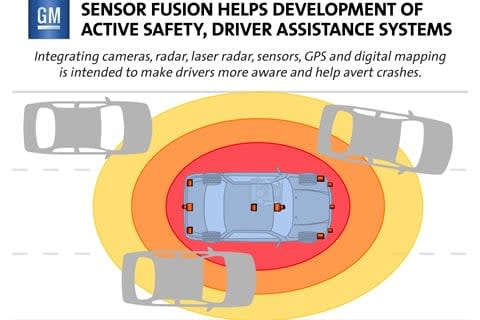
GM Sensor Fusion
“A system that combines the strengths of multiple sensing technologies and expertly manages those inputs can provide advisory, warning and control interventions to help drivers avoid collisions and save lives,” Litkouhi said.
Sensor fusion also is a building block in the development of semi-autonomous and fully autonomous vehicles, which are designed to maintain lane position and adapt to traffic environments. More sophisticated self-driving technology, which could enable semi-autonomous and fully autonomous driving, is expected by the end of the decade.
GM’s work on sensor fusion draws on its experience with The Boss, a fully autonomous Chevrolet Tahoe developed by GM, Carnegie Mellon University and other partner companies, and named for GM R&D founder Charles F. “Boss” Kettering. In 2007, The Boss navigated 60 miles of urban traffic, busy intersections and stop signs in less than six hours to win the Defense Advanced Research Projects Agency (DARPA) Urban Challenge competition.
Sensor fusion development also is bolstered by GM’s work on the EN-V, three semi-autonomous electric concept vehicles unveiled at the 2010 Shanghai World Expo. By combining GPS with vehicle-to-vehicle communications, distance-sensing and object detection technologies, EN-V can be driven both manually and autonomously -- the latter allowing it to automatically select the fastest route based on real-time traffic information.
Among the technologies that GM is considering to develop for future active safety systems is LIDAR, a light detecting and ranging technology that can measure the distance to a vehicle or object by illuminating it, often using pulses from a laser. Although LIDAR is no replacement for driver vision, it can become another set of eyes when visibility has deteriorated due to inclement weather or darkness. When combined with radar, cameras and ultrasonic sensors, LIDAR has potential crash avoidance capability.
A more advanced positioning system, using more accurate GPS and digital mapping, also is expected to play an important role on future active safety systems because it helps locate vehicles in relation to one another. While GPS effectiveness can be limited in urban canyon environments where high-rise buildings can interfere with satellite signals, the technology is still considered an asset when “fused” with other sensing and positioning technologies.
“No sensor working alone provides all the needed information. That’s why multiple sensors and positioning technologies need to work together synergistically and seamlessly,” Litkouhi said. “Sensor fusion will help facilitate that.”
More Safety
IIHS Crash Avoidance Tests Reveal Safety Gaps in Cargo Vans and Work Trucks
New crash-avoidance ratings from the Insurance Institute for Highway Safety reveal inconsistent performance among commercial vehicles, with several popular cargo vans and heavy-duty pickups struggling to avoid collisions with other vehicles and pedestrians.
Read More →
What’s Next for Fleet? Safety, AI & Industry Recognition | AF News Recap
Could your company's culture be encouraging distracted driving? This week, we're exploring how workplace expectations affect driver safety, what AI, EVs, and autonomous vehicles could mean for the future of fleet management, and how fleet professionals can strengthen their award nominations.
Read More →
Does Your Fleet's Culture Encourage Distracted Driving?
What happens when the people responsible for enforcing safety rules are the ones setting the wrong example? The answer may reveal why some of the biggest risks to fleet drivers have little to do with what's written in the employee handbook.
Read More →
Fleet Manager’s Ultimate Playbook: Navigating the New Standard in OEM Connectivity
Rising operating costs, driver safety concerns, and unplanned downtime are putting unprecedented pressure on modern fleets. Discover how fleet managers use embedded OEM connectivity and real-time vehicle data to cut TCO, prevent downtime, and protect drivers without aftermarket telematics hardware.
Read More →
From Driver Well-Being to EV Charging | AF News Recap
Mental health belongs in the fleet safety conversation. This week, we’re looking at five ways fleets can support employee well-being before a crisis, plus Holman’s expansion in Mexico, new one-day Fleet Forward passes, and why EV charging demand is outpacing infrastructure growth.
Read More →
Nexar-Nauto Merger Aims to Give Fleets Better Safety Intelligence Through Larger Driving Dataset
Stefan Heck tells Automotive Fleet that combining more than 10 billion miles of driving history with Nexar's AI models will give fleets deeper insights into driver risk and roadway conditions than either company could provide independently.
Read More →
Don't Wait for a Crisis: 5 Ways to Build Mental Health Into Your Fleet Safety Program
For Suicide Prevention Month, fleet and safety leaders have an opportunity to put mental health where it belongs: at the center of workplace safety.
Read More →
How Camera Data Can Strengthen a Fleet’s Insurance Renewal
Insights from a commercial insurance carrier and a broker show how fleets can turn video telematic data, driver coaching, and improved claims results into a stronger case at insurance renewal.
Read More →
The Safest Fleets Aren’t the Ones with the Most Technology
You’ve made the telematics investment. Here’s how to capture the other half of its value and build the safest fleet on the road.
Read More →
Hidden in Plain Sight: Fleet Compliance Risks
Fleet compliance isn't just about having policies — it's about consistently enforcing them. This practical guide reveals six hidden compliance risks common in public sector and shared fleet operations and outlines proven strategies to improve visibility, accountability, and audit readiness
Read More →