




2012 Volt Moves into California’s HOV Fast Lane
LOS ANGELES – A low-emissions package that qualifies the model-year 2012 Chevrolet Volt to access California’s high-occupancy vehicle traffic lanes will be standard on all models sold in the Golden State early next year, Chevrolet announced.
LOS ANGELES – A low-emissions package that qualifies the model-year 2012 Chevrolet Volt to access California’s high-occupancy vehicle traffic lanes will be standard on all models sold in the Golden State early next year, Chevrolet announced.
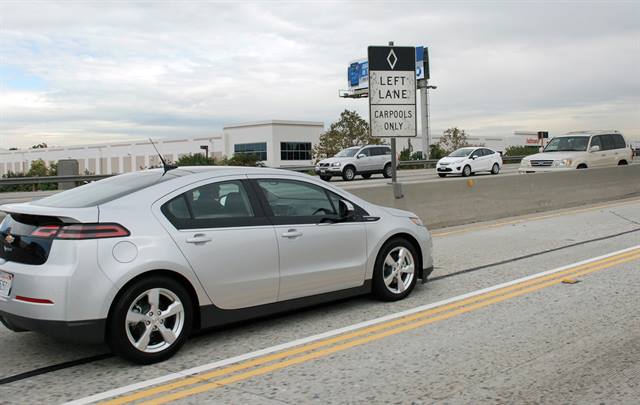
"HOV lane access is a coveted perk in California,” said Chris Perry, vice president of global Chevrolet marketing. “The low-emissions Volt will be a strong draw for drivers who commute daily in the most-congested driving environments in the United States.”
Owners of a 2012 Volt with the low-emissions package will be eligible to apply for one of 40,000 available HOV lane stickers issued to vehicles that qualify as a California “Enhanced, Advanced Technology – Partial Zero Emissions Vehicle.”
Additionally, the new low-emissions package makes the 2012 Volt eligible for owners to receive up to $1,500 in state rebates through the state’s Clean Vehicle Rebate Project. This incentive is in addition to the federal government’s $7,500 tax credit.
California has more than 1,400 miles of HOV lanes. Originally, these lanes were restricted to vehicles with two or more occupants to help minimize congestion. However, the state updated the program to allow single occupancy use of HOV lanes as a way to encourage early adoption of advanced, low-emission vehicles.
Chevrolet engineers modified the Volt’s engine and exhaust components – specifically the catalytic converter – by adding a secondary air-injection pump that streams ambient air into the exhaust stream to increase its ability to remove pollutants. The additional oxygen helps the catalytic converter remove even more pollutants than the standard Volt.
The Volt has a total driving range of up to 379 miles, based on EPA estimates. For the first 35 miles, the Volt can drive gas- and tailpipe-emissions-free using a full charge of electricity stored in its 16-kWh lithium-ion battery. When the Volt’s battery runs low, a gas-powered engine/generator seamlessly operates to extend the driving range another 344 miles on a full tank.
Volt owners have traveled more than 10 million miles since the vehicle launched late last year. Roughly two-thirds of those miles were powered by grid electricity.
There are more than 140 participating Chevrolet Volt dealers in California.
More Green Fleet
The EV Breakdown Nobody's Talking About: Why Most Electric Vehicle Roadside Calls Aren't Mechanical Failures
Here's why EV breakdowns are widely misunderstood.
Read More →
ChargePoint Now Available in Energy Pass
ChargePoint and additional planned charging network integrations were added to GM's Energy Pass.
Read More →

First Look: Slate Auto's Electric Fleet Pickup
Could an affordable, modular EV pickup make electrification more practical for fleets?
Read More →
Slate Debuts Colorful, Unique EV Models
A recent media and client event, studded with electric vehicles dressed up on platforms, planted a new position for the manufacturer in the wider EV market. Fleets will find cost-saving advantages.
Read More →
Slate Electric SUV, Pickup Switchable Model Aims For Light-Duty Fleets
Everything about this EV is counterintuitive and understated, making it stand out from the crowd.
Read More →
Inspiration Mobility Acquires Key Electrada Assets
Inspiration Mobility Group has acquired select assets of Electrada, adding the fleet electrification provider's team, technology, and charging infrastructure development capabilities to its energy management business.
Read More →
Turning Connected Vehicle Data Into Decisions That Matter
Fleet leaders have more data than ever, but turning that data into clear, actionable decisions remains a challenge. This white paper shows how leading organizations are using connected vehicle data to improve safety, reduce costs, and optimize fleet performance. Learn how to turn insight into action across your fleet.
Read More →
Are You Tracking Your Fleet's True Total Cost of Ownership?
Bobit Business Media surveyed 190 fleet professionals and found that while most fleets are tracking costs, fragmented systems and data gaps are keeping true TCO visibility out of reach. With rising pressure to control spend in an increasingly volatile environment, the gap between what fleets think they know and what the data actually shows is wider than you might expect. See how your peers are managing costs today and where the industry still has room to improve.
Read More →
Hybrids: Electrification Without the Challenges
For fleet managers, fuel is one of the biggest line items in the budget — and it's one hybrids can shrink without changing how your people work. Download the eBook to see the numbers, understand the technology, and get a step-by-step guide to making the switch.
Read More →