




2012 Honda Civic Lineup Features More Fuel Efficiency & Technology
TORRANCE, CA - The all-new, ninth-generation range of 2012 Honda Civic models consists of sedans and coupes powered by conventional gasoline, hybrid, and compressed natural gas engine choices.
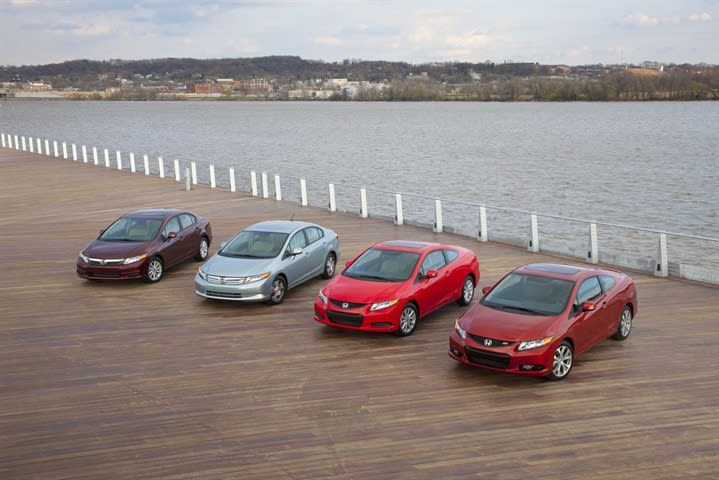
All 2012 Civic models, except the Civic Si, receive Eco Assist technology, an innovation that can enhance efficient vehicle operation at the touch of a button while also providing visual feedback to promote or confirm an efficient driving style.
TORRANCE, CA - The all-new, ninth-generation 2012 Honda Civic, which was scheduled to arrive at dealers nationwide starting on April 20, debuts with a new, sleek style and a fuel-efficient, technologically advanced lineup.
Under the Hood
The Civic range consists of sedans and coupes powered by conventional gasoline, high-performance, hybrid, and compressed natural gas engine choices. Technology and features new to the Civic include an available "intelligent" Multi-Information Display (i-MID), an available Eco Assist system and a new Motion Adaptive Electronic Power Steering (EPS) system that works in conjunction with Vehicle Stability Assist (VSA), included as standard equipment on all models. All Civic models achieve higher EPA fuel economy ratings compared to the 2011 models, up by as much as 8 percent on the highway in Civic Sedans and Coupes equipped with automatic transmissions. The Civic operates on an efficient i-VTEC 4-cylinder engine technologies for economy and performance.
The Civic Hybrid introduces the latest generation of the fuel-efficient Integrated Motor Assist (IMA) system - now with a lithium-ion battery for the first time on a Honda hybrid vehicle. Plus, an entirely new model, the Civic HF, a conventional, gasoline-only powered vehicle with an automatic transmission, debuts as a value-oriented, high fuel-economy sedan with 41 mpg highway fuel economy rating. The Civic Natural Gas (previously named Civic GX) remains the only manufacturer-built, natural gas-powered car currently available in the United States and is now available with a navigation system that includes public refueling stations for compressed natural gas (CNG) vehicles. The performance enthusiast-inspired Civic Si Coupe and Civic Si Sedan, each with a larger 2.4L engine with 201 hp and 22 percent more peak torque than before, debut as the most powerful production Civic Si models ever introduced, according to Honda.
Exterior Features
The new Civic is designed with a sleek windshield rake, sweeping roofline, and a new interpretation of the previous generation's "one-motion" profile, with lines suggesting a more sophisticated and athletic appearance than before. The Civic Coupe with its shorter length and unique front and rear styling result in a more aggressive and dramatic styling demeanor. Both vehicles feature a low and wide stance that contributes to a distinctive visual presence, while thinner A-pillars stretch further toward the front of the vehicle than before to improve visibility and the perception of interior space. The C-pillars also stretch further toward the rear of the vehicle compared to the previous generation to better complete the flowing one-motion appearance.
Interior Features
The Civic's 5-passenger interior features an intuitive "two-tier" layout that prioritizes frequently referenced instruments such as the speedometer up high in the driver's line of sight with less frequently referenced information positioned down lower. A "smart interface" approach divides the vehicle controls into smartly grouped zones for audio, air conditioning, and vehicle controls. Ergonomically shaped dials, buttons, and gear shifter operate with solid precision and provide a tactile feel, according to the automaker. The 2012 Civic Sedan passenger volume of 94.7 cubic feet (Civic LX Sedan) increases by 3.7 cubic feet, and gains have also been made in front shoulder room (+2.9 inches) and rear legroom (+1.6 inches).
Civic LX and above models are equipped with audio systems that range from a 160-watt AM/FM/CD unit (Civic LX, EX Sedan, EX-L Sedan, HF and Hybrid) to a 360-watt AM/FM/CD unit with a subwoofer (Civic EX Coupe, EX-L Coupe, Si). Standard audio features include WMA and MP3 audio file capability, Radio Data System (RDS), Speed-Sensitive Volume Control (SVC), an audio input jack and a USB audio interface. The Civic EX and above models add Bluetooth HandsFreeLink and audio streaming, front tweeters, and the availability of the Honda Satellite-Linked Navigation System with voice activation and a 6.5-inch TFT color touch display. The navigation system can now overlay FM Traffic data on its maps, a free public resource available in participating major metropolitan areas for freeway congestion, collisions, and construction zones.
The Honda Satellite-Linked Navigation System debuting on the 2012 Civic features 16 GB of flash memory in place of the DVD-based system used previously. The system features more than 10 million points of interest and the voice activation is capable of recognizing numbers, street names, and cities. For ease-of-reference, the i-MID can display turn-by-turn directions in conjunction with the navigation screen.
Safety Features
For safety, a wide variety of standard equipment includes Honda's exclusive Advanced Compatibility Engineering (ACE body structure for enhanced frontal collision energy management and vehicle-to-vehicle frontal crash compatibility. ACE enhances frontal collision energy management through a network of load bearing structures in the front of the vehicle. Standard safety equipment includes VSA that integrates with the new Motion Adaptive EPS system; dual-stage, multiple-threshold front airbags; front side airbags with occupant position detection system (OPDS); side curtain airbags; and a 4-channel anti-lock braking system (ABS) with Electronic Brake Distribution (EBD) and Brake Assist. The Civic's hood and front fender areas are designed to deform if contacted by the head of a pedestrian in a frontal collision.
Trim Levels
For 2012, the Civic Sedan and Coupe continue to be available in trim level choices of Civic DX (basic features), LX (popular features), EX (full features) and EX-L (luxury features). The new i-MID on Civic LX-and-above models provides a platform for integration of vehicle information and compatible personal electronics with a driver-oriented 5-inch color LCD display and intuitive steering wheel controls. All 2012 Civic models, except the Civic Si, receive Eco Assist technology, an innovation that can enhance efficient vehicle operation at the touch of a button while also providing visual feedback to promote or confirm an efficient driving style.
The 2012 Civic continues to use a fully independent suspension design. Ride and handling improvements are made possible by a 10-percent more rigid unit-body structure resulting from enhanced structural designs and increased use of high-strength steel (55 percent on the sedan compared to 50 percent on the previous model).
Read full descriptions of each trim level.
More Operations

Fleet Has a Talent Pipeline Problem. What Comes Next? | AF News Recap
Where will fleet’s next generation of leaders come from? This week, we’re looking at the industry’s talent pipeline, what certification can add to a fleet career, how to build an award-worthy track record, and the return of Automotive Fleet’s Personal Use Survey.
Read More →
Smith System Launches Driver Risk Management Program
Fleets have more driver data than ever, but identifying risky behavior doesn't necessarily correct it. Smith System's new Driver Risk Management program combines monitoring, training, and follow-up coaching to help fleets connect risk signals with driver intervention.
Read More →
Automotive Fleet Opens 2026 Personal Use Survey for Commercial Fleet Managers
Less than two weeks left! Commercial and corporate fleet managers are invited to share how their organizations handle company vehicle personal-use policies, charges, and driver eligibility.
Read More →
From AI Prompts to AI-Generated Safety Songs | AF News Recap
Can better prompts make AI more useful for fleet managers? This week, we’re breaking down smarter fleet analysis, an AI-assisted experiment that turned safety training into music, and what happened to fuel prices in August.
Read More →
How to Write Better AI Prompts for Fleet Analysis
Include these six elements in your fleet prompts to generate more relevant analysis and accurate answers.
Read More →
Fleet Meets: Eric Kilgore
This edition of the Fleet Meets series features one of the industry's best leaders driving multi-market and national operations.
Read More →
Why Reactive Fleet Management Is Becoming Too Expensive to Sustain
Research highlights a growing need for proactive management strategies to address rising costs in fleet operations effectively.
Read More →
What Your Fleet KPIs Aren’t Telling You
Tracking fleet metrics is only useful when the data leads to better decisions. This guide helps fleet leaders assess cost, utilization, and downtime more accurately, identify performance gaps, and prioritize the actions that can improve operational results.
Read More →
Hidden in Plain Sight: Fleet Compliance Risks
Fleet compliance isn't just about having policies — it's about consistently enforcing them. This practical guide reveals six hidden compliance risks common in public sector and shared fleet operations and outlines proven strategies to improve visibility, accountability, and audit readiness
Read More →
Turning Fleet Payment Data into Executive Insights
Does data alone drive results in operations?
Read More →