




Your Own Service Facility? The Plusses and Minuses
A case history on how one fleet quickly proved that 'Doing it Yourself' pays off in the long run
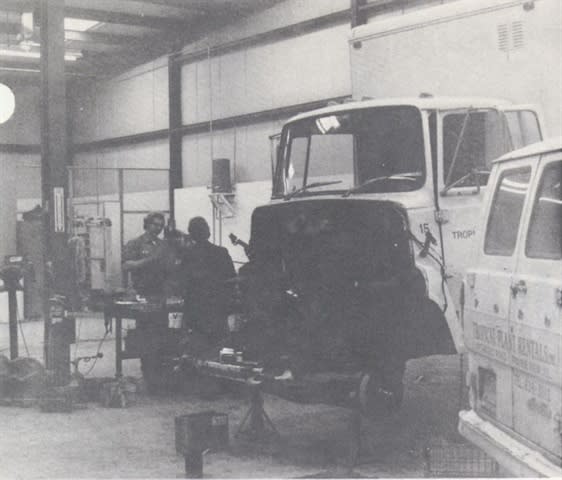
Thanks to the new facility, vehicle maintenance like this can be done without taking up valuable space in other departments like shipping and receiving.
No one can deny that two segments of the automotive industry are booming. Those two segments are the aftermarket and service industries. People are holding onto their cars, fixing and re-fixing them, taking care of them before they break down. A preventive maintenance program is usually the first step towards reducing overall vehicle maintenance costs.
And when you have a fleet of vans that have to go over 20,000 miles a year and last for about five years, you better get some kind of system set up to handle regular maintenance or your vehicles will be scattered all over your sales territory registering down time.
Tropical Plant Rentals, Inc., one of the larger plants distribution companies in the country, has taken maintenance matters into its own hands after completing a $50,000 vehicle maintenance facility at its corporate headquarters in Prairie View, Illinois.
Just recently completed in mid-December, 1947, the facility is 100 feet long, 50 feet wide and has ceilings that are 25 feet at the highest point. It is equipped with all of the necessary devices that will allow the quickest possible completion of maintenance services.
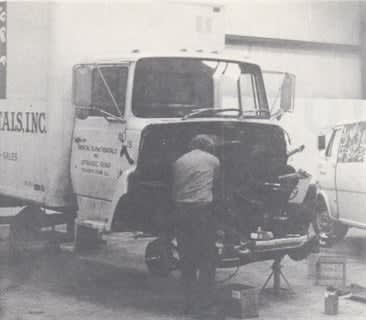
Tropical Plant Rentals' (TRR) fleet consists of 22 Ford Econoline Vans, five Ford medium-duty trucks (E.W.-9,500 lbs.). They also have nine cars, including six Ford Pinto Station Wagons, which are used for light delivery and plant servicing purposes. It was not until January, 1974, that TPR decided to do something about its highly inflated and out of control vehicle maintenance costs.
"Our outside costs were way out of line," explained Jim Leider, one of the chief executives of the company. "We could also never get the trucks fixed fast enough and consequently our delivery people were always behind schedule."
Bob Hermes, Maintenance Foreman, pointed out that he had all kinds of problems when he tried to handle vehicle maintenance without a facility. "I was getting in the way of everybody and could never get the bigger jobs done at all," he said. "Of course the fleet was smaller but we still had a lot of headaches keeping the vans in top condition."
He explained further that he had to use portions of the storage warehouse in the past to fix the vans, trucks and cars in cold or inclement weather, "I was constantly getting in the way of people who were loading trucks and it really created a lot of confusion.
"That $50,000 figure is approximate because all we really did was block off part of the warehouse and make it a maintenance area," Leider said. "The figure also includes all the equipment that is used in the facility to maintain the vehicles."
Some of the equipment in the facility includes a hoist lift, tire changer, air compressor, parts washer designed for hand rinsing of small parts to remove oil and grease, a "hi-boy" oil dispenser, a high pressure washer to clean the body and engine of the vehicle, an arc welder, a gas welder, and an AC-Delco Diagnostic Tune-up Center.
The Tune-Up center is a complete engine analyzer that can check battery charge, alternator, ignition input and output, dwell angel, timing, coil, balance the carburetor, check the mechanical and vacuum advance, wires and the condition of the individual cylinders and spark plugs. The analyzer also has a device that can be attached to check the 1975 electronic ignition systems.
[PAGEBREAK]
Hermes talked about the mileage put on the vans during the course of a year. "I'd say each one gets about 20,000 miles a year put on it, and about every 10,000 miles we give it a complete tune-up on our engine analyzer," he said. "Every 4,000 miles, we change the oil and filter. Our front ends are aligned every year so we don't have to rotate the tires. In the winter we put snow tires on the rear wheels."
The alignment is done on the outside. That and minor body work are the only functions TPR cannot do.
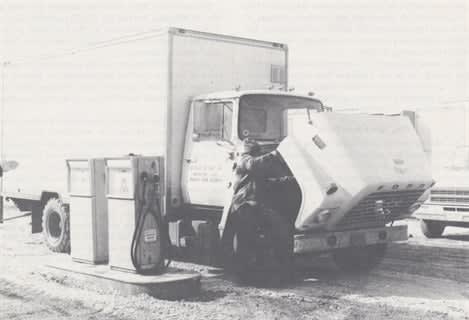
Inside the facility, TPR has a small area fenced off to keep extra parts and the AC-Delco Engine Analyzer under a more secure lock. They also have a small office in which to keep records for their preventive maintenance program.
"Yes we do have a preventive maintenance program that is of course designed to keep the vans and all the vehicles away from major repairs," Hermes explained. "We can already see results and it's only been thing we're not prepared to do is heavy body work on these vehicles."
Hermes said TPR has stuck with Fords because for the most part they just have good luck with them. "By staying with one make, it also makes it easier for us to get and stock parts," he added, "and this usually allows us to make repairs faster and get the vans back out on the road faster."
Part of the preventive maintenance program is the responsibility of the driver, of course. He has been instructed to fill out a short from after each excursion designating how much gas has been used, how much oil needed, if any, and it anything appears to be wrong with the vehicle.
Hermes started with TPR eight years ago when the company had eight vehicles (two vans, three trucks and three cars). "I used to work part-time around here at nights doing maintenance on the vehicles," he said. "In January of 74, the management decide that enough money had been pumped into outside maintenance centers (at the time, TPR had about 30 vehicles) and that expansion had made it clear that we must have our own maintenance center for the vehicles."
One example of the savings that TPR has already experienced happened just recently with one of their medium duty trucks that needed major repair work on the engine as well as the brakes. The whole job took 50 hours of labor in their own facility. After figuring out the savings in just parts cost, which they now buy in volume, TPR estimated $400 and several hours in transportation time.
Other future plans include possible national account programs for both tires and oil. Being a volume user, these plans are bound to save this operation some money over the long run.
"I have one mechanic who does all the major work on the vehicles." Hermes said, "and he's been with us since the facility has been in use," "He has an assistant who does some minor repair work, but the majority of the work is handled by one man."
Hermes said there were no real big problems with setting up the facility. "Just make sure you have enough ceiling room for the floor hoist and have some people you can count on for parts," he said.
In the future, TPR plans to purchase tire racks for the inside of the facility, and a tow truck to rescue sick vehicles. All this should keep business at TPR blooming for a long time.
More Operations

Avis Budget Group Deploys Neology Toll Management Technology Across Major Brands
Neology’s neoFleet platform will manage toll transactions and toll-authority operations for vehicles across Avis, Budget, Payless, Budget Truck and Zipcar.
Read More →
Fleet Personal-Use Charges Edge Higher in 2026
Nearly eight in 10 surveyed fleets allow personal use of company vehicles, while just over half of respondents report charging employees for the privilege.
Read More →
The Future of Fleet + What’s Changing Right Now | AF News Recap
Could developments overseas offer a preview of what’s coming for U.S. fleets? This week, we’re looking at the future of AI, autonomy, and electrification, plus Ford Pro’s new certified pre-owned program, smarter vehicle offboarding, and a new way for fleets to manage toll expenses.
Read More →
How to Handle Vehicle Offboarding
What do fleet managers need to do when a driver leaves?
Read More →
Fleet Manager’s Ultimate Playbook: Navigating the New Standard in OEM Connectivity
Rising operating costs, driver safety concerns, and unplanned downtime are putting unprecedented pressure on modern fleets. Discover how fleet managers use embedded OEM connectivity and real-time vehicle data to cut TCO, prevent downtime, and protect drivers without aftermarket telematics hardware.
Read More →
U.S. Bank Adds Verra Mobility Toll Management to Voyager Fleet Platform
The integration allows U.S. Bank Voyager fleet customers to manage toll payments and violations alongside fuel, EV charging and maintenance expenses.
Read More →
ADAS Prevents Crashes. But Repairs Cost More | AF News Recap
ADAS-equipped vehicles may crash less often, but they can cost more when they do. This week, we’re breaking down what that tradeoff means for fleets, plus Subaru’s first Forester Wilderness Hybrid, Nissan’s new e-POWER Rogue, and why Calstart has become Catalyst Mobility.
Read More →
Moventum Fleet Management Names Mark Iorillo Head of Sales
Iorillo brings nearly 20 years of fleet management and sales experience to the role, including previous positions at Element Fleet Management, CEI, Donlen and Ryder.
Read More →
Fleet Has a Talent Pipeline Problem. What Comes Next? | AF News Recap
Where will fleet’s next generation of leaders come from? This week, we’re looking at the industry’s talent pipeline, what certification can add to a fleet career, how to build an award-worthy track record, and the return of Automotive Fleet’s Personal Use Survey.
Read More →
Smith System Launches Driver Risk Management Program
Fleets have more driver data than ever, but identifying risky behavior doesn't necessarily correct it. Smith System's new Driver Risk Management program combines monitoring, training, and follow-up coaching to help fleets connect risk signals with driver intervention.
Read More →