





Ten Tows Down: Understanding the Difference Between Light-, Heavy-Duty Towing
Why Pickup Towing Standardization Matters for Fleets
The major light-duty truck manufacturers have all embraced the Society of Automotive Engineers (SAE) J2807 towing standard. Fleets will benefit from better ability to spec their vehicles.
October 17, 2014

Photo of the Ram 2500.
Photo: Ram
5 min to read
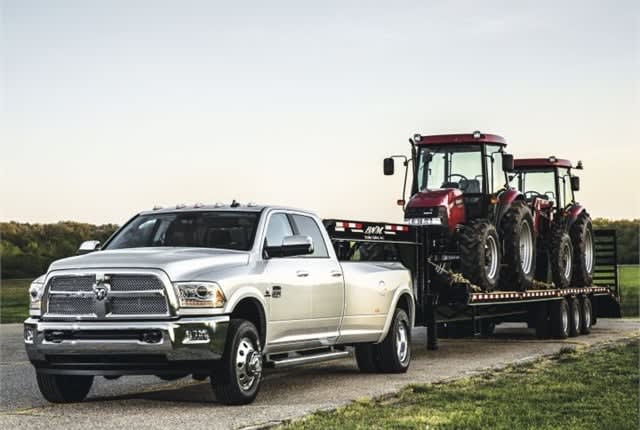
Photo of the Ram 2500 courtesy of Ram Truck.
Pickup truck towing capability mostly takes center stage during football TV commercials and recreational settings. But, it does play its part for fleets, particularly utilities and construction fleets, who augment truck payload capacity when equipment needs to be brought to job sites.
And, 2014 has been a watershed year for towing, as Ford, General Motors, and Ram Truck all agreed to implement a new engineering standard that will take the guesswork out of the spec'ing process for fleets purchasing light-duty trucks that are also used for towing.
This year, the manufacturers will all roll out at least one model that complies with the Society of Automotive Engineers (SAE) J2807 towing standard, a rigorous regimen of testing procedures and capabilities the trucks must meet before arriving in the market.
The tests are designed to push a truck's aerodynamic, thermal, and powertrain capabilities to the limit.
Putting Trucks to the SAE Test
A truck must pass a series of performance tests before it can be labeled as J2807 compliant. The tests require the truck being measured to achieve certain benchmarks for acceleration on level ground or on a highway grade, dynamic handling at various speeds, and braking without trailer brakes on uphill and downhill grades.
To meet propulsion requirements on level ground, the truck must accelerate from 0-30 mph within 12 seconds, 0-60 mph in 30 seconds, and 40-60 mph in 18 seconds while in towing mode. The truck must also launch 16 feet on a 12-percent grade five times within five minutes.
Perhaps the most daunting evaluation involves the so-called "gradeability" test at Davis Dam in the Arizona desert. The test requires the truck to climb from 500 feet above sea level at Bullhead City, Ariz., to 3,500 feet in elevation at Union Pass, Ariz. — a run of 11.4 miles — while maintaining a minimum speed of 40 mph. This test must be undertaken with an ambient temperature of 100-degrees Fahrenheit and full air-conditioning running inside the cab.
"When you look at the length of time, it's a very long, steep grade under extreme temperatures," said Anita Burke, chief engineer for General Motors' 2015 Chevrolet Colorado and GMC Canyon. "You've got the vehicle really tested to its capacity."
The truck must also meet several handling performance tests for understeer and trailer sway response. These tests require the vehicle to show capability for taking turns while maintaining course and control.
Additional brake testing requires the truck towing fewer than 3,000 pounds to stop from 20 mph without trailer brakes in 35 feet. The standard requires park-brake testing where the truck and trailer must hold on a 12-percent uphill and downhill grade.
The testing procedures were finalized in July by the SAE with extensive input from the truck manufacturers.

Photo of the Chevrolet Silverado 1500 courtesy of GM.
Truck Manufacturers Embrace the Standard
Toyota was the first OEM to sell a truck that meets the J2807 standard with its 2013 Tacoma pickup. After working with the SAE to develop testing standards, the Detroit Three began rolling it out on its 2015 models. The 2015 Chevrolet Silverado, which began showing up at dealerships in August, became the second J2807-compliant pickup.
The Ram 1500, Ram 2500 HD, and Ram 3500 HD will all meet the standard when they arrive in late 2014. The Ram 3500 with the 6.7L Cummins diesel can tow up to 30,000 pounds.
"Aligning with J2807 did not hurt our maximum towing numbers," said Rob Palmerlee, a Ram Truck engineer. "At the end of the day, using the J2807 test criteria adds to Ram's credibility."
For the 2015 model-year, Ford initially said only its redesigned F-150 would meet the J2807 standard and that its F-250, F-350, and F-450 Super Duty trucks would meet the standard for their next redesign.
However, in early September, Ford announced that the 2015 F-450 would be J2807-compliant. Ford's 2015 Transit vans will also meet the standard.
"We leave no doubt with customers that the F-450 pickup truck has best-in-class towing of 31,200 pounds — whether tested using our own internal towing standards or SAE J2807," said Raj Nair, Ford's group vice president of global product development.
Ultimately, fleet managers will have to make their own educated choice about the vehicle that fits best within their companies' operational needs.
General Motors has said its Chevrolet Silverado 1500 and GMC Sierra 1500 will meet the towing standard for the 2015-MY, along with its mid-size Colorado and Canyon. GM is also aligning its full-size SUVs, such as the Tahoe, Suburban, and Yukon to meet J2807.
GM is waiting until the 2016 model-year for its heavier duty pickups, such as the Silverado/Sierra 2500 HD and Silverado/Sierra 3500 HD, to be subjected to the rigors of the SAE J2807 testing.

Photo of the F-450 Super Duty courtesy of Ford.
Spec'ing for Fleet
Fleet buyers have greeted announcements from the major truck manufacturers about their embrace of the SAE standard as a helpful way to add standardization to the vehicle spec'ing process. Dave Duford, ARI's truck specifications analyst, said it will help him during the procurement process for utility fleets.
"When the utilities talk to us, we are going to dig into what the manufacturer is offering and what they have written," Duford said. "We're going to try to make sure the truck is going to pull the correct amount of weight for its required trailer."
The utility or construction fleets served by ARI often use pintle hook attachments so light- and medium-duty trucks alike can tow a variety of trailer types. Telecommunications fleets laying underground cable often tow spool trailers that can weigh up to 10,000 pounds. And, utility and construction trucks often need to tow trailers with a larger generator to power equipment or a tool trailer to travel to and from job sites.
Duford warned that towing capability isn't the only factor fleets need to consider when adding light-duty trucks. Gross combined vehicle weight is often a more important measurement, because fleets often use a truck's bed to haul payload or use a crew cab model to bring personnel to the job site.
Oftentimes fleets can overload a truck without realizing it, only to be cited with a violation at a highway weighing station. During its evaluation of a fleet's needs, ARI completes a broad-based analysis of the vehicle's usage, Duford said.
"We're also going to factor in payload," Duford said. "We're going to do an overall weight analysis on the GVW and the GCW of the truck and trailer."
Subscribe to Our Newsletter
More Operations

Avis Budget Group Deploys Neology Toll Management Technology Across Major Brands
Neology’s neoFleet platform will manage toll transactions and toll-authority operations for vehicles across Avis, Budget, Payless, Budget Truck and Zipcar.
Read More →
Fleet Personal-Use Charges Edge Higher in 2026
Nearly eight in 10 surveyed fleets allow personal use of company vehicles, while just over half of respondents report charging employees for the privilege.
Read More →
The Future of Fleet + What’s Changing Right Now | AF News Recap
Could developments overseas offer a preview of what’s coming for U.S. fleets? This week, we’re looking at the future of AI, autonomy, and electrification, plus Ford Pro’s new certified pre-owned program, smarter vehicle offboarding, and a new way for fleets to manage toll expenses.
Read More →
How to Handle Vehicle Offboarding
What do fleet managers need to do when a driver leaves?
Read More →
Sponsored•October 1, 2026
Fleet Manager’s Ultimate Playbook: Navigating the New Standard in OEM Connectivity
Rising operating costs, driver safety concerns, and unplanned downtime are putting unprecedented pressure on modern fleets. Discover how fleet managers use embedded OEM connectivity and real-time vehicle data to cut TCO, prevent downtime, and protect drivers without aftermarket telematics hardware.
Read More →
U.S. Bank Adds Verra Mobility Toll Management to Voyager Fleet Platform
The integration allows U.S. Bank Voyager fleet customers to manage toll payments and violations alongside fuel, EV charging and maintenance expenses.
Read More →
ADAS Prevents Crashes. But Repairs Cost More | AF News Recap
ADAS-equipped vehicles may crash less often, but they can cost more when they do. This week, we’re breaking down what that tradeoff means for fleets, plus Subaru’s first Forester Wilderness Hybrid, Nissan’s new e-POWER Rogue, and why Calstart has become Catalyst Mobility.
Read More →
Moventum Fleet Management Names Mark Iorillo Head of Sales
Iorillo brings nearly 20 years of fleet management and sales experience to the role, including previous positions at Element Fleet Management, CEI, Donlen and Ryder.
Read More →
Fleet Has a Talent Pipeline Problem. What Comes Next? | AF News Recap
Where will fleet’s next generation of leaders come from? This week, we’re looking at the industry’s talent pipeline, what certification can add to a fleet career, how to build an award-worthy track record, and the return of Automotive Fleet’s Personal Use Survey.
Read More →
Smith System Launches Driver Risk Management Program
Fleets have more driver data than ever, but identifying risky behavior doesn't necessarily correct it. Smith System's new Driver Risk Management program combines monitoring, training, and follow-up coaching to help fleets connect risk signals with driver intervention.
Read More →