





Related: Distraction Remains Problematic Annual Accident Survey Finds
Unilever Drivers Turn Motors On, Mobile Phones Off
Two years ago, Unilever rolled out a policy — MOMO — meant to curb distracted driving. Since its implementation, the company has noticed a substantial fall in accident rates and collision claims in Canada and the U.S.
August 1, 2017
Shown is one of Unilever’s promotional vehicles modified and upfitted to hold three mini freezers to deliver ice cream to various corporate and community events. Photo courtesy of Unilever.
5 min to read
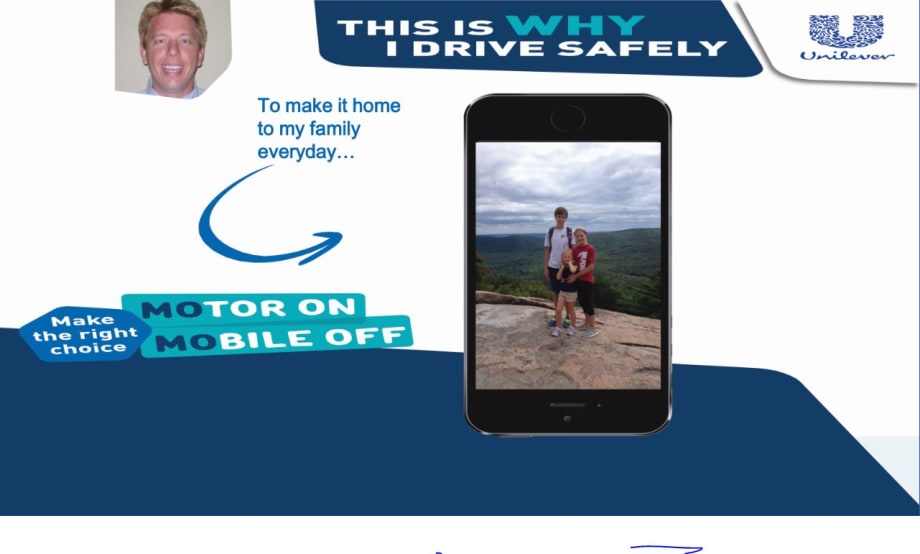
Neal Saiz, EHS and security director for Unilever created this image to send out to Unilever employees. Distracted driving is a real problem on roads, and the MOMO initiative was started to help reduce and prevent fatal accidents. Image courtesy of Unilever.
Ask any Unilever employee about MOMO and he or she will know exactly what it is. Whether it’s someone in the accounting department, a fleet driver, or an executive, he or she will tell you that MOMO stands for “motor on, mobile off.”
It’s a company policy that has been deeply ingrained into the company culture to the point that even family members of Unilever employees know about, and follow the MOMO policy.
“It stems from a mantra that we have within Unilever: small actions lead to big results,” said Oleg Cytowicz, Americas fleet lead for Unilever. “Identifying the fact that distracted driving is becoming a very prominent issue within our society, a small action that we, as Unilever, can do is eliminate the potential threat of a distracted driver, which can have a big impact on our society.”
Birth of MOMO
This anti-distracted driving policy was officially rolled out a little over two years ago in July 2015.
Around this time, Unilever had performed a large-scale global audit of its operations to find areas with potential risk to employees. Risk factors in the eight different “clusters” the company operated in determined what risk category those clusters would fall in. And, depending on the risk category, a certain action plan would be assigned to that cluster.
Various factors such as population in the areas business is conducted, types of road conditions, vehicles available, and safety equipment offered were analyzed.
North America — which is one of eight clusters — fell into a low risk category, according to Neal Saiz, EHS and security director. Saiz is responsible for the North American cluster, and as such, was responsible for implementing and rolling out the MOMO campaign across the continent.
As it might have been expected, MOMO was met with a great deal of employee hesitation at first, according to Cytowicz. Employees had a lot of questions to the specifics of the policy.
Does this policy only apply to mobile devices? Is the policy literal? Can I check my emails if I’m in a parking lot idling?
“We had months and months and months of communicating the program on a regular basis, held town halls, and sent out various electronic communications, it was a well thought out process,” said Neal Saiz, EHS and security director.
Policy Details
The policy applies to all electronics, not just mobile devices. It also isn’t literal. A vehicle’s motor can be on, idling, while employees check their emails or take calls in a safe area. The policy also isn’t limited to just company cars or a Monday to Friday work week.
If an employee receives a call on a company phone while in a personal car on a Sunday, he or she can’t take the call. The employee has to wait until he or she is no longer driving in order to return the call. Hands-free Bluetooth devices are also not allowed.
Two years later, Unilever feels like it has provided a bevy of information to answer most common questions. The policy is now in what Saiz calls “maintenance mode.”
“Our leadership endorsed it, which I think really helped the program globally. Right now, we’re in maintenance mode. Once a quarter we remind our employees of the requirements and we also include them in the new hire orientation,” said Saiz.
While the company operates on the assumption that its employees are following the policy, it is fully aware that there are going to be employees who violate the policy and use their electronic devices while operating a vehicle. So, the company has setup a two-strike system for violators.
“If we do a driver record check, and it comes back that one of our drivers received a ticket or violation due to using a cell phone while in their car, then OK we caught you this time, you’re going to receive a warning,” said Cytowicz. “If this comes back again, you could be let go.”
Shown is one of Unilever’s promotional vehicles modified and upfitted to hold three mini freezers to deliver ice cream to various corporate and community events. Photo courtesy of Unilever.
In the two years since MOMO has been implemented Saiz has only investigated one accident involving a company car caused by distracted driving.
Effects of the Policy
Cytowicz said that it’s been difficult to determine the exact results of the MOMO policy, as accidents caused by distracted driving wasn’t a metric that the company tracked. However, one thing he has noticed since rolling out the policy is a reduction in accident rates.
“We believe our accident rate has dropped pretty significantly since MOMO was introduced. To the point where the president of our collision management company called us to confirm that we had not moved to a different collision management company, because they noticed a significant drop in claims not going through their system,” said Cytowicz.
So far in 2017, there have been no reported incidents involving driving related incidents across the U.S. and Canada. The year before that, there were several, according to Saiz.
“I can’t say that it’s all because of MOMO,” Saiz said. “But, I can say that I’m paying less on collision and I’m having fewer accidents.”
The Future of the Policy
MOMO is something that Cytowicz said he would love to share with other organizations. It’s a policy that has resonated with employees, and it has resulted in a positive change for the company.
Saiz noted that the future of the policy, and its mission to combat distracted driving, will be determined by evolving technology.
One recent example of this is the recently announced “Do Not Disturb While Driving” mode coming to iPhones as part of the iOS 11 update. The feature will block notifications such as texts while a person is driving a vehicle. Anyone who attempts to contact the driver while the mode is turned on will receive an automated response explaining that the driver is operating a vehicle and will not be able to receive the message until he or she reaches his or her destination.
Saiz is exploring options for it to be a requirement that all company phones turn this feature on when it is released. “Leveraging technology and continuing to sustain the process is the future of the program,” said Saiz.
Subscribe to Our Newsletter
More Safety

What’s Next for Fleet? Safety, AI & Industry Recognition | AF News Recap
Could your company's culture be encouraging distracted driving? This week, we're exploring how workplace expectations affect driver safety, what AI, EVs, and autonomous vehicles could mean for the future of fleet management, and how fleet professionals can strengthen their award nominations.
Read More →
Does Your Fleet's Culture Encourage Distracted Driving?
What happens when the people responsible for enforcing safety rules are the ones setting the wrong example? The answer may reveal why some of the biggest risks to fleet drivers have little to do with what's written in the employee handbook.
Read More →
Sponsored•October 1, 2026
Fleet Manager’s Ultimate Playbook: Navigating the New Standard in OEM Connectivity
Rising operating costs, driver safety concerns, and unplanned downtime are putting unprecedented pressure on modern fleets. Discover how fleet managers use embedded OEM connectivity and real-time vehicle data to cut TCO, prevent downtime, and protect drivers without aftermarket telematics hardware.
Read More →
From Driver Well-Being to EV Charging | AF News Recap
Mental health belongs in the fleet safety conversation. This week, we’re looking at five ways fleets can support employee well-being before a crisis, plus Holman’s expansion in Mexico, new one-day Fleet Forward passes, and why EV charging demand is outpacing infrastructure growth.
Read More →
Nexar-Nauto Merger Aims to Give Fleets Better Safety Intelligence Through Larger Driving Dataset
Stefan Heck tells Automotive Fleet that combining more than 10 billion miles of driving history with Nexar's AI models will give fleets deeper insights into driver risk and roadway conditions than either company could provide independently.
Read More →
Don't Wait for a Crisis: 5 Ways to Build Mental Health Into Your Fleet Safety Program
For Suicide Prevention Month, fleet and safety leaders have an opportunity to put mental health where it belongs: at the center of workplace safety.
Read More →
How Camera Data Can Strengthen a Fleet’s Insurance Renewal
Insights from a commercial insurance carrier and a broker show how fleets can turn video telematic data, driver coaching, and improved claims results into a stronger case at insurance renewal.
Read More →
The Safest Fleets Aren’t the Ones with the Most Technology
You’ve made the telematics investment. Here’s how to capture the other half of its value and build the safest fleet on the road.
Read More →
Sponsored•August 7, 2026
Hidden in Plain Sight: Fleet Compliance Risks
Fleet compliance isn't just about having policies — it's about consistently enforcing them. This practical guide reveals six hidden compliance risks common in public sector and shared fleet operations and outlines proven strategies to improve visibility, accountability, and audit readiness
Read More →
NETS Sets 2026 Fleet Safety Benchmark Conference for Indianapolis
The Sept. 15–17 program will feature fleet benchmarking data, case studies, emerging technologies, and implementation strategies while running alongside the NSC Safety Congress & Expo.
Read More →