





Photos: EVs and Auto Tech at the 4th Annual Merchants Fleet Summit
TurnPoint is ‘Bringing It All Together’
To centralize a 100% decentralized fleet — nearly 60 individual fleets and 4,200 vehicles dispersed nationwide — a well-thought-out change management plan is paramount, says Adam Nesbit, VP of procurement for TurnPoint.
September 18, 2023
Founded in 2016, TurnPoint Services today provides HVAC, plumbing and electric services to residential and commercial properties. The $1.4 billion company has nearly 60 local brands and operates a nationally dispersed fleet of 4,200 vehicles.
Photo: TurnPoint | Automotive Fleet
6 min to read
When Adam Nesbitt joined TurnPoint Services as VP of procurement in late 2021, the company’s 3,000-unit fleet was dispersed in 40 locations throughout the U.S., each with its own fleet organization, practices, and data system.
Nesbitt’s mission: centralize all fleet operations — standardize procurement, maintenance, and replacement tasks and, most importantly, create an accurate account of the fleet’s true costs.
Over the following 18 months, Nesbitt and his five-member staff planned and implemented an effective change management process, a “paramount” factor to the successful centralization endeavor.
Rapid Growth Fuels Centralization
Founded in 2016, TurnPoint Services today provides HVAC, plumbing, and electric services to residential and commercial properties. The company’s nearly 60 local brands — and 4,200 fleet vehicles — are scattered across the country. The $1.4 billion company’s growth has been driven by annual acquisitions of 15-20 businesses. Owned by TurnPoint, each acquired enterprise is managed by its owner-operator.
“TurnPoint provides ancillary services, such as HR support, health insurance, and truck procurement fuel, maintenance, etc.,” Nesbitt explained. “We take away their headaches, and they concentrate on managing their customer base and growing their business, what they do best.”
The TurnPoint fleet comprises acquired brand vehicles, primarily cargo vans such as the Ford Transit and Chevy Express, high-roof extended vans, pickup trucks, and some box trucks.
In addition to vehicles, the fleet also includes 4,300 pieces of equipment, such as Bobcats for digging trenches and jetters for drain cleaning.
This year, Nesbitt projects adding another 750 vehicles through business growth and vehicle replacement.
No Accounting on True Costs
As the TurnPoint grew quickly, the company focused on “getting everything on board for the brands: trucks, equipment, replacements, fuel cards,” Nesbitt said. “There was no focus on the true cost of our fleet, no hardcore numbers to drill down to.”
“The only centralized view of the fleet we had was from the WEX fuel cards. There was no way of getting a complete view from telematics of milage, actual maintenance costs, or even knowing where every truck was. There was almost zero visibility of day-to-day and maintenance fleet operations,” he added.
TurnPoint officials had already begun exploring a fleet management solution.
“Having a comprehensive fleet management approach is a critical success factor for TurnPoint,” said company COO Tim Russell. “We are taking significant steps to make sure we have the safest vehicles possible for our team. Having real-time data to make operational decisions is one of our founding principles. Adam and his team are working hard to make both of those priorities come true.”
The company’s two fleet managers, Ron McGuigan and Jay Parsley, played “an integral part of supporting TurnPoint operations,” before he arrived, Nesbitt pointed out. They started the due diligence process, exploring potential fleet management company relationships.
Once onboard, Nesbitt developed the business case for partnering with a fleet management company. Ultimately, TurnPoint selected New England-based Merchants Fleet.
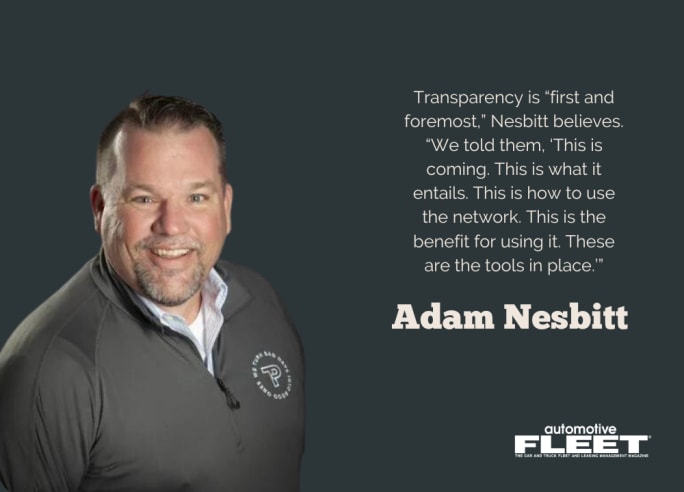
Adam Nesbitt is VP of procurement for TurnPoint Services. Over an 18-month period, Nesbitt and his five-member staff successfully centralized the company's fleet operations.
Photo: TurnPoint | Automotive Fleet
‘Positive’ FMC Move
From the start, Nesbitt and his team had a “roadmap” for their association with Merchants Fleet: determine actual fleet spend, uncover expense points, and create operational visibility. A future goal is building analytics for improved forecasting and budgeting.
“The move to a fleet management company was a positive,” Nesbitt believes, particularly in leveraging Merchant services.
“TurnPoint is a lean company,” he pointed out. “We may be at $1.4 billion in revenue, but we have just 140-145 employees. I would need to bring on 15-20 full-time people to do what Merchants Fleet does. And those new hires would have a learning curve — no one would be really comfortable with their jobs for at least six months.”
Merchants’ relationships with maintenance and towing companies, its network of vendors helped speed TurnPoint’s fleet centralization process.
In addition, the Merchants’ ReadyFleet program — a pool of near-new and pre-owned vehicles — proved especially advantageous in procuring urgently required vehicles during recent daunting industry sourcing challenges.
“Without trucks, we’re out of business,” Nesbitt stated.
Managing Change
Managing the change from a collection of many — and growing — individual fleet operations to a cohesive, integrated organization required a comprehensive series of carefully planned steps.
Working with Merchants, Nesbitt and his team began “bringing it all together in a centralized way. We leveraged Merchants' data, their knowledge on how they rolled out their platform to other fleets.”
A great deal of work in managing the centralization process with Merchants was done upfront with communication and internal marketing activities, Nesbitt said.
Parsley and McGuigan were essential in implementing the rollout, hosting monthly calls to introduce Merchants, its team and software package to brand general managers and fleet lead personnel.
Transparency is “first and foremost,” Nesbitt believes. “We told them, ‘This is coming. This is what it entails. This is how to use the network. This is the benefit for using it. These are the tools in place.’”
Live and online trainings were held on the Merchants platform. Finance teams were trained on extrapolating and analyzing essential cost data now available with the Merchants platform.
Movie-style posters announcing, “It’s coming” were circulated.
Routinely, key performance indicators were sent to general managers tracking the progress of the changeover to Merchants: “This is your program adoption. This is the cost you’re seeing. This is what we’ve mitigated from costs.”
An Evolving Relationship
Individual TurnPoint brands began adopting the platform, using Merchants’ online tools. Currently, 50% of the brands — “and growing” — have integrated a standard telematics program.
Nesbitt and his team now download real-time information on fuel, procurement, replacement, etc.
“We’re taking live mileage feed and bringing the data stream in via the Merchants platform so we can start real-time status of who’s doing maintenance on time, providing alerts to brands and conveying that information to the brand GM,” he explained.
Merchants now manages vehicle leasing according to TurnPoint specifications through upfitting and wrapping processes.
The TurnPoint fleet managers are “in lockstep” with the Merchants team. Weekly meetings track the status of truck procurement, upfitting, transit and delivery. During ‘higher-level” biweekly meetings with senior Merchant representatives, Nesbitt and his team evaluate the changeover process as well as uncover opportunities to improve.
The relationship with Merchants is maturing, Nesbitt observed.
“Now we are beginning to look at how to better utilize the tools,” said Nesbitt. “In a lot of ways, we’re learning how each other works, and we’re evolving in the relationship.”
However, he added, “We’re 1-million percent better than we were a year ago.”
That improvement forms a solid foundation for a centralization process that will continue as TurnPoint aims to grow its business three-fold-plus through additional local brand acquisitions in the next few years, said Nesbitt.
“That will mean adding close to 10,000 trucks as well as equipment. As one of the company’s bigger spend items, we want to be sure we’re investing correctly," he said.
To pilot that investment in fleet acquisition, Nesbitt and his team will again turn to the critical elements of effective change management: planning, communication, transparency, monitoring, and evaluation.
Subscribe to Our Newsletter
More Operations

How Fleets Can Recruit and Train Veterans for Technician Roles
Here's how the technician shortage has affected uptime for fleets, and what to do about it.
Read More →
Avis Budget Group Deploys Neology Toll Management Technology Across Major Brands
Neology’s neoFleet platform will manage toll transactions and toll-authority operations for vehicles across Avis, Budget, Payless, Budget Truck and Zipcar.
Read More →
Fleet Personal-Use Charges Edge Higher in 2026
Nearly eight in 10 surveyed fleets allow personal use of company vehicles, while just over half of respondents report charging employees for the privilege.
Read More →
The Future of Fleet + What’s Changing Right Now | AF News Recap
Could developments overseas offer a preview of what’s coming for U.S. fleets? This week, we’re looking at the future of AI, autonomy, and electrification, plus Ford Pro’s new certified pre-owned program, smarter vehicle offboarding, and a new way for fleets to manage toll expenses.
Read More →
How to Handle Vehicle Offboarding
What do fleet managers need to do when a driver leaves?
Read More →
Sponsored•October 1, 2026
Fleet Manager’s Ultimate Playbook: Navigating the New Standard in OEM Connectivity
Rising operating costs, driver safety concerns, and unplanned downtime are putting unprecedented pressure on modern fleets. Discover how fleet managers use embedded OEM connectivity and real-time vehicle data to cut TCO, prevent downtime, and protect drivers without aftermarket telematics hardware.
Read More →
U.S. Bank Adds Verra Mobility Toll Management to Voyager Fleet Platform
The integration allows U.S. Bank Voyager fleet customers to manage toll payments and violations alongside fuel, EV charging and maintenance expenses.
Read More →
ADAS Prevents Crashes. But Repairs Cost More | AF News Recap
ADAS-equipped vehicles may crash less often, but they can cost more when they do. This week, we’re breaking down what that tradeoff means for fleets, plus Subaru’s first Forester Wilderness Hybrid, Nissan’s new e-POWER Rogue, and why Calstart has become Catalyst Mobility.
Read More →
Moventum Fleet Management Names Mark Iorillo Head of Sales
Iorillo brings nearly 20 years of fleet management and sales experience to the role, including previous positions at Element Fleet Management, CEI, Donlen and Ryder.
Read More →
Fleet Has a Talent Pipeline Problem. What Comes Next? | AF News Recap
Where will fleet’s next generation of leaders come from? This week, we’re looking at the industry’s talent pipeline, what certification can add to a fleet career, how to build an award-worthy track record, and the return of Automotive Fleet’s Personal Use Survey.
Read More →