




Top 5 Last-Mile Routing Challenges & How to Solve Them
Delivery fleets face increased customer demands, missed ETAs, and vague delivery locations daily. A combination of technology implementations, rethinking operational processes, and leveraging customer information can help.


Delivery fleets face increased customer demands, missed ETAs, and vague delivery locations daily. A combination of technology implementations, rethinking operational processes, and leveraging customer information can help.
Photo: Getty Images
So much can happen during the very last leg of a delivery. A driver could get lost or have trouble finding the delivery location. Weather or traffic could impact delivery times. ETAs can be missed, and sensitive products can spoil. Those are just a few of the many hiccups that can happen, but they all have one thing in common: they can severely impact costs and customer satisfaction.
“The final mile is often the most complex, challenging, and costly segment of a shipment’s journey. It’s not uncommon for half of the cost of getting a shipment from origin to destination to occur in just the final mile movement,” said Brian Larwig, director of strategy at Trimble MAPS. “Reduced cost and added efficiencies come along as very direct benefits of overcoming last-mile routing challenges. But the overwhelmingly more impactful benefit is the ability to deliver excellent customer service in the final mile.”
The stakes are high when it comes to last-mile delivery, so understanding the challenges — and more importantly, how to overcome them — can yield significant business wins.
CHALLENGE 1: Meeting Increasingly Demanding Customer Expectations
Over the past few years, customers’ expectations for their delivery experiences have evolved dramatically. More and more, people expect accurate ETAs, short delivery times, and shipment visibility all along the way, even in the B2B space – and all of that puts more pressure on getting the final mile right.
“One of the biggest shifts that last-mile delivery fleets now face is consumers’ expectations for a five-star delivery experience. These expectations have been evolving for years due to Amazon. Still, they were catapulted forward with lockdown measures forcing many businesses to shut their doors to the public for months,” said Marc Kuo, founder and CEO for Routific. “When people were isolated at home, many were forced to try delivery services for the first time, using apps like Uber Eats, DoorDash, and Instacart, to name a few. Consumers have gotten used to this standard of delivery experiences and are now expecting the same from smaller delivery businesses.”
The solution: If businesses want to stay competitive in an increasingly customer-friendly landscape, Kuo said they need to look for ways to improve their delivery experience. This could include automated delivery notifications, real-time delivery tracking, tight time windows, accurate delivery times, and proof-of-delivery.
“To tackle the delivery experience, typically a business will use some software that will plan and optimize delivery routes, automate delivery communications, and provide tools for drivers to increase efficiencies when on the road,” Kuo said. “A good route planning software will optimize delivery routes with accurate delivery times and should also offer the ability to commit to tight time windows for customers. This helps to build trust with your customers.”
In addition to improving the customer service, Marin Šaric, CEO for OptimoRoute, said route optimization software could cut down the time spent fielding customer inquiries.
“Mature route optimization solutions have fully integrated dispatch and manage texting your customers with status messages and live updating Estimated Times of Arrival,” he said. “An all-in-one route optimization solution with real-time order tracking and text message notifications to customers can cut customer service support calls by as much as 70%.”
Cyndi Brandt, VP sales enablement & product marketing at Omnitracs, said another way to improve the customer experience is to hang onto the customer information you capture and use it to your advantage. “With a lot of last-mile deliveries going to repeat locations, fleets should understand preferences of the people or businesses they’re delivering to, and ensure their expectations continue to be met, so they remain satisfied customers,” she said.
CHALLENGE 2: Last-Minute Orders
It’s not uncommon for a route to be set and then an order comes in that changes the entire game plan.
“There are times where inventory may be ordered after a route is already set, which can create logistical challenges,” Brandt said. “Pending any last-minute orders, managers need to account for these situations by using solutions that ensure drivers aren’t maxing out their hours and all other deliveries will still be completed in time.”
The solution: Route optimization software can help delivery fleets quickly adapt to changes, running the new scenario through their algorithms in just moments.
“Routing can be chaotic, and customers often have little awareness of just how much work happens and how easily things can go wrong,” said George Shchegolev, co-founder and VP of operations, Route4Me. “So when fleets leverage route optimization, it makes the work easier and more enjoyable for those performing the work and at the same time makes happier customers who have high expectations in the modern world of instantaneous gratification.”
Šaric said route optimization software could also accommodate the changes that come with growth. “Many small businesses can take hours to create delivery plans for their fleet,” he said. “Without advanced route optimization, more and more hours are spent planning as the business grows, and making changes is painful. The most advanced solutions need only seconds to answer questions such as whether you need to get more vehicles on the road.”
CHALLENGE 3: Missed ETAs
One missed ETA can disappoint a customer, but it can also lead to more missed ETAs that disappoint even more customers.
“In a recent study, we found that 42% of the missed ETAs in the study of multi-stop, last-mile routes lead to an additional missed ETA on the same route,” Larwig said. “This shows how important it is to have a realistic and efficient route constructed from the beginning because once a driver falls behind, it is tough to catch back up.”
The solution: While it’s understandable that fleets will be laser-focused on routing, Larwig said the priority should be customers. “Focus on quality customer service first, and routing efficiency second,” he advised. “Since you never know what may happen on the road, give your routes enough buffer time to still get to stops on time if they encounter minor delays. Look for routing solutions that understand the concepts of customer service and don’t just tout ‘fewer miles’ with their solutions.”
Brandt said routing software allows delivery fleets to remain agile while maintaining delivery schedules. “Having proper routing technology ensures a fleet can deal with constant changes in volume and maximize capacity for each trip while ensuring deliveries are made on time,” she said.
Kuo said delivery management software helped ensure on-time deliveries for cold-pressed juice delivery service Greenhouse. Greenhouse faces the dual challenge of short shelf life and the need for refrigeration, so on-time, next-day deliveries are critical. “Sending email notifications to customers to let them know when their orders arrive helps to alleviate both of these potential problem areas,” Kuo said.
CHALLENGE 4: Getting to — and Finding — Delivery Locations
The challenge of successfully navigating to and arriving at delivery locations is comprised of several smaller challenges, including pinpointing the exact location, finding parking, encountering low bridges, getting stuck in traffic, and ending up on streets that are too narrow for delivery vehicles.
The solution: Larwig said solving these challenges is best done through a combination of technology and operational focus. “Adoption of routing software, visibility tools, commercial mapping, and location management systems are vital to be able to overcome these challenges,” he said. “But just as important is the ability of the operation to fully utilize these tools and establish an open ecosystem between all parties involved in a shipment (shipper, carrier, receiver) to ensure everyone is on the same page with expectations and real-time updates.”
Vehicle selection and figuring vehicle type into routing software can also resolve the geographic challenges delivery vehicles face.
“Vehicles that are too big for the areas in which they are delivering will waste time finding parking and will have to drive circuitous routes to fit under low bridges or avoid narrow streets,” Kuo said. “By selecting the most efficient vehicles that fit your delivery needs, you can reduce fuel costs and return-to-hub time.”
John McAvoy, V.P., GIS Engineering, Rand McNally, advises that if a large vehicle is making that last-mile trip, delivery fleets should use a router to route vehicles based on their physical characteristics, like weight, height, and width. “Truck-based routers will take into account the road network’s physical characteristics, legal restrictions for trucks, and truck designated routes,” he said. “A router for vans and light trucks may not safely or correctly route larger commercial vehicles.”
CHALLENGE 5: Driver Accountability
Delivery fleets may plan their routes perfectly, but if they don’t have visibility into how well their drivers are executing those routes, they could lose the efficiencies, productivity, and customer satisfaction gains they seek.
“When it comes to routing for last-mile delivery fleets, there are common challenges associated with driver productivity, safety, and lack of customer visibility,” said Sherry Calkins, vice president, Connected Car Business Development, Geotab. “Attempting to manage this problem manually creates challenges with late deliveries, driver overtime, and identifying driver gaps into their workday.”
Lack of visibility and accountability can also let unsafe driving practices go unchecked.
The solution: Pairing a telematics solution with routing software can give fleet managers insights into driver behavior.
“By integrating a telematics platform, fleet managers can achieve full visibility into dispatched jobs and planned routes in real-time,” Calkins explained. “This will help enable fleet managers and drivers to respond quickly to last-minute changes, plan routes effectively to maximize routes in the shortest period, and better manage missed or late deliveries.”
Telematics and advanced technology can provide the visibility needed to keep the final mile safe, too.
“Some last-mile fleets are installing video cameras with built-in artificial intelligence (AI) to help capture risky events and increase fleet safety,” Calkins said. “With access to greater visibility into the behavior of their drivers, last-mile fleet managers can better manage and assess driver risk and support driver coaching by identifying high-risk drivers.”
Originally posted on Work Truck Online
More Operations
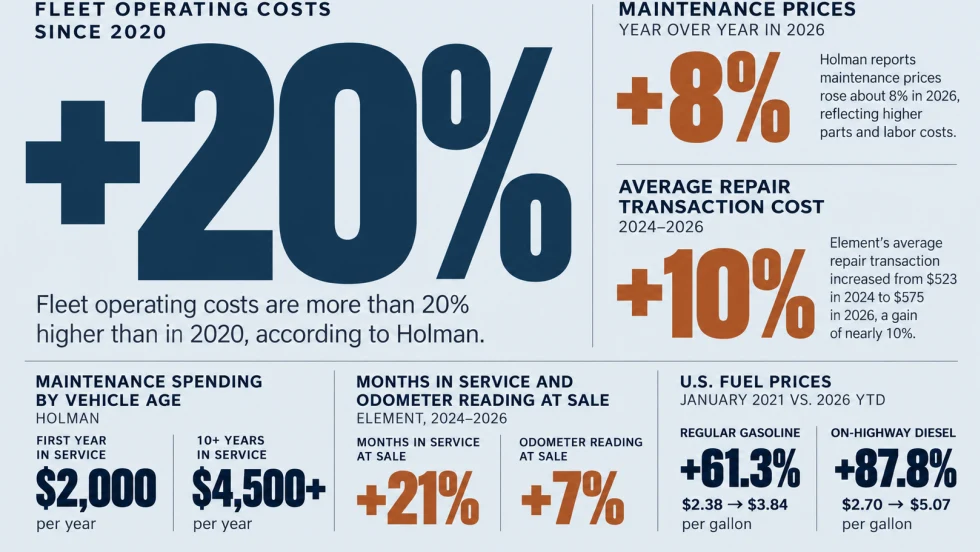
Managing Fleet Costs in an Era of Permanent Volatility
Fleet operating costs have risen more than 20% since 2020, raising a key question: When does extending a vehicle's service life stop making financial sense?
Read More →
The Next Evolution of Fleet Management: Autonomous Operations
This opening keynote session at the Fleet Forward Conference highlights the future of autonomous driving for fleets.
Read More →
How to Reduce the Total Cost of Risk From Catalytic Converter Theft
A stolen catalytic converter can cost fleets far more in downtime and lost productivity than in repairs. A total-cost-of-risk approach can help fleet managers quantify their exposure and prioritize theft prevention.
Read More →

Personal-Use Charges Rise as Vehicle Values Fall | AF News Recap
Personal-use charges are climbing, wholesale used-vehicle values are declining, and commercial fleet sales growth is slowing. This week, we're breaking down the latest fleet data, plus how Element Fleet Management is helping Waymo prepare for its first Canadian robotaxi market.
Read More →
Here's When You Should Make an Exception to Fleet Policy
Fleet policies are designed to create consistency, but not every driver or situation fits neatly within standard rules.
Read More →
AI-Native or AI-Acquired: What Should Fleet Managers Look for in an AI Platform?
Six questions can help fleet managers look beyond AI marketing claims to evaluate integration, data access, and real-world operational performance.
Read More →
A buyer's guide to fleet management software in 2027
Buying fleet management software in 2027 means looking beyond features and price. As fleet operations, technology and expectations evolve, this guide explores what today’s fleet professionals should consider when choosing a system that can deliver value now and adapt to what comes next.
Read More →
What Will Shape the Next Era of Fleet Management?
EVs, AI, and autonomous vehicles are reshaping fleet management. Discover what’s ahead—and how fleet leaders can prepare for the next era.
Read More →
How Fleets Can Recruit and Train Veterans for Technician Roles
Here's how the technician shortage has affected uptime for fleets, and what to do about it.
Read More →
Avis Budget Group Deploys Neology Toll Management Technology Across Major Brands
Neology’s neoFleet platform will manage toll transactions and toll-authority operations for vehicles across Avis, Budget, Payless, Budget Truck and Zipcar.
Read More →