




Top 10 Trends in Chassis-Mounted Auxiliary Equipment
Key trends in auxiliary equipment specifications focus on driver productivity and idle reduction using telematics, safety enhancements with crash avoidance sensors, and maximizing space using multi-function equipment.

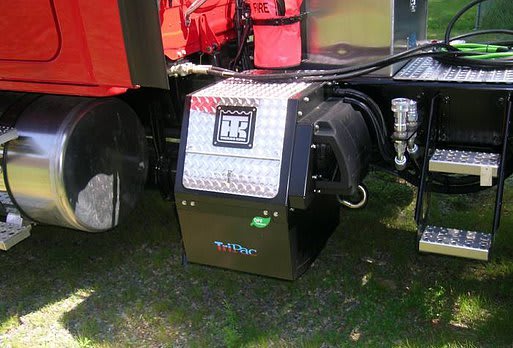
Increased use of auxiliary power units (APUs) (above) to power auxiliary equipment, spec’ing auxiliary equipment for weight reduction, and improved packaging have helped significantly improve fuel economy and environmental sustainability. (PHOTO: Fontaine Modification)
A variety of trends are impacting the specification of chassis-mounted auxiliary equipment by commercial fleets. Work Truck asked industry subject-matter experts to identify these trends and explain why they are occurring.
Here is what they told us:
Trend 1: Greater Use of Multi-Function Components
One example of multi-function equipment used in upfits is a three-in-one air compressor, generator, and welder.
“There’s an immense drive to reduce weight so a vehicle is below the threshold for DOT and CDL requirements,” said Joe Brightwell, manager, fleet services operations – truck engineering for Wheels. “In addition, the space savings created by multi-function equipment and ease of operator access is a win for drivers.”
Trend 2: More Interest in Crash Avoidance Add-On Equipment
OEM option packaging restrictions are causing many fleets to add safety equipment at the upfitter.
“Starting in late 2014, we have seen interest in fleets requesting crash-avoidance features. The majority of crash-avoidance features are offered by OEMs, which requires customers to select up-level or luxury trims. As a result, fleets are utilizing aftermarket companies and upfitters to install crash avoidance features on work level or base trim vehicles,” said Charles Mathew, supply chain specialist for Donlen. “The most common crash avoidance technologies used by fleets are forward-collision warning, lane-departure warning, and lane-departure prevention. This technology enables safer driver behavior, reduces the risk of accidents, and saves lives.”
Trend 3: Widespread Focus on Fuel Efficiency
A major trend with auxiliary equipment is the push for increased fuel efficiency.
“Significant gains are being made in both fuel economy and environmental sustainability by spec’ing auxiliary equipment for weight reduction, improved packaging, and the increased use of auxiliary power units (APUs) to power auxiliary equipment,” said Mike Crumlett, manager, North America truck maintenance operations for Emkay.
Trend 4: Increased Use of Telematics in Commercial Fleets
Fleet telematics applications have proliferated. “Various types of installed telematics components have hit the fleet industry with a major impact on fleet operations. Monitoring driver habits, as well as vehicle operational data, is becoming almost as commonplace as cruise control or power windows. We view the telematics industry as a constantly evolving, invaluable partner providing our customers with real-time information that will assist them in their job,” said Bill Byron, senior truck specialist for medium- and heavy-duty trucks for Donlen.
There are several reasons why this is occurring: “These devices provide cost-savings opportunities by developing downloadable critical data pertaining to driver habits, pointing toward accident prevention and fuel usage. Additionally, by monitoring vehicle performance, a fleet manager can utilize the data to make more educated fleet vehicle selector choices for his or her company,” said Byron.
One impact to the upfitting of these devices is the incorporation of this equipment by OEMs into the vehicles during the new-vehicle assembly process.
“Fleets continue to seek out new telematics technology in an effort to maximize fuel efficiency, monitor drivers to ensure safe driving, and manage logistics. Competition will increase in this market as OEMs continue to develop in-vehicle telematics systems,” said Howard Goldman, vehicle purchasing manager for Merchants Fleet Management.
Trend 5: More Fleets are Specifying Cranes, Compressors & Inverters
“We’ve experienced an increased frequency in being asked by customers to include equipment, such as cranes, compressors, and inverters, within our upfit quotations prior to an order being placed. Our customers prefer using nationally recognized brands at a consistent, repeatable price for their use wherever their need may be,” said Byron of Donlen.
Another reason is for improved cost control.
“Fleet managers are continually been pressed to control or reduce costs and having these types of equipment added post-vehicle delivery not only limits the productivity of the vehicle operator (if they are out seeking quotes and not working), but also the costs can vary dramatically between their New York branch and San Francisco branch, for example. Where possible, we coordinate with our upfit partners to have as much of the job-specific necessary equipment added prior to final delivery to reduce technician downtime and, just as importantly, to standardize costs,” said Byron.
Trend 6: Cargo Management Systems for Downsized Vehicles
“As commercial fleets continue to downsize to smaller vehicles, the need to maximize cargo space becomes much more important,” said Goldman of Merchants Fleet Management. “Upfitters, for both pickup trucks and cargo vans, are recognizing this need and are offering maximum storage space solutions in slide-in storage units and interior upfit van packages.”
Trend 7: Greater Use of Wireless Tools by Drivers
“More companies are providing laptops to employees. We’re providing upfit technology so drivers can do their job on the road and connect back to home base. Three years ago, you didn’t see laptops in vehicles. Now, we need to supply a constant source of energy. With wireless, there’s a constant communications link. Although new cars have this technology built in, with trucks it’s still an add-on. Very few OEMs are providing that capability now, but it will change in the next year or so,” said Don Scare, manager, truck excellence at Element Fleet Management.
Trend 8: Lead Times are Increasing Across the Board
With the increasing demand and growth of the commercial truck and van segments, particularly among utilities and service industries, the percentage of upfit vehicles is growing, which creates backlogs and delays in order-to-delivery.
“Business is back, and few OEM and auxiliary equipment manufacturers have added significant capacity. Lead-times are now commonly stated in months. Shop floors and systems are being challenged with heavy order volumes. Lead times are growing as many firms absorb the increases,” said Brightwell of Wheels.
Trend 9: Refurbishment of Auxiliary Equipment
One trend for auxiliary equipment is the refurbishment and re-use of existing service bodies and equipment, particularly if customized for a specific job.
“Fleets invest significant time and resources to create upfits and equipment that fulfill the needs of drivers. In many cases, the cost of the auxiliary equipment exceeds the cost of the chassis. While careful consideration is given to picking the correct chassis, its value lies in its ability to get the equipment to the jobsite,” said Crumlett of Emkay. “In addition, it’s typically easier to sell off a cab and chassis than it is to find a buyer for specialty equipment. Due to these factors, it’s often preferable to refurbish and refit equipment when it’s time to cycle the chassis.”
Trend 10: Solar Battery Charging /Auxiliary Power
As anti-idling laws become more prevalent, fleets are turning to onboard generators, called auxiliary power units (APUs), to operate accessory equipment without having to idle the vehicle engine. In addition to APUs, fleets are also looking at innovative, non-fossil-based fuels to power accessory equipment.
“One trend is to use solar power to operate in-cab heating and needed power to operate equipment. This is being accomplished by adding solar panels on the roof of the vehicle. The key reason why this is a growing trend is because fleets are looking for sources to reduce fuel consumption and need to idle vehicles. Currently, no-idle laws are in effect in 28 states and more states will soon follow,” said Scare.
Originally posted on Work Truck Online
More Operations

Fleet Has a Talent Pipeline Problem. What Comes Next? | AF News Recap
Where will fleet’s next generation of leaders come from? This week, we’re looking at the industry’s talent pipeline, what certification can add to a fleet career, how to build an award-worthy track record, and the return of Automotive Fleet’s Personal Use Survey.
Read More →
Smith System Launches Driver Risk Management Program
Fleets have more driver data than ever, but identifying risky behavior doesn't necessarily correct it. Smith System's new Driver Risk Management program combines monitoring, training, and follow-up coaching to help fleets connect risk signals with driver intervention.
Read More →
Automotive Fleet Opens 2026 Personal Use Survey for Commercial Fleet Managers
Less than two weeks left! Commercial and corporate fleet managers are invited to share how their organizations handle company vehicle personal-use policies, charges, and driver eligibility.
Read More →
From AI Prompts to AI-Generated Safety Songs | AF News Recap
Can better prompts make AI more useful for fleet managers? This week, we’re breaking down smarter fleet analysis, an AI-assisted experiment that turned safety training into music, and what happened to fuel prices in August.
Read More →
How to Write Better AI Prompts for Fleet Analysis
Include these six elements in your fleet prompts to generate more relevant analysis and accurate answers.
Read More →
Fleet Meets: Eric Kilgore
This edition of the Fleet Meets series features one of the industry's best leaders driving multi-market and national operations.
Read More →
Why Reactive Fleet Management Is Becoming Too Expensive to Sustain
Research highlights a growing need for proactive management strategies to address rising costs in fleet operations effectively.
Read More →
What Your Fleet KPIs Aren’t Telling You
Tracking fleet metrics is only useful when the data leads to better decisions. This guide helps fleet leaders assess cost, utilization, and downtime more accurately, identify performance gaps, and prioritize the actions that can improve operational results.
Read More →
Hidden in Plain Sight: Fleet Compliance Risks
Fleet compliance isn't just about having policies — it's about consistently enforcing them. This practical guide reveals six hidden compliance risks common in public sector and shared fleet operations and outlines proven strategies to improve visibility, accountability, and audit readiness
Read More →
Turning Fleet Payment Data into Executive Insights
Does data alone drive results in operations?
Read More →