




The State of the Wholesale Used-Vehicle Market
High demand and scarce supply has resulted in extremely strong resale values, which are forecast to persist for the next several years.
While the rest of the economy is still floundering, remarketers have something to celebrate: 2011 has been an unbelievable sales year in the used-vehicle business.
Commercial fleet managers and their fleet management companies have been real heroes for their respective companies. Demand is extremely strong for good used vehicles as many dealers are clamoring to meet consumer demands for what they perceive as a better buy — a three- to four-year-old used vehicle.
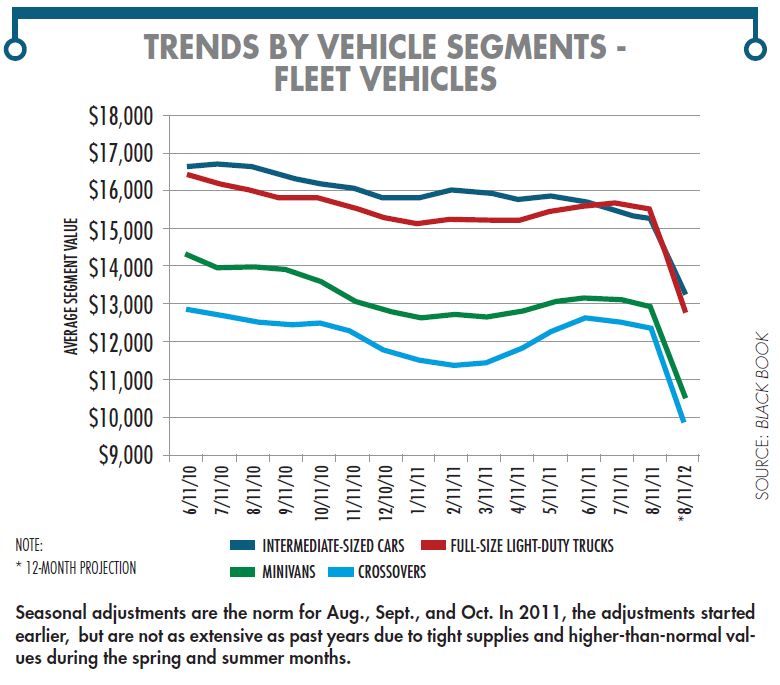
Because of continuing limited used-vehicle supplies, resale value retention has been at tremendous levels for most of the past seven to eight months. Historically, the wholesale used-vehicle market gets a seasonal adjustment during the August to November time period, as dealers make room for an additional model-year of vehicles coming to dealer showrooms.
As the industry headed into August a trend change was observed with the easing up of resale values on most models and segments. The key point is that this current softening is at a much smaller level than has historically been the case. The movement from higher-than-normal resale values to a seasonal adjustment, which is much more controlled, is all being driven by a lack of supply of used vehicles.
Fewer returning off-lease units, fewer rental cars being remarketed, even strategic remarketing by fleets extending vehicle lifecycles, to go along with drops of 38 percent and 30 percent in 2009 and 2010 respectively from pre-recession levels of new vehicle sales, are all driving forces behind the current tight used-vehicle inventory.
Cause of the Banner Year
The reason for 2011’s banner used-vehicle sales year is simple — demand is outstripping supply.
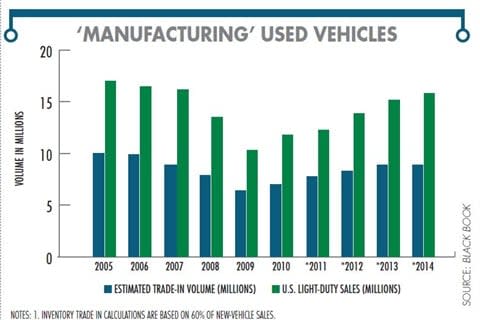
The beginning of the shortage of used vehicles can be pinpointed to 2009 when annual new vehicle sales fell to a low of 10.3 million units from the previous year’s mark of 16.9 million.
With every new vehicle sale there is a used vehicle being manufactured. Excluding lease contracts from retail and commercial segments, it is not known when a vehicle will be released to the used marketplace. In retail sales, dealers say that between 45 percent and 75 percent of sales have a trade-in. Using 2005 and 2009 volumes, and a rate of 60 percent, almost 4 million potential used vehicles did not come into the marketplace.
This used-vehicle model supply shortage was made even more prevalent due to large numbers of consumers who could have been new-vehicle purchasers, instead, electing to buy or finance a good used vehicle at a lesser total expenditure, e.g., a $12,000 to $14,000 used vehicle versus a $28,000 to $30,000 new vehicle.
It will probably be 2013 before new-vehicle unit volume returns to the 15-plus-million level of new vehicle sales. At an estimated 15.5 million in 2013 and the traditional 60-percent trade-in rate, there will only be 400,000 fewer trade-in units than the market had access to in 2007 when new vehicle sales were at 16.2 million. It is expected that there will be a solid level of value in the used market through the middle of 2013.
Getting back to the expected new-vehicle volumes will be a steady climb, raising the expected used-vehicle inventory at the same pace. In some quarters there is a belief that the new-vehicle market will be back to over 17-million sales in the next three to four years.
However, there is one factor missing from this rosy prediction — the lack of home equity money. When sales volumes were at 17-million units, about 1.7 million of these transactions were financed through home equity loans.
Because of the housing crash, it is likely that it will be some time before this financing source returns. Without home equity funding as a source of financing, a more realistic sales projection is 15.5 million, with estimates between 15.6 and 15.8 million for the 2014 and 2015 model-years.
Finding a Reasonable Market
The evaluation of any used vehicle is usually based on the last vehicle bought or sold at auction. For a buyer, it may have been a “steal” or “overvalued.” For a seller, that last vehicle may not have “brought enough.”
The ideal is for both parties to walk away from a deal thinking that that it was “reasonable.” The road to getting a reasonable deal both as a seller and as a buyer doesn’t have to be difficult. But it is important to know — particularly at this moment in time — what factors are driving the wholesale remarketing segment as a whole.
Impact of Regional Differences
Regional differences have gradually become a moot point as online auction and listing venues have expanded, erasing geographic distances.
Timely and versatile shipping solutions have made distance purchases very seamless. With today’s tight supplies and limited selection of units, dealers are almost forced to expand their purchasing area, especially when looking for an exceptional, extra-clean, low-mileage vehicle. From a seller’s viewpoint, the market of potential buyers has expanded as well once a vehicle is listed and offered online.
As a vehicle enters the digital wholesale marketplace, it is crucial to remember the importance of detailed and accurate inspection and condition reports, particularly for a buyer who may be located a state or two away.
Getting more eyes from a broader geographical area is a tremendous way to improve returns. Physical and online auctions do a great job with Web tools and solutions to make this a solid way to find inventory.
It is an easy process to search for vehicles, compare condition reports, and complete the bidding and purchase process. Oftentimes an online buyer’s confidence level is raised when in-lane bidding is strong. The transaction may still be from an in-lane bidder, but if the next-to-last bidder was online, he or she may be responsible for pushing the bid a little higher, thus getting an extra $100 or more for the seller.
The Effects of Mileage
Supply has an effect on all phases of the industry, and the limited availability of low- or even normal-mileage units has made some dealers more willing to purchase vehicles with high mileage. Of course, low-mileage vehicles are still in high demand.
Today’s mileage charts are reflective of past adjustment levels, except on the higher-line luxury units where the deduction is slightly more for the same age and mileage ranges. What has changed is the additional value dealers are willing to place on very low-mileage units.
The growth in the use of mobile applications to value a car has allowed more dealers to apply the mileage variances into their appraisal and valuation process, instead of just guessing. The result is more consistency in these extremely low- and far-out higher mileage transactions.
Contd.
[PAGEBREAK]
The Cost of Age
The newer the vehicle the more of a struggle it has become to get multiple bidders willing to spend top dollar. Many are seeing the overall strong used market where the one- and two-year-old used vehicle is just too close to a new model, not only in total cost but in real-world monthly payments.
The most crucial question to ask at this point in the calendar year is if the upcoming end of the model-year will possibly bring some aggressive clear out with inventory incentives? Simply put, dealers don’t want to get overloaded in a segment of the market that might have an extra push downward to keep the new to used value separated.
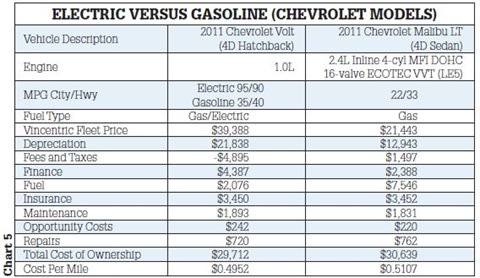
Valuing Color as a Resale Enhancer
Color is one of the most difficult items to track and trend. Shades and variances of reds, greens, and grays will sometimes vary greatly. Tracking exactly the same model, mileage, equipment, and condition, and then throwing in color differences makes it extremely difficult to affix a value.
Location combined with color selection can drive vehicle value up or down. Selling a white car in New York could be as difficult as selling a black one in Arizona. This is one variable where geographic region — even for Internet sales and listings — becomes a factor.
Popular colors are often desirable because of the model and not the shade. For instance, red may be on the top of the list for a full-size pickup, but a red luxury sedan will likely see no advantage.
A unique color on one vehicle may do well. However, trying to find a dozen buyers for a fluorescent green sports car can be a challenge, even after lowering the floor significantly. This might be the scenario where you get that unique buyer by listing the vehicle upstream.
Impact of Optional Equipment and Accessories on Resale
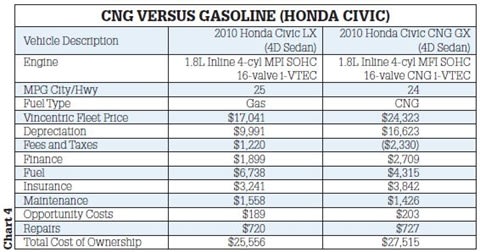
Sometimes uniqueness can increase resale value or drop it. This is particularly the case with optional equipment and accessories.
Values can vary most when equipment that is expected by a buyer is not installed on a vehicle. For instance, there’s not a hue and cry in the market for manual-transmission Escapes. Likewise, imagine the reaction when the upscale trim level of a full-size pickup with leather seating is deleted. Or, consider the likelihood of selling a minivan without the rear entertainment center — which would be viewed as something out of the dark ages by any family with children under the age of 15.
The same scenario exists for getting extra, non-standard equipment. In the past five years, optional diesel engines have been one of the strongest retention values in the industry. Many of these engines bring 100-percent or more of their initial retail value after two or even three years of use. The number of vehicles offering these is currently small, thus helping value retention. However, there are some models on which the optional diesel engine has a high penetration and it is often hard to find a gas engine model, the 1-ton pickup is an example of a saturated diesel segment.
On the car side, Volkswagen has captured most of this diesel engine market. On the truck side, there are and have been a few Jeep and Mercedes-Benz models for some cars and utilities, while ¾- and 1-ton pickups have strong volumes with diesel power plants.
Other optional equipment that not only adds value, but makes a vehicle stand out and hopefully sell more quickly include sunroofs, leather interior, and even upgraded wheels. In some segments, rear entertainment systems are almost expected, as is third-row seating on some vans and sport/utilities.
Adjusting to the Market
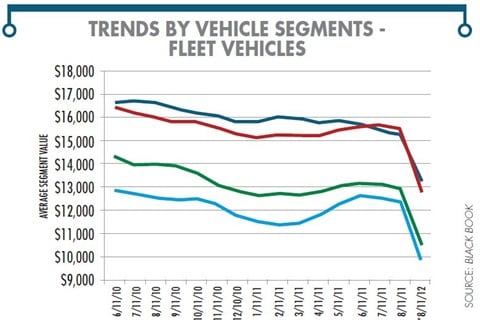
Today’s dealers — both independent and franchised — are proactively adjusting to more controlled new manufacturing levels, tougher to find used inventories, fluctuations with financing, and a less-than-confident retail buyer. One thing about the remarketing industry is the dealers’ drive and ability to adjust to whatever is thrown at them. From an oversupply of off-lease cars at one time to drastic gas price fluctuations, which drove all interest away from full-size SUVs to alternative-fuel vehicles; the dealers have and will adjust.
The wider use of tools and venues to obtain the needed inventory is another step dealers have taken. Tracking used offerings at multiple sites is the norm for most dealers. That’s the most important reason for a fleet remarketer to post upstream and online: to get more eyes from an expanded market area.
Dealers’ concerns are currently focused around getting the right product at the right price. Consumer financing is not as big an issue as it was in 2009 and 2010 when lending criteria was almost locked down.
What’s Hot & What’s Not
Depending on location, consignment, and attendance there will be strong days at an auction and then a day where many sellers will struggle. The real strength in the market right now is the four- to five-year-old vehicle and those in the $5,000 to $8,000 range.
When a one- to two-year-old vehicle, especially a full-size SUV with all ofthe equipment and very low mileage appears in the lanes or online, the bidding wars begin, and remarketers will see particularly healthy profits.
During July and early August there was not a specific segment type that stood out with increasing values. There were 11 different segment types that depreciated less than 1 percent over the previous month.
There were six segment types with the largest monthly depreciation percentage ranging from -1.4 percent to -1.8 percent. This depreciation runs over a yearly period, and, given an annual depreciation of 16.8 percent to 21.7 percent, is just above the historically expected 16-percent to 18-percent level.
The Bottom Line
Although the overall economy may be recovering more slowly than expected, businesses will see a revival of their fleet needs.
The fleet industry is facing a number of ongoing challenges, including tighter manufacturing production levels and a focus on limiting and controlling fleet and daily rental volumes to strengthen residual retention. As the overall volumes grow, the end of service values can’t be expected to maintain the strength the market is experiencing today.
In 2011, remarketing teams are heroes because of their level of returns versus residual forecast from two to three years ago. It shouldn’t be expected that this “golden age” will look the same a couple of cycles from now, unless forecasts on value retention take future volumes into account for today’s projections.
More Operations

Turn Fleet Data Into Smarter Decisions
Fleet leaders have access to more operational data than ever, but disconnected systems and unclear metrics often slow decision-making instead of improving it. This article outlines five practical steps fleets can take to transform fragmented data into actionable insights that improve planning, safety, utilization, and long-term performance.
Read More →
Hybrids: Electrification Without the Challenges
For fleet managers, fuel is one of the biggest line items in the budget — and it's one hybrids can shrink without changing how your people work. Download the eBook to see the numbers, understand the technology, and get a step-by-step guide to making the switch.
Read More →
How NOV Uses Telematics to Improve Fleet Safety Across 160 Locations
James Victory of NOV discusses how the company manages fleet safety, maintenance, and telematics across more than 150 locations supporting oilfield operations throughout the U.S.
Read More →
Fleet Meets: Steven Santostasi
This edition of the Fleet Meets series features Steven Santostasi, the current TSP channel manager for Ford Pro.
Read More →
Why Fleet Managers Are Replacing Departmental Vehicles with Shared Motor Pools
Departmentally assigned vehicles often create hidden costs through underutilization, poor visibility, and increased administrative burden. This white paper explores how shared motor pool strategies help fleets reduce costs, improve accountability, and optimize vehicle utilization.
Read More →
Soap Box Derby Challenge: Assembling the Crew
Meet Gabriel, Matthew, and Angel — the team helping bring this soap box derby build to life.
Read More →
BBL Fleet Acquires Velcor Leasing Corporation
BBL Fleet expanded its footprint in the fleet management industry with the acquisition of Velcor Leasing Corporation of Madison through a stock purchase agreement finalized Feb. 27, 2026.
Read More →
Lytx Introduces New AI Fleet Technologies at Protect 2026
The company introduced new AI-driven fleet safety and operations technologies during its annual user conference.
Read More →
Fleet Costs Are Rising: Here’s How Leaders Are Responding
Fleet leaders are under pressure to reduce costs, adapt to economic uncertainty, and make smarter decisions. See how peers across North America are responding with real data, proven strategies, and forward-looking insights. Download the 2026 Market Pulse Report to benchmark your strategy and uncover where you can gain an edge.
Read More →
From Waffle House to AI: Fleet Trends You Need to Know
In this AF news recap, host Faith Howell covers how Waffle House stepped up during disaster response and new AI tech on the market.
Read More →