




The Corporate Fleet Manager: Today & Tomorrow
There is a need to identify new ways to save money and decrease accidents. Changes in the economy and to whom fleet managers report have adjusted the role of the fleet manager today and will change it again in the future.

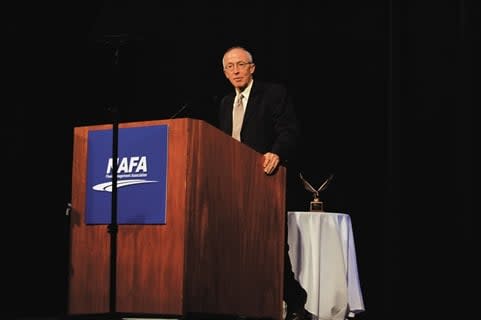
Jim Frank, CEO and president of Wheels Inc., which sponsors the Professional Fleet Manager of the Year award, speaks about the value of professional fleet management at the 2011 NAFA Institute & Expo.
Jim Frank, CEO and president of Wheels Inc., which sponsors the Professional Fleet Manager of the Year award, speaks about the value of professional fleet management at the 2011 NAFA Institute & Expo.
As one reviews the backgrounds and accomplishments of all of the nominees for the 2011 Professional Fleet Manager of the Year award, you cannot help but be impressed. They show:
● Numerous examples of substantial cost savings, as much as $1 million to $5 million in a year.
● Dramatic improvements in fuel economy, resulting in both cost savings and salutary environmental impact.
● Effective management of "upsizing" and "downsizing" of fleets from 400 to 10,000 vehicles.
● DOT-compliance implementation, avoiding embarrassing fines and improving productivity.
● Effective safety program implementation, resulting in significant reductions in accidents with corresponding savings in repair costs, increases in employee productivity, and most importantly, the human payback related to fewer injuries.
We have to ask ourselves whether or not these, and similar important accomplishments, would have been possible without the leadership of a capable and knowledgeable professional fleet manager. I think the answer would frequently be "no." The fleet manager's role in the implementation of successful enhancements to the fleet program is complex and multifaceted. It requires, at a minimum, obtaining endorsement of senior management, selection and supervision of appropriate vendors/partners, internal coordination and communication, and in many cases, securing enthusiasm and commitment from the vehicle operators.
Virtually all of these complex tasks, by their very nature, require an in-house manager to sponsor and drive.
So, would the job definition of fleet manager today look like one written five or 10 years ago? It is pretty clear that the answer is "no," which is a positive development as the scope and impact has clearly been elevated. There is no less need for fleet management today; rather, the stakes have been raised much higher and the potential contribution has been dramatically enhanced as the fleet manager leverages supplier expertise and technology to the benefit of the employer.
The Future of Fleet Management
What about the future? A recent article in Automotive Fleet indicated expense control and reduction is by far the No. 1 priority of the vast majority of fleet managers. Our own experience at Wheels would confirm the survey results. And this focus on expense reduction is perfectly rational.
To start with, 70 percent of the fleet managers with whom we deal now report to sourcing, whereas in the past it was very common for fleet to report to sales, operations, finance, or HR, depending on the nature of the client and their primary business requirements. Sourcing, by its very nature, will tend to focus on expense reduction. And appropriately so, given that we expect to see serious pressures on the cost of fleet operations in the near future.
We have been fortunate that through sound management, aggressive and thoughtful initiatives led by fleet managers, and sympathetic external forces, cost of fleet has barely increased, if at all, in the last 10 years.
The future, however, promises to be more difficult on a variety of fronts. Certainly, we cannot anticipate that interest rates will remain at record lows and could easily expect that they will increase by 2-3 times the current levels in the next few years. Fuel prices are already at record levels with a reasonable probability of further increases over time. There are powerful forces that may well drive significant increases in new vehicle prices, not the least of which are production rationalization by the OEMs and the cost in technology and materials required to achieve a 40-percent increase in fuel economy as mandated by the federal government. Some of these cost pressures will be offset by strong residual values and improved mpg, but the net impact will be increasing costs.
Given that we have effectively harvested the low-hanging and obvious savings opportunities, it will require the combined and shared thinking of sourcing, the fleet manager, and supplier partners to identify and effectively implement material savings in the future.[PAGEBREAK]
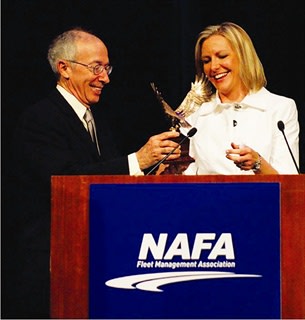
Frank presents the 2011 Professional Fleet Manager of the Year award to Theresa Belding of Forest Pharmaceuticals at the 2011 NAFA I&E.
Photo courtsey: NAFA
However, fleet management in the future goes well beyond cutting expenses. Just as the job definition of the fleet manager has changed substantially in the past few years, similar to virtually every other corporate role, the fleet manager job description, if it is to remain relevant, will continue to evolve to a higher value role in the future.
For one, as the economy evolves and improves, corporate focus will adjust and it is up to the fleet manager to interpret these changes and incorporate them into fleet policy. With higher interest rates, the cost of funding will become more significant and will influence fleet decision-making in ways that are not relevant today. Also, with an improving economy, the labor market will become more challenging and fleet policy can play an important role in attracting, retaining, and motivating sales and service staffs.
Areas such as finance, HR, sales, and service become much more relevant and the professional fleet manager, even within the context of sourcing, can play the key role in integrating the important interests of these diverse groups into the formation of informed fleet policy.
Within sourcing, the game is changing as well. Many of the savings opportunities have already been harvested, and many sourcing organizations are now looking at how they can leverage vendor relationships to improve the top line. In this regard, fleet can certainly be an ally. Most importantly, many perceive that wise fleet policy can not only provide cost efficiencies, but when implemented thoughtfully, can also contribute to employee retention, enthusiasm, and increased productivity. These important contributors to top-line growth may come at some expense in terms of both fleet policy and vehicle selection, but the secret is to balance cost versus benefit and come up with the best balance of both. The fleet manager is well positioned to contribute great value to this delicate balancing act.
'A Whole New World'
Finally, a whole new frontier is opening up in an area that could dramatically change the effectiveness of sound fleet management. Ultimately, it is not trivial to remind ourselves that the reason we have fleets is to support the sales and service function of the drivers. However, it is also, in many respects, the drivers who hold the key to the most cost-effective fleet program.
We need them to be enthusiastic and supportive of fleet selection, engaged in good driving practices that promote efficient fuel consumption, and most importantly, from both a cost and humanitarian standpoint, be committed to safe driving and the reduction of accidents.
Getting drivers to be our partners in effective fleet management has been the most challenging and underdeveloped aspect of what has certainly become a quite sophisticated profession of fleet management. We now believe that new tools of communication and involvement made possible with advances in technology have opened the way for developing very effective incentive-based programs that will effectively encourage drivers to become partners with fleet in implementation of ever more successful fleet management.
The professional fleet manager is a key link in developing and implementing these new opportunities in a way consistent with each company's unique culture and business requirements.
There is, indeed, a whole new world of exciting opportunities in optimizing the company fleet. The role of the corporate fleet manager will evolve, but there is no shortage of initiatives to significantly contribute to company success through enhanced fleet programs.
More Operations

How Fleets Can Recruit and Train Veterans for Technician Roles
Here's how the technician shortage has affected uptime for fleets, and what to do about it.
Read More →
Avis Budget Group Deploys Neology Toll Management Technology Across Major Brands
Neology’s neoFleet platform will manage toll transactions and toll-authority operations for vehicles across Avis, Budget, Payless, Budget Truck and Zipcar.
Read More →
Fleet Personal-Use Charges Edge Higher in 2026
Nearly eight in 10 surveyed fleets allow personal use of company vehicles, while just over half of respondents report charging employees for the privilege.
Read More →
The Future of Fleet + What’s Changing Right Now | AF News Recap
Could developments overseas offer a preview of what’s coming for U.S. fleets? This week, we’re looking at the future of AI, autonomy, and electrification, plus Ford Pro’s new certified pre-owned program, smarter vehicle offboarding, and a new way for fleets to manage toll expenses.
Read More →
How to Handle Vehicle Offboarding
What do fleet managers need to do when a driver leaves?
Read More →
Fleet Manager’s Ultimate Playbook: Navigating the New Standard in OEM Connectivity
Rising operating costs, driver safety concerns, and unplanned downtime are putting unprecedented pressure on modern fleets. Discover how fleet managers use embedded OEM connectivity and real-time vehicle data to cut TCO, prevent downtime, and protect drivers without aftermarket telematics hardware.
Read More →
U.S. Bank Adds Verra Mobility Toll Management to Voyager Fleet Platform
The integration allows U.S. Bank Voyager fleet customers to manage toll payments and violations alongside fuel, EV charging and maintenance expenses.
Read More →
ADAS Prevents Crashes. But Repairs Cost More | AF News Recap
ADAS-equipped vehicles may crash less often, but they can cost more when they do. This week, we’re breaking down what that tradeoff means for fleets, plus Subaru’s first Forester Wilderness Hybrid, Nissan’s new e-POWER Rogue, and why Calstart has become Catalyst Mobility.
Read More →
Moventum Fleet Management Names Mark Iorillo Head of Sales
Iorillo brings nearly 20 years of fleet management and sales experience to the role, including previous positions at Element Fleet Management, CEI, Donlen and Ryder.
Read More →
Fleet Has a Talent Pipeline Problem. What Comes Next? | AF News Recap
Where will fleet’s next generation of leaders come from? This week, we’re looking at the industry’s talent pipeline, what certification can add to a fleet career, how to build an award-worthy track record, and the return of Automotive Fleet’s Personal Use Survey.
Read More →